



Antibacterial agent 83
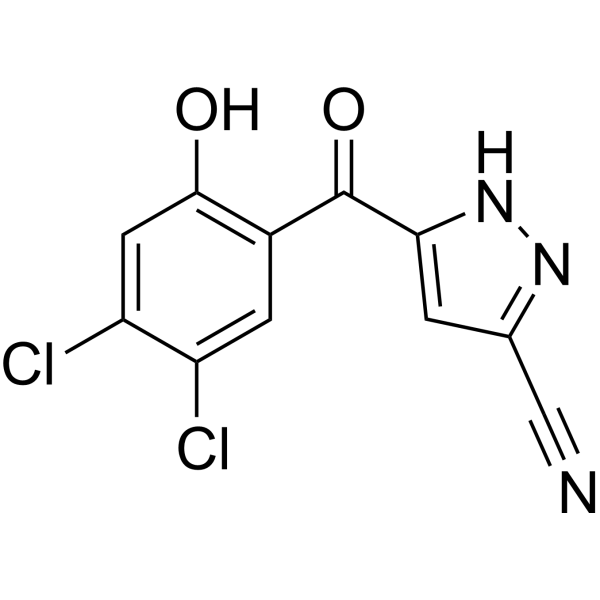
Antibacterial agent 83 (compound 17h) displays potent antibacterial activity against various vancomycin-resistant Enterococcus faecalis (VRE) and methicillin-resistant Staphylococcus aureus (MRSA). Antibacterial agent 83 can significantly reduce the biofilm formation of MRSA and exhibited promising selectivity. Antibacterial agent 83 is metabolically stable in human liver microsomes.
商品は「研究用試薬」です。人や動物の医療用・臨床診断用・食品用の製品ではありません。
研究用途以外に使用した場合、当社は一切の責任を負いかねます。
- CAS 番号: 2413865-92-4
- 分子式: C11H5Cl2N3O2
- 分子量:282.08
-
保管条件:
Please store the product under the recommended conditions in the Certificate of Analysis.

To place orders, for customer services and technical support, please contact: MedChemExpress USA
Tel: 609-228-6898 E-mail: [email protected] [email protected]


-
 生物活性
生物活性
-
化学情報
- プロトコル
- 純度とドキュメンテーション
- 参考文献
-
 Help & FAQs




生物活性
製品説明
Cellular Effect
|
Cell Line

|
Type | Value | Description | References |
|---|---|---|---|---|
| L02 | IC50 |
10.7 μM
Compound: 17h
|
Cytotoxicity against human L02 cells after 72 hrs by CCK-8 assay
Cytotoxicity against human L02 cells after 72 hrs by CCK-8 assay
|
[PMID: 35398730] |
| L02 | IC50 |
3.02 μg/mL
Compound: 17h
|
Cytotoxicity against human L02 cells after 72 hrs by CCK-8 assay
Cytotoxicity against human L02 cells after 72 hrs by CCK-8 assay
|
[PMID: 35398730] |
体外実験
Antibacterial agent 83 (compound 17h) shows antibacterial activity against Newmana, USA300b, and Mu50, with MIC of 0.25 μg/mL all[1].
Antibacterial agent 83 performs poor stability in the liver microsomes of rat, mouse and dog[1].
MedChemExpress (MCE) has not independently confirmed the accuracy of these methods. They are for reference only. Further protocols information, click here.


化学情報
-
CAS 番号 2413865-92-4
-
分子量 282.08
-
分子式 C11H5Cl2N3O2
-
SMILES
N#CC1=NNC(C(C2=C(C=C(C(Cl)=C2)Cl)O)=O)=C1
-
輸送条件
Room temperature in continental US; may vary elsewhere.
-
保管条件
Please store the product under the recommended conditions in the Certificate of Analysis.

プロトコル
-
Research Protocol for Infectious Diseases
Infectious-disease experiments test how pathogens interact with host barriers, innate immune receptors, inflammatory signaling, pathogen replication, and tissue injury; pattern-recognition receptors such as TLRs, RIG-I-like receptors, NOD-like receptors, and inflammasomes detect microbial molecules and activate NF-κB, interferon, and cytokine responses. The central hypothesis is that infection severity reflects the balance between pathogen burden and host response: protective inflammation restricts pathogen growth, whereas excessive or mislocalized inflammation contributes to tissue damage and disease phenotype. Unresolved questions include which host pathways are protective versus pathogenic, why some infection models fail to translate to human disease, and which combined readouts best predict clinically relevant infection outcomes.
-
Bacterial live/dead nucleic-acid viability staining
The LIVE/DEAD bacterial viability staining method is based on differential permeability of nucleic-acid-binding fluorescent dyes, most commonly SYTO 9 and propidium iodide (PI), which enables discrimination of bacterial populations with intact versus compromised cytoplasmic membranes. SYTO 9 penetrates both intact and damaged bacterial membranes and binds nucleic acids to produce green fluorescence, whereas propidium iodide penetrates only cells with compromised membranes and fluoresces red while also reducing SYTO 9 signal through competitive binding and fluorescence interactions. The resulting fluorescence pattern is interpreted as a proxy for membrane integrity, which is widely used as an indicator of bacterial viability in microscopy, flow cytometry, and spectroscopic platforms. However, mechanistic studies show that SYTO 9 and PI interactions involve displacement and fluorescence resonance energy transfer effects, which can influence signal interpretation depending on dye ratios a
-
Fungal Biofilm Culture
Fungal biofilm culture is an in vitro method for growing surface-attached fungal communities, most commonly Candida albicans, on abiotic substrates such as polystyrene wells, silicone elastomer, or polymethylmethacrylate; the assay models adhesion, proliferation, filamentation, extracellular-matrix-associated maturation, and dispersion. Biofilm output can be read by optical density at 600 nm for adherent biomass, XTT reduction for metabolic activity, CFU recovery for viable attached or dispersed cells, and microscopy for architecture.


純度とドキュメンテーション
参考文献

Calculators
濃度 (開始) × 体積 (開始) = 濃度 (終了) × 体積 (終了)


Antibacterial agent 83 関連分類
HY-143326 関連分類
 Powered by Bioz