



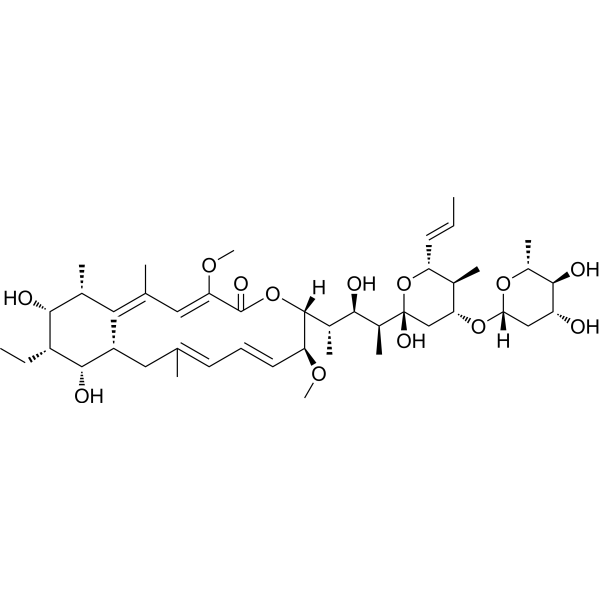
Concanamycin C

Based on 1 Customer Validation
Concanamycin C is a macrolide antibiotic with inhibitory activity against certain fungi and yeasts, but no activity against bacteria. Concanamycin C inhibits the proliferation of mouse splenic lymphocytes. Concanamycin C exhibits acute toxicity in ddY mice. Concanamycin C can be used in studies related to fungal infections and yeast infections.
商品は「研究用試薬」です。人や動物の医療用・臨床診断用・食品用の製品ではありません。
研究用途以外に使用した場合、当社は一切の責任を負いかねます。
- 純度 : 99.9%
- CAS 番号: 81552-34-3
- 分子式: C45H74O13
- 分子量:823.06
-
保管条件:Powder -20°C, 3 years ; In solvent -80°C, 6 months , -20°C, 1 month

To place orders, for customer services and technical support, please contact: MedChemExpress USA
Tel: 609-228-6898 E-mail: [email protected] [email protected]


-
 生物活性
生物活性
-
化学情報
- プロトコル
- 純度とドキュメンテーション
- 参考文献
-
 Help & FAQs


Antibiotic アイソフォーム固有の製品をすべて表示
More

生物活性
製品説明
体外実験
Concanamycin C exhibits in vitro inhibitory activity against specific fungi and yeasts, including Saccharomyces cerevisiae, S. sake, Alternaria citri, Penicillium citrinum, and Pirricularia oryzae, but has no activity against tested bacteria and other fungi/yeasts[1].
MedChemExpress (MCE) has not independently confirmed the accuracy of these methods. They are for reference only. Further protocols information, click here.
体内実験
MedChemExpress (MCE) has not independently confirmed the accuracy of these methods. They are for reference only.
-
Animal Model:ddY mice[1]
-
Dosage:0.1 mg/kg; 1.0 mg/kg
-
Administration:i.p.; single dose
-
Result:Resulted in 100% survival in ddY mice.
Resulted in 100% mortality in ddY mice.


化学情報
-
CAS 番号 81552-34-3
-
性状 Solid
-
分子量 823.06
-
分子式 C45H74O13
-
Color White to off-white
-
SMILES
C[C@H](C/C(C)=C\C=C\[C@H](OC)[C@]([C@@H](C)[C@@H](O)[C@H](C)[C@@]1(O)C[C@@H](O[C@@]2([H])C[C@@H](O)[C@H](O)[C@@H](C)O2)[C@H](C)[C@@H](/C=C/C)O1)([H])O3)[C@H](O)[C@H](CC)[C@H](O)[C@H](C)/C=C(C)/C=C(OC)/C3=O
-
Structure Classification
-
Initial Source
Streptomyces diastatochromogenes S-45
-
輸送条件
Room temperature in continental US; may vary elsewhere.
-
保管条件
Powder -20°C 3 years In solvent -80°C 6 months -20°C 1 month

プロトコル
-
Acute Systemic Toxicity Study
Acute systemic toxicity studies evaluate adverse effects occurring after a single exposure, or repeated exposure within a short acute window, and the main in vivo readouts are mortality, moribund condition, clinical signs, body-weight change, and gross pathological findings; acute oral toxicity methods were developed to replace classical LD50 testing with reduced-animal designs such as fixed-dose procedure, acute toxic class method, and up-and-down procedure. The fixed-dose procedure classifies acute toxicity by administering predefined dose levels and observing evident toxicity rather than using death as the primary endpoint, whereas the acute toxic class method uses sequential groups of three animals per step and the up-and-down procedure doses animals sequentially to estimate an LD50 with fewer animals than conventional LD50 testing.
-
Cell Viability Determination by MTT Colorimetric Assay
The following protocol uses the MTT colorimetric assay as a classic literature-established method for assessing cell viability/metabolic activity in cultured mammalian cells. MTT[3-(4,5-dimethylthiazol-2-yl)-2,5-diphenyltetrazolium bromide] is reduced by metabolically active cells to a colored formazan product; the amount of formazan is quantified spectrophotometrically and provides an indirect measure of metabolically active viable cells. Importantly, MTT reduction reflects cellular oxidoreductase/metabolic activity rather than an absolute direct count of living cells, so changes in cellular metabolism can alter the signal independently of cell number.


純度とドキュメンテーション
-
データシート (267 KB)
-
SDS (481 KB)
- English - EN (481 KB)
- Français - FR (481 KB)
- Deutsch - DE (481 KB)
- Norwegian - NO (481 KB)
- Español - ES (481 KB)
- Swedish - SV (481 KB)
- Italian - IT (481 KB)
- Korean - KR (481 KB)
- Portuguese - PT (481 KB)
-
取扱説明書 (2659 KB)
参考文献

Calculators
濃度 (開始) × 体積 (開始) = 濃度 (終了) × 体積 (終了)


Concanamycin C 関連分類
HY-126813 関連分類
 Powered by Bioz