



DM1-PEG4-DBCO

Based on 1 Customer Validation
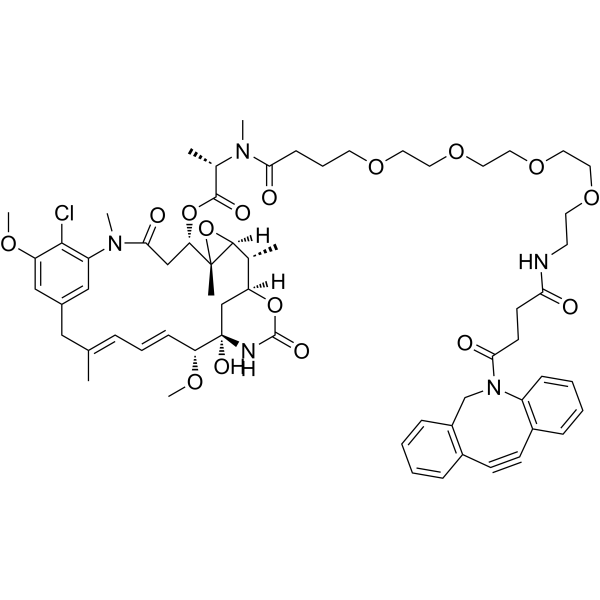
DM1-(PEG)4-DBCO is a drug-linker conjugate composed of the tubulin inhibitor DM1 (HY-19792) and the linker DBCO-PEG4-Ahx. DM1 is a tubulin inhibitor and an antibody-conjugated maytansinoid; it was developed to overcome the systemic toxicity associated with maytansine and to enhance tumor-specific delivery. DM1-PEG4-DBCO is a click chemistry reagent.
商品は「研究用試薬」です。人や動物の医療用・臨床診断用・食品用の製品ではありません。
研究用途以外に使用した場合、当社は一切の責任を負いかねます。
- 純度 : 96.11%
- 分子式: C63H80ClN5O16
- 分子量:1198.79
-
保管条件:
-20°C, protect from light
* In solvent : -80°C, 6 months; -20°C, 1 month (protect from light)

To place orders, for customer services and technical support, please contact: MedChemExpress USA
Tel: 609-228-6898 E-mail: [email protected] [email protected]


-
 生物活性
生物活性
-
化学情報
-
溶剤 & 溶解度
- プロトコル
- 純度とドキュメンテーション
-
 Help & FAQs


Drug-Linker Conjugates for ADC アイソフォーム固有の製品をすべて表示
More

生物活性
製品説明
IC50 & Target
|
Maytansinoids |
体外実験
DM1-(PEG)4-DBCO contains a DBCO group capable of undergoing strain-promoted alkyne-azide cycloaddition (SPAAC) with molecules containing an azide group.
MedChemExpress (MCE) has not independently confirmed the accuracy of these methods. They are for reference only. Further protocols information, click here.


化学情報
-
性状 Solid
-
分子量 1198.79
-
分子式 C63H80ClN5O16
-
Color Off-white to light yellow
-
SMILES
COC1=CC(C/C(C)=C/C=C/[C@@H](OC)[C@]2(O)NC(O[C@@]([C@@H](C)[C@@](O3)([H])[C@]3(C)[C@@H](OC([C@H](C)N(C)C(CCCOCCOCCOCCOCCNC(CCC(N4CC(C=CC=C5)=C5C#CC6=C4C=CC=C6)=O)=O)=O)=O)CC7=O)([H])C2)=O)=CC(N7C)=C1Cl
-
輸送条件
Room temperature in continental US; may vary elsewhere.
-
保管条件
-20°C, protect from light
* In solvent : -80°C, 6 months; -20°C, 1 month (protect from light)


溶剤 & 溶解度
体外:
DMSO : 100 mg/mL (83.42 mM; Need ultrasonic; Hygroscopic DMSO has a significant impact on the solubility of product, please use newly opened DMSO)
Please refer to the solubility information to select the appropriate solvent. Once prepared, please aliquot and store the solution to prevent product inactivation from repeated freeze-thaw cycles.
Storage method and period of stock solution: -80°C, 6 months; -20°C, 1 month (protect from light). When stored at -80°C, please use it within 6 months. When stored at -20°C, please use it within 1 month.
Please refer to the solubility information to select the appropriate solvent. Once prepared, please aliquot and store the solution to prevent product inactivation from repeated freeze-thaw cycles.
Storage method and period of stock solution: -80°C, 6 months; -20°C, 1 month (protect from light). When stored at -80°C, please use it within 6 months. When stored at -20°C, please use it within 1 month.
濃度 (開始) × 体積 (開始) = 濃度 (終了) × 体積 (終了)

プロトコル
-
EdU Incorporation Assay (Click Chemistry-Based DNA Synthesis Measurement)
The EdU incorporation assay measures DNA synthesis by adding the thymidine analog 5-ethynyl-2′-deoxyuridine to cells or tissues, where it is incorporated into newly synthesized DNA during S phase. Incorporated EdU is detected by copper-catalyzed azide-alkyne cycloaddition, in which a fluorescent azide covalently reacts with the ethynyl group on EdU, allowing S-phase cells to be detected by fluorescence microscopy, flow cytometry, or high-content imaging. EdU detection does not require DNA denaturation or anti-BrdU antibody access, which preserves sample structure and improves compatibility with immunostaining and multiparameter cytometry compared with BrdU-based detection. EdU can be cytotoxic in a cell-type- and exposure-dependent manner, so pulse duration, concentration, and continuous-labeling designs should be validated for each cell type.
-
Subchronic/Chronic Toxicity Study
A subchronic/chronic oral toxicity study detects systemic adverse effects caused by repeated administration of a test article, using mortality, clinical signs, body weight, food/water intake, ophthalmology, urinalysis, hematology, serum biochemistry, organ weights, gross necropsy, and histopathology as integrated readouts. The readout reflects dose-related physiological injury, target-organ pathology, reversibility after recovery, and derivation of NOAEL, LOAEL, or related point-of-departure values when the dataset supports them.
-
Acute Systemic Toxicity Study
Acute systemic toxicity studies evaluate adverse effects occurring after a single exposure, or repeated exposure within a short acute window, and the main in vivo readouts are mortality, moribund condition, clinical signs, body-weight change, and gross pathological findings; acute oral toxicity methods were developed to replace classical LD50 testing with reduced-animal designs such as fixed-dose procedure, acute toxic class method, and up-and-down procedure. The fixed-dose procedure classifies acute toxicity by administering predefined dose levels and observing evident toxicity rather than using death as the primary endpoint, whereas the acute toxic class method uses sequential groups of three animals per step and the up-and-down procedure doses animals sequentially to estimate an LD50 with fewer animals than conventional LD50 testing.


純度とドキュメンテーション
-
データシート (249 KB)
-
SDS (251 KB)
- English - EN (251 KB)
- Français - FR (251 KB)
- Deutsch - DE (251 KB)
- Norwegian - NO (251 KB)
- Español - ES (251 KB)
- Swedish - SV (251 KB)
- Italian - IT (251 KB)
- Korean - KR (251 KB)
- Portuguese - PT (251 KB)
-
取扱説明書 (2659 KB)


Complete Stock Solution Preparation Table
Please refer to the solubility information to select the appropriate solvent. Once prepared, please aliquot and store the solution to prevent product inactivation from repeated freeze-thaw cycles.
Storage method and period of stock solution: -80°C, 6 months; -20°C, 1 month (protect from light). When stored at -80°C, please use it within 6 months. When stored at -20°C, please use it within 1 month.
| Optional Solvent | Concentration Solvent Mass | 1 mg | 5 mg | 10 mg | 25 mg |
|---|---|---|---|---|---|
| DMSO | 1 mM | 0.8342 mL | 4.1709 mL | 8.3417 mL | 20.8544 mL |
| 5 mM | 0.1668 mL | 0.8342 mL | 1.6683 mL | 4.1709 mL | |
| 10 mM | 0.0834 mL | 0.4171 mL | 0.8342 mL | 2.0854 mL | |
| 15 mM | 0.0556 mL | 0.2781 mL | 0.5561 mL | 1.3903 mL | |
| 20 mM | 0.0417 mL | 0.2085 mL | 0.4171 mL | 1.0427 mL | |
| 25 mM | 0.0334 mL | 0.1668 mL | 0.3337 mL | 0.8342 mL | |
| 30 mM | 0.0278 mL | 0.1390 mL | 0.2781 mL | 0.6951 mL | |
| 40 mM | 0.0209 mL | 0.1043 mL | 0.2085 mL | 0.5214 mL | |
| 50 mM | 0.0167 mL | 0.0834 mL | 0.1668 mL | 0.4171 mL | |
| 60 mM | 0.0139 mL | 0.0695 mL | 0.1390 mL | 0.3476 mL | |
| 80 mM | 0.0104 mL | 0.0521 mL | 0.1043 mL | 0.2607 mL |


DM1-PEG4-DBCO 関連分類
HY-136261 関連分類
 Powered by Bioz