



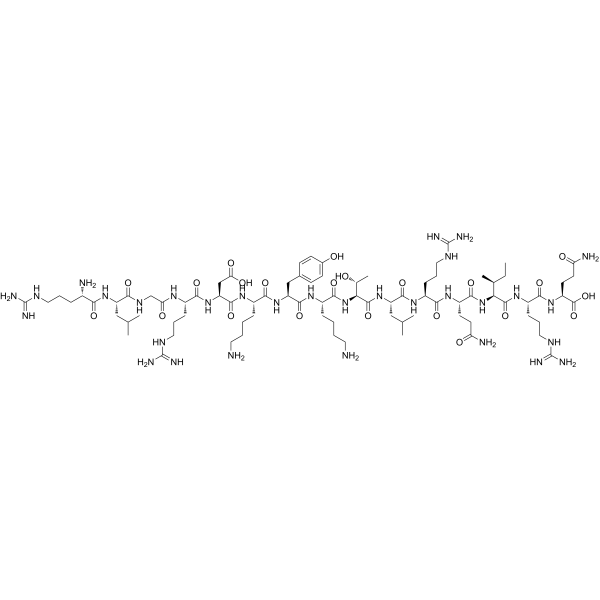
LRRKtide

Based on 1 Customer Validation
LRRKtide is a polypeptide substrate. LRRKtide is a specific phosphorylation substrate of LRRK2, a kinase associated with Parkinson's disease, and its phosphorylation site is a threonine residue. LRRKtide can be used for characterization of the catalytic properties of LRRK2, as well as studies on kinase activity and inhibition. LRRKtide is applicable to research related to Parkinson's disease.
商品は「研究用試薬」です。人や動物の医療用・臨床診断用・食品用の製品ではありません。
研究用途以外に使用した場合、当社は一切の責任を負いかねます。
- 純度 : 99.94%
- CAS 番号: 1071466-49-3
- 分子式: C83H147N31O22
- 分子量:1931.25
-
保管条件:
Sealed storage, away from moisture.
Powder -80°C, 2 years , -20°C, 1 year* In solvent : -80°C, 6 months; -20°C, 1 month (sealed storage, away from moisture)

To place orders, for customer services and technical support, please contact: MedChemExpress USA
Tel: 609-228-6898 E-mail: [email protected] [email protected]


-
 生物活性
生物活性
-
化学情報
-
溶剤 & 溶解度
- プロトコル
- 純度とドキュメンテーション
- 参考文献
-
 Help & FAQs




生物活性
製品説明
体外実験
LRRKtide is a key tool peptide for dissecting the functions of LRRK2 and the mechanisms of Parkinson's disease[1].
MedChemExpress (MCE) has not independently confirmed the accuracy of these methods. They are for reference only.


化学情報
-
CAS 番号 1071466-49-3
-
性状 Solid
-
分子量 1931.25
-
分子式 C83H147N31O22
-
Color White to off-white
-
配列
Arg-Leu-Gly-Arg-Asp-Lys-Tyr-Lys-Thr-Leu-Arg-Gln-Ile-Arg-Gln
-
シーケンスの短縮
RLGRDKYKTLRQIRQ
-
輸送条件
Room temperature in continental US; may vary elsewhere.
-
保管条件
Sealed storage, away from moisture
Powder -80°C 2 years -20°C 1 year * In solvent : -80°C, 6 months; -20°C, 1 month (sealed storage, away from moisture)


溶剤 & 溶解度
体外:
H2O : ≥ 100 mg/mL (51.78 mM)
DMSO : 20 mg/mL (10.36 mM; Need ultrasonic; Hygroscopic DMSO has a significant impact on the solubility of product, please use newly opened DMSO)
* "≥" means soluble, but saturation unknown.
Please refer to the solubility information to select the appropriate solvent. Once prepared, please aliquot and store the solution to prevent product inactivation from repeated freeze-thaw cycles.
Storage method and period of stock solution: -80°C, 6 months; -20°C, 1 month (sealed storage, away from moisture). When stored at -80°C, please use it within 6 months. When stored at -20°C, please use it within 1 month.
* Note: If you choose water as the stock solution, please dilute it to the working solution, then filter and sterilize it with a 0.22 μm filter before use.
Please refer to the solubility information to select the appropriate solvent. Once prepared, please aliquot and store the solution to prevent product inactivation from repeated freeze-thaw cycles.
Storage method and period of stock solution: -80°C, 6 months; -20°C, 1 month (sealed storage, away from moisture). When stored at -80°C, please use it within 6 months. When stored at -20°C, please use it within 1 month.
* Note: If you choose water as the stock solution, please dilute it to the working solution, then filter and sterilize it with a 0.22 μm filter before use.
濃度 (開始) × 体積 (開始) = 濃度 (終了) × 体積 (終了)


純度とドキュメンテーション
-
データシート (271 KB)
-
SDS (254 KB)
- English - EN (254 KB)
- Français - FR (254 KB)
- Deutsch - DE (254 KB)
- Norwegian - NO (254 KB)
- Español - ES (254 KB)
- Swedish - SV (254 KB)
- Italian - IT (254 KB)
- Korean - KR (254 KB)
- Portuguese - PT (254 KB)
-
取扱説明書 (2659 KB)
参考文献
[1]. Liu M, et al. Kinetic mechanistic studies of wild-type leucine-rich repeat kinase 2: characterization of the kinase and GTPase activities. Biochemistry. 2010;49(9):2008-2017. [Content Brief]
[2]. Ray S, et al. The Parkinson disease-linked LRRK2 protein mutation I2020T stabilizes an active state conformation leading to increased kinase activity. J Biol Chem. 2014;289(19):13042-13053. [Content Brief]


Complete Stock Solution Preparation Table
Please refer to the solubility information to select the appropriate solvent. Once prepared, please aliquot and store the solution to prevent product inactivation from repeated freeze-thaw cycles.
Storage method and period of stock solution: -80°C, 6 months; -20°C, 1 month (sealed storage, away from moisture). When stored at -80°C, please use it within 6 months. When stored at -20°C, please use it within 1 month.
| Optional Solvent | Concentration Solvent Mass | 1 mg | 5 mg | 10 mg | 25 mg |
|---|---|---|---|---|---|
| DMSO / H2O | 1 mM | 0.5178 mL | 2.5890 mL | 5.1780 mL | 12.9450 mL |
| 5 mM | 0.1036 mL | 0.5178 mL | 1.0356 mL | 2.5890 mL | |
| 10 mM | 0.0518 mL | 0.2589 mL | 0.5178 mL | 1.2945 mL | |
| H2O | 15 mM | 0.0345 mL | 0.1726 mL | 0.3452 mL | 0.8630 mL |
| 20 mM | 0.0259 mL | 0.1294 mL | 0.2589 mL | 0.6472 mL | |
| 25 mM | 0.0207 mL | 0.1036 mL | 0.2071 mL | 0.5178 mL | |
| 30 mM | 0.0173 mL | 0.0863 mL | 0.1726 mL | 0.4315 mL | |
| 40 mM | 0.0129 mL | 0.0647 mL | 0.1294 mL | 0.3236 mL | |
| 50 mM | 0.0104 mL | 0.0518 mL | 0.1036 mL | 0.2589 mL |
* Note: If you choose water as the stock solution, please dilute it to the working solution, then filter and sterilize it with a 0.22 μm filter before use.


LRRKtide 関連分類
HY-P5979 関連分類
 Powered by Bioz