



Vonaprument

Based on 1 Customer Validation
Vonaprument (ANX-007) is an intravitreally injected C1q antibody fragment (with a molecular weight of approximately 48 kDa) and a human monoclonal antibody. Vonaprument inhibits the activation of the classical complement cascade by specifically recognizing the globular head of C1q and blocking substrate binding. After intravitreal injection, Vonaprument distributes to the retina, choroid and optic nerve, and achieves complete C1q target binding in the aqueous humor and retinal tissues. Vonaprument can be used in research related to neurodegenerative eye diseases such as age-related macular degeneration and glaucoma.
商品は「研究用試薬」です。人や動物の医療用・臨床診断用・食品用の製品ではありません。
研究用途以外に使用した場合、当社は一切の責任を負いかねます。
- 純度 : 96.00%
- CAS 番号: 3050549-24-8
-
保管条件:
Please store the product under the recommended conditions in the Certificate of Analysis.


To place orders, for customer services and technical support, please contact: MedChemExpress USA
Tel: 609-228-6898 E-mail: [email protected] [email protected]


-
 生物活性
生物活性
-
化学情報
- プロトコル
- 純度とドキュメンテーション
- 参考文献
-
 Help & FAQs




生物活性
製品説明
Isotype
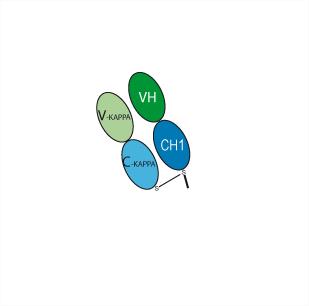
immunoglobulin Fab VH-G1(CH1-10h)_L-kappa
Species Reactivity
Human
IC50 & Target
[1]|
C1q 136 pM (EC50, Human) |
C1q 147 pM (EC50, Human serum) |
C1q 179 pM (EC50, Cynomolgus Monkey serum) |
体外実験
Vonaprument (ANX007/ANX-007) (8-3000 ng/mL) binds with similar high affinity to human and cynomolgus monkey C1q, with EC50 values of 136 pM, 147 pM, and 179 pM for purified human C1q, human serum C1q, and cynomolgus monkey serum C1q, respectively[1].
MedChemExpress (MCE) has not independently confirmed the accuracy of these methods. They are for reference only. Further protocols information, click here.
体内実験
MedChemExpress (MCE) has not independently confirmed the accuracy of these methods. They are for reference only.
-
Animal Model:Mixed gender (female-only in single-dose study; male and female in repeat-dose studies), 2-4 years old, 2.1-3.7 kg[1]
-
Dosage:1 mg/eye; 2.5 mg/eye; 5 mg/eye
-
Administration:i.v.t.; single bilateral dose, or two bilateral doses on days 1 and 29
-
Result:Measured vitreous free drug levels through 4 weeks following single doses of 1 or 5 mg/eye, with an approximate 3-day vitreous half-life.
Recorded vitreous Cmax values of 468,000 ng/mL (1 mg/eye) and 2,010,000 ng/mL (5 mg/eye), with AUClast values of 46,500,000 h*ng/mL (1 mg/eye) and 247,000,000 h*ng/mL (5 mg/eye).
Detected free drug in perfused retina and choroid 4 weeks post-last dose, and up to 2 weeks post-last dose in optic nerve following repeat doses of 5 mg/eye.
Achieved near complete inhibition of free-C1q levels in all sampled ocular fluids and tissues at 2 weeks post-last dose, with suppression maintained in retina, choroid, vitreous, and aqueous humor at 4 weeks post-last dose.
Demonstrated a strong correlation between aqueous humor free-C1q suppression and vitreous and retina free-C1q suppression, and a weaker but significant correlation with choroid free-C1q suppression.
No drug-related adverse changes were observed across all dose levels.
遺伝子ID
アクセッション番号
Target
C1q
Conjugated
Unconjugated
Reconsititution
The product can be reconstituted/diluted with sterile PBS or saline.
Format
-
Fab'-G1-kappa
アプリケーション
ELISA, FACS, Functional assay


化学情報
-
CAS 番号 3050549-24-8
-
性状 Liquid
-
Color Colorless to light yellow
-
SMILES
[Vonaprument]
-
別名
ANX-007
-
輸送条件
Shipping with dry ice.
-
Formulation
Please refer to the lot-specific COA for specific buffer information.
-
保管条件
Please store the product under the recommended conditions in the Certificate of Analysis.

プロトコル
-
How to Select the Route of Administration for Mammals
Route-of-administration selection in mammals is a pharmacokinetic, pharmacodynamic, formulation, animal-welfare, and translational decision, not a default technical choice. The selected route should match the study goal: intravenous dosing is most useful when complete systemic exposure and rapid onset are required, oral dosing is most translational for orally intended medicines but is affected by absorption and first-pass metabolism, subcutaneous or intramuscular dosing can provide slower systemic exposure, and intraperitoneal dosing can be useful in rodent proof-of-concept studies but may have limited clinical translation. Published route-comparison studies show that the same compound can produce different exposure, onset, bioavailability, tissue distribution, and tolerability depending on route; therefore, route choice should be supported by pilot pharmacokinetic or pharmacodynamic evidence when the literature is insufficient. Unresolved questions include how to standardize route sel


純度とドキュメンテーション
-
データシート (261 KB)
-
SDS (251 KB)
- English - EN (251 KB)
- Français - FR (251 KB)
- Deutsch - DE (251 KB)
- Norwegian - NO (251 KB)
- Español - ES (251 KB)
- Swedish - SV (251 KB)
- Italian - IT (251 KB)
- Korean - KR (251 KB)
- Portuguese - PT (251 KB)
-
Inhibitory Antibodies User Guide (603 KB)
参考文献
[1]. Grover A, et al. Pharmacokinetic and Target Engagement Measures of ANX007, an Anti-C1q Antibody Fragment, Following Intravitreal Administration in Nonhuman Primates. Investigative ophthalmology & visual science. 2023 Feb 01;64(2):3. [Content Brief]
[2]. Sun Y, et al. Safety and Target Engagement of Complement C1q Inhibitor ANX007 in Neurodegenerative Eye Disease: Results from Phase I Studies in Glaucoma. Ophthalmol Sci. 2023 Feb 24;3(2):100290. [Content Brief]

Calculators
濃度 (開始) × 体積 (開始) = 濃度 (終了) × 体積 (終了)


Vonaprument 関連分類
HY-P992142 関連分類
 Powered by Bioz