



Kinetin triphosphate
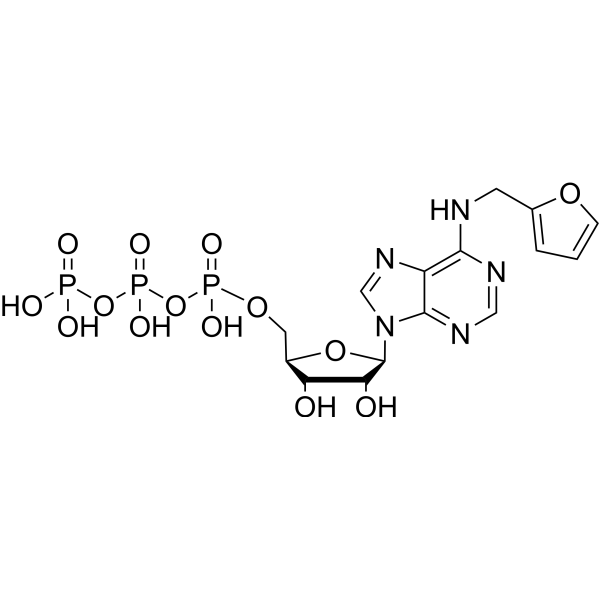
Kinetin triphosphate(6-Fu-ATP; KTP) is an ATP analogue that regulates or enhances kinase function with higher catalytic efficiency than its endogenous substrate, ATP. Kinetin triphosphate can be used in Parkinson's disease research.
For research use only. We do not sell to patients.
- CAS No.: 1450894-16-2
- Formula: C15H20N5O14P3
- Molecular Weight:587.27
-
Storage:
Please store the product under the recommended conditions in the Certificate of Analysis.

To place orders, for customer services and technical support, please contact: MedChemExpress USA
Tel: 609-228-6898 E-mail: [email protected] [email protected]


-
 Biological Activity
-
Chemical Information
- Protocols
- Purity & Documentation
- References
-
 Help & FAQs




Biological Activity
Description
In Vitro
Kinetin triphosphate can act as a phosphate donor for PINK1 to recognize the T257 autophosphorylation site, and can restore the catalytic activity of PINK1 G309D to close to WT levels in HeLa cells in vitro[1].
MedChemExpress (MCE) has not independently confirmed the accuracy of these methods. They are for reference only. Further protocols information, click here.
Clinical Trial
| NCT Number | Sponsor | Condition | Start Date |
Phase

|
|---|---|---|---|---|
| NCT01329991 | Plexxikon| | 2011-05 | PHASE1 |


Chemical Information
-
CAS No. 1450894-16-2
-
Molecular Weight 587.27
-
Formula C15H20N5O14P3
-
SMILES
O=P(O)(O)OP(OP(OC[C@H]1O[C@@H](N2C3=NC=NC(NCC4=CC=CO4)=C3N=C2)[C@H](O)[C@@H]1O)(O)=O)(O)=O
-
Synonyms
6-Fu-ATP; KTP
-
Shipping
Room temperature in continental US; may vary elsewhere.
-
Storage
Please store the product under the recommended conditions in the Certificate of Analysis.

Protocols
-
Human pluripotent stem cell midbrain dopaminergic neuron differentiation
Human pluripotent stem cells are directed toward midbrain dopaminergic neurons by first inducing a neural floor-plate-like progenitor state, then patterning cells with ventralizing SHH signaling and midbrain/WNT-FGF cues, and finally maturing progenitors into neurons expressing dopaminergic markers such as TH, NURR1/NR4A2, PITX3, DAT/SLC6A3, VMAT2/SLC18A2, GIRK2/KCNJ6, FOXA2, LMX1A, and EN1. The main readouts are loss of pluripotency, acquisition of FOXA2+/LMX1A+ midbrain floor-plate progenitors, emergence of βIII-tubulin+/MAP2+ neurons, and production of TH+ dopaminergic neurons with molecular, dopamine-release, and electrophysiological features of midbrain dopaminergic identity.


Purity & Documentation
References

Calculators
Concentration (start) × Volume (start) = Concentration (final) × Volume (final)


Kinetin triphosphate Related Classifications
HY-134398 Related Classifications
 Powered by Bioz