



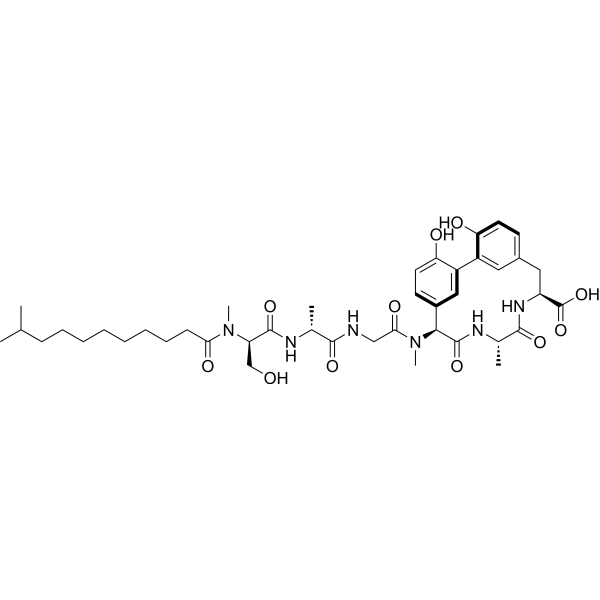
Arylomycin A2

Based on 1 Customer Validation
Arylomycin A2, an antibiotic (Antibiotic), is a lipopeptide type I signal peptidase (SPase I) inhibitor. Arylomycin A2 has antibacterial effects.
For research use only. We do not sell to patients.
- Purity : 97.37%
- CAS No.: 459844-20-3
- Formula: C42H60N6O11
- Molecular Weight:824.96
-
Storage:
Sealed storage, away from moisture.
Powder -80°C, 2 years , -20°C, 1 year* In solvent : -80°C, 6 months; -20°C, 1 month (sealed storage, away from moisture)

To place orders, for customer services and technical support, please contact: MedChemExpress USA
Tel: 609-228-6898 E-mail: [email protected] [email protected]


-
 Biological Activity
-
Chemical Information
- Protocols
- Purity & Documentation
- References
-
 Help & FAQs


All Antibiotic Isoforms
More

Biological Activity
Description
IC50 & Target
|
Lipopeptide |
In Vitro
Arylomycin A2 exhibits very potent antibacterial activity against free-living S. epidermidis cells. The MIC values against planktonic S. epidermidis 1457 and RP62A are 0.235 μg/mL and 0.058 μg/mL for Arylomycin A2, respectively. Arylomycin A2 shows the antibacterial effect towards S. epidermidis biofilms, and reduces biofilm formation markedly[2].
MedChemExpress (MCE) has not independently confirmed the accuracy of these methods. They are for reference only.


Chemical Information
-
CAS No. 459844-20-3
-
Appearance Solid
-
Molecular Weight 824.96
-
Formula C42H60N6O11
-
Color Off-white to light yellow
-
Shipping
Room temperature in continental US; may vary elsewhere.
-
Storage
Sealed storage, away from moisture
Powder -80°C 2 years -20°C 1 year * In solvent : -80°C, 6 months; -20°C, 1 month (sealed storage, away from moisture)


Purity & Documentation
-
Data Sheet (258 KB)
-
SDS (252 KB)
- English - EN (252 KB)
- Français - FR (252 KB)
- Deutsch - DE (252 KB)
- Norwegian - NO (252 KB)
- Español - ES (252 KB)
- Swedish - SV (252 KB)
- Italian - IT (252 KB)
- Korean - KR (252 KB)
- Portuguese - PT (252 KB)
-
Handling Instructions (2659 KB)
References
[1]. Mark Paetzel, et al. Crystallographic and biophysical analysis of a bacterial signal peptidase in complex with a lipopeptide-based inhibitor. J Biol Chem. 2004 Jul 16;279(29):30781-90. [Content Brief]
[2]. Katrijn Bockstael, et al. Evaluation of the type I signal peptidase as antibacterial target for biofilm-associated infections of Staphylococcus epidermidis. Microbiology (Reading). 2009 Nov;155(Pt 11):3719-3729. [Content Brief]

Calculators
Concentration (start) × Volume (start) = Concentration (final) × Volume (final)


Arylomycin A2 Related Classifications
HY-P3884 Related Classifications
 Powered by Bioz