



CMI-392
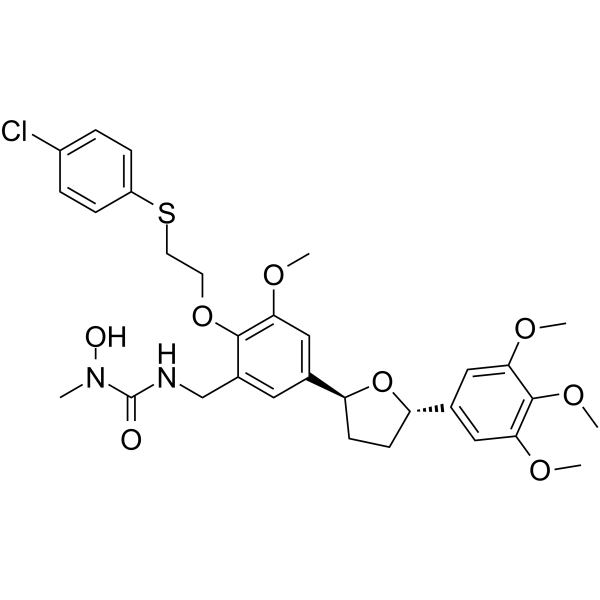
CMI-392 (LDP-392) is an orally active dual 5-lipoxygenase inhibitor and platelet-activating factor receptor (PAFR) antagonist, with an IC50 of 10 nM for human PAF receptor and an IC50 of 100 nM for rat 5-lipoxygenase. CMI-392 blocks PAF receptor binding, inhibits leukotriene synthesis, attenuates PAF-induced hemoconcentration, and suppresses arachidonic acid- and TPA-induced ear swelling in mice. CMI-392 reduces inflammatory cell infiltration, decreases MPO levels, alleviates ocular inflammation, and improves dextran sulfate sodium-induced colitis. CMI-392 can be used in the research of inflammatory and immune-related diseases such as colitis and atopic dermatitis.
연구목적의 판매만을 진행합니다. 환자를 대상으로 한 판매는 하지 않습니다.
- CAS No.: 193739-23-0
- 화학식: C31H37ClN2O8S
- 분자량:633.15
-
보관:
Please store the product under the recommended conditions in the Certificate of Analysis.

To place orders, for customer services and technical support, please contact: MedChemExpress USA
Tel: 609-228-6898 E-mail: [email protected] [email protected]


-
 Biological Activity
-
Chemical Information
- Protocol
- 순도&문서
- References
-
 Help & FAQs




Biological Activity
제품 설명
IC50 & Target
|
5-Lipoxygenase 100 nM (IC50) |
Cellular Effect
|
Cell Line

|
Type | Value | Description | References |
|---|---|---|---|---|
| RBL-2H3 | IC50 |
100 nM
Compound: 40
|
Inhibition of 5-lipoxygenase mediated conversion of [14C]arachidonic acid to leukotrienes in RBL-2H3 cells
Inhibition of 5-lipoxygenase mediated conversion of [14C]arachidonic acid to leukotrienes in RBL-2H3 cells
|
[PMID: 9599246] |
In Vitro
CMI-392 potently inhibits the specific binding of [3H]PAF to cell membranes of CHO cells expressing human PAF receptors, with an IC50 of 10 nM; it inhibits 5-lipoxygenase activity in RBL-2H3 cell extracts, with an IC50 of 100 nM; it suppresses the production of LTB4 in human whole blood activated by calcium ionophore, with an IC50 of 7.8 μM[1].
MedChemExpress (MCE) has not independently confirmed the accuracy of these methods. They are for reference only.
In Vivo
CMI-392 (administered orally) dose-dependently alleviates the severity of dextran sulfate sodium (DSS)-induced colitis injury in mice and also inhibits ocular inflammatory responses in a rabbit eye model[2].
MedChemExpress (MCE) has not independently confirmed the accuracy of these methods. They are for reference only.


Chemical Information
-
CAS No. 193739-23-0
-
분자량 633.15
-
화학식 C31H37ClN2O8S
-
SMILES
O=C(NCC1=CC([C@H]2O[C@H](C3=CC(OC)=C(OC)C(OC)=C3)CC2)=CC(OC)=C1OCCSC4=CC=C(Cl)C=C4)N(O)C
-
Synonyms
LDP-392
-
선적
Room temperature in continental US; may vary elsewhere.
-
보관
Please store the product under the recommended conditions in the Certificate of Analysis.


순도&문서
References
[1]. Cai X, et al. (+/-)-trans-2-[3-methoxy-4-(4-chlorophenylthioethoxy)-5-(N-methyl-N- hydroxyureidyl)methylphenyl]-5-(3,4, 5-trimethoxyphenyl)tetrahydrofuran (CMI-392), a potent dual 5-lipoxygenase inhibitor and platelet-activating factor receptor antagonist. Journal of medicinal chemistry. 1998 May 21;41(11):1970-9. [Content Brief]

Calculators
Concentration (start) × Volume (start) = Concentration (final) × Volume (final)


CMI-392 Related Classifications
HY-19205A Related Classifications
 Powered by Bioz
Keywords
- CMI-392
- 193739-23-0
- LDP-392
- CMI392
- CMI 392
- LDP392
- LDP 392
- Lipoxygenase
- Platelet-activating Factor Receptor (PAFR)
- TPA
- 5-lipoxygenase
- RBL-2H3 cell
- mouse ear edema
- arachidonic acid
- dextran sodium sulfate-induced colitis
- rat 5-lipoxygenase
- leukotriene
- human PAF receptor
- platelet-activating factor receptor
- Inhibitor
- inhibitor
- inhibit