



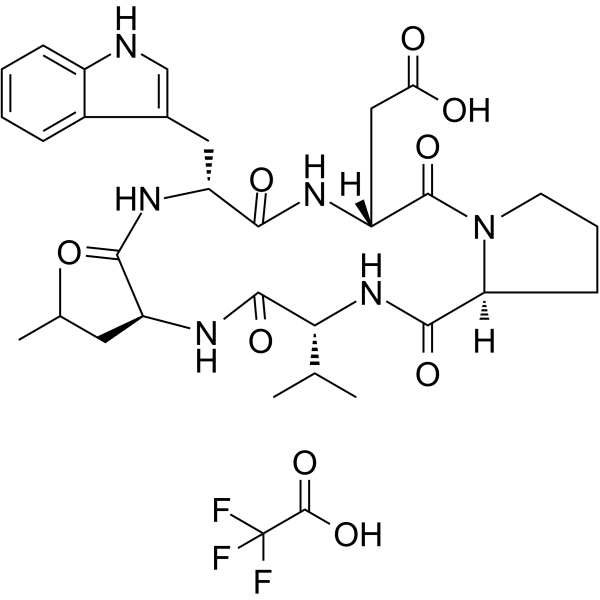
BQ-123 TFA
Based on 4 publication(s) in Google Scholar
BQ-123 TFA is a potent and selective endothelin A (ETA) receptor antagonist with an IC50 of 7.3 nM and a Ki of 25 nM. BQ-123 TFA inhibits endothelin-1-mediated proliferation of human pulmonary artery smooth muscle cells and lowers blood pressure in different rat models of hypertension.
연구목적의 판매만을 진행합니다. 환자를 대상으로 한 판매는 하지 않습니다.
- 화학식: C33H43F3N6O9
- 분자량:724.72
-
보관:
Please store the product under the recommended conditions in the Certificate of Analysis.

To place orders, for customer services and technical support, please contact: MedChemExpress USA
Tel: 609-228-6898 E-mail: [email protected] [email protected]


-
 Biological Activity
-
Chemical Information
- Protocol
- 순도&문서
- References
-
 Help & FAQs


Publications Citing Use of MedChemExpress (MCE) BQ-123 TFA
More

Biological Activity
제품 설명
IC50 & Target
IC50: 7.3 nM (Endothelin A receptors)[1]
Ki: 25 nM (Endothelin A receptors)[2]
In Vivo
BQ-123 (3 mg/kg; i.v.; given 15 minutes before pentylenetetrazole (PTZ)) impedes the formation and spread of seizure to a great degree in PTZ (50 mg/kg; i.p.) +BQ-123 groups[5].
MedChemExpress (MCE) has not independently confirmed the accuracy of these methods. They are for reference only.
-
Animal Model:Male Wistar albino rats[5]
-
Dosage:3 mg/kg
-
Administration:Intravenous injection; given 15 minutes before PTZ
-
Result:Number of rats with major seizure decreased.
Clinical Trial
| NCT Number | Sponsor | Condition | Start Date |
Phase

|
|---|---|---|---|---|
| NCT01329991 | Plexxikon| | 2011-05 | PHASE1 |


Chemical Information
-
분자량 724.72
-
화학식 C33H43F3N6O9
-
SMILES
O=C(N[C@](C(N(CCC1)[C@]1([H])C2=O)=O)([H])CC(O)=O)[C@H](NC([C@@H](NC([C@H](N2)C(C)C)=O)CC(C)C)=O)CC3=CNC4=CC=CC=C34.OC(C(F)(F)F)=O
-
선적
Room temperature in continental US; may vary elsewhere.
-
보관
Please store the product under the recommended conditions in the Certificate of Analysis.


Publications (4)
-
Journal Impact Factor
-
Most Recent
-
-
Biochem Pharmacol
Bosentan confers cardioprotection against cisplatin toxicity: Involvement of β-arrestin-linked ETA receptor signaling. [Abstract]2026 Aug;250(Pt 2):118027. PMID: 42069228 -
Int Immunopharmacol
E. Coli LPS-induced calcium signaling regulates the expression of hypoxia-inducible factor 1α in periodontal ligament fibroblasts in a non-hypoxia-dependent manner. [Abstract]2024 Feb 15:128:111418. PMID: 38176341 -
PLoS Pathog
Endothelin receptors promote schistosomiasis-induced hepatic fibrosis via splenic B cells. [Abstract]2020 Oct 19;16(10):e1008947. PMID: 33075079


순도&문서
References
[1]. Ihara M, et al. In vitro biological profile of a highly potent novel endothelin (ET) antagonist BQ-123 selective for the ETA receptor. J Cardiovasc Pharmacol. 1992;20 Suppl 12:S11-S14. [Content Brief]
[2]. Sakamoto A, et al. Distinct subdomains of human endothelin receptors determine their selectivity to endothelinA-selective antagonist and endothelinB-selective agonists. J Biol Chem. 1993 Apr 25;268(12):8547-53. [Content Brief]
[3]. Zamora MA, et al. BQ123, an ETA receptor antagonist, inhibits endothelin-1-mediated proliferation of human pulmonary artery smooth muscle cells. Am J Respir Cell Mol Biol. 1993;9(4):429-433. [Content Brief]
[4]. Douglas SA, et al. BQ-123, a selective endothelin subtype A-receptor antagonist, lowers blood pressure in different rat models of hypertension. J Hypertens. 1994;12(5):561-567. [Content Brief]
[5]. Erdogan H et al. The protective effects of endothelin-A receptor antagonist BQ-123 in pentylenetetrazole-induced seizure in rats. Hum Exp Toxicol, 2014 Oct, 33(10):1008-16. [Content Brief]

Calculators
Concentration (start) × Volume (start) = Concentration (final) × Volume (final)


BQ-123 TFA Related Classifications
HY-12378A Related Classifications
 Powered by Bioz