



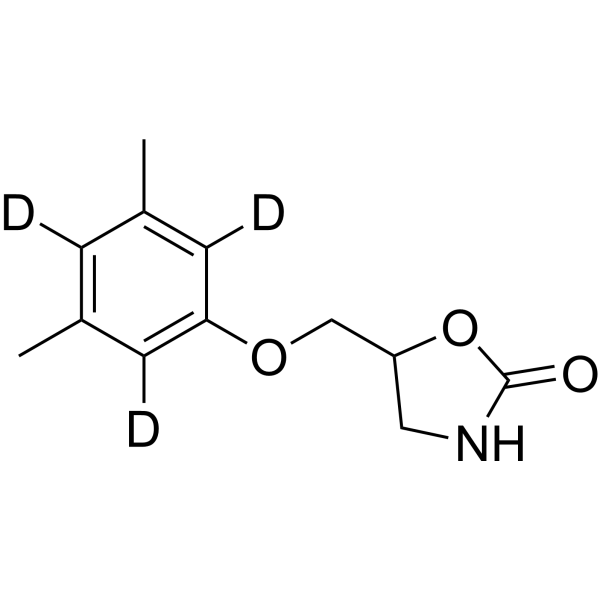
Metaxalone-d3

Based on 1 Customer Validation
Metaxalone-d3 is the deuterium labeled Metaxalone. Metaxalone (AHR438; NSC170959) is an FDA-approved muscle relaxant. Metaxalone acts mainly on the central nervous system and achieves muscle relaxation by inhibiting polysynaptic reflex arcs. In addition, Metaxalone is an inhibitor of MAO-A, which has anti-inflammatory and antioxidant effects. Metaxalone inhibits IL-1β-induced inflammatory phenotype, modulates NF-κB and other related signaling pathways, and decreases MAO-A expression and activity in IL-1β-treated microglia.
연구목적의 판매만을 진행합니다. 환자를 대상으로 한 판매는 하지 않습니다.
- Purity : 98.0%
- CAS No.: 1192812-66-0
- 화학식: C12H12D3NO3
- 분자량:224.27
-
보관:Powder -20°C, 3 years , 4°C, 2 years ; In solvent -80°C, 6 months , -20°C, 1 month

To place orders, for customer services and technical support, please contact: MedChemExpress USA
Tel: 609-228-6898 E-mail: [email protected] [email protected]


-
 Biological Activity
-
Chemical Information
-
용액&용해도
- Protocol
- 순도&문서
- References
-
 Help & FAQs




Biological Activity
제품 설명
IC50 & Target
PPARγ and MAO-A[4]
In Vitro
Stable heavy isotopes of hydrogen, carbon, and other elements have been incorporated into drug molecules, largely as tracers for quantitation during the drug development process. Deuteration has gained attention because of its potential to affect the pharmacokinetic and metabolic profiles of drugs[1].
MedChemExpress (MCE) has not independently confirmed the accuracy of these methods. They are for reference only.
신청
1. This compound can be used as a tracer
2. This compound can be used as an internal standard for quantitative analysis by NMR, GC-MS, or LC-MS.


Chemical Information
-
CAS No. 1192812-66-0
-
Unlabeled CAS 1665-48-1
-
Appearance Solid
-
분자량 224.27
-
화학식 C12H12D3NO3
-
Color White to off-white
-
SMILES
CC1=C([2H])C(C)=C([2H])C(OCC2OC(NC2)=O)=C1[2H]
-
선적
Room temperature in continental US; may vary elsewhere.
-
보관
Powder -20°C 3 years 4°C 2 years In solvent -80°C 6 months -20°C 1 month


용액&용해도
In Vitro:
DMSO : ≥ 100 mg/mL (445.89 mM; Hygroscopic DMSO has a significant impact on the solubility of product, please use newly opened DMSO)
* "≥" means soluble, but saturation unknown.
Please refer to the solubility information to select the appropriate solvent. Once prepared, please aliquot and store the solution to prevent product inactivation from repeated freeze-thaw cycles.
Storage method and period of stock solution: -80°C, 6 months; -20°C, 1 month. When stored at -80°C, please use it within 6 months. When stored at -20°C, please use it within 1 month.
Please refer to the solubility information to select the appropriate solvent. Once prepared, please aliquot and store the solution to prevent product inactivation from repeated freeze-thaw cycles.
Storage method and period of stock solution: -80°C, 6 months; -20°C, 1 month. When stored at -80°C, please use it within 6 months. When stored at -20°C, please use it within 1 month.
Concentration (start) × Volume (start) = Concentration (final) × Volume (final)


순도&문서
-
Data Sheet (273 KB)
-
SDS (251 KB)
- English - EN (251 KB)
- Français - FR (251 KB)
- Deutsch - DE (251 KB)
- Norwegian - NO (251 KB)
- Español - ES (251 KB)
- Swedish - SV (251 KB)
- Italian - IT (251 KB)
- Korean - KR (251 KB)
- Portuguese - PT (251 KB)
-
Handling Instructions (2659 KB)
References
[1]. Russak EM, et al. Impact of Deuterium Substitution on the Pharmacokinetics of Pharmaceuticals. Ann Pharmacother. 2019;53(2):211-216. [Content Brief]
[2]. http://en.wikipedia.org/wiki/Metaxalone
[3]. Stanko JR. Review of oral skeletal muscle relaxants for the craniomandibular disorder (CMD) practitioner. Cranio. 1990 Jul;8(3):234-43. [Content Brief]
[4]. Pallio G, et al. MAO-A Inhibition by Metaxalone Reverts IL-1β-Induced Inflammatory Phenotype in Microglial Cells. Int J Mol Sci. 2021;22(16):8425. [Content Brief]


Complete Stock Solution Preparation Table
Please refer to the solubility information to select the appropriate solvent. Once prepared, please aliquot and store the solution to prevent product inactivation from repeated freeze-thaw cycles.
Storage method and period of stock solution: -80°C, 6 months; -20°C, 1 month. When stored at -80°C, please use it within 6 months. When stored at -20°C, please use it within 1 month.
| Optional Solvent | Concentration Solvent Mass | 1 mg | 5 mg | 10 mg | 25 mg |
|---|---|---|---|---|---|
| DMSO | 1 mM | 4.4589 mL | 22.2946 mL | 44.5891 mL | 111.4728 mL |
| 5 mM | 0.8918 mL | 4.4589 mL | 8.9178 mL | 22.2946 mL | |
| 10 mM | 0.4459 mL | 2.2295 mL | 4.4589 mL | 11.1473 mL | |
| 15 mM | 0.2973 mL | 1.4863 mL | 2.9726 mL | 7.4315 mL | |
| 20 mM | 0.2229 mL | 1.1147 mL | 2.2295 mL | 5.5736 mL | |
| 25 mM | 0.1784 mL | 0.8918 mL | 1.7836 mL | 4.4589 mL | |
| 30 mM | 0.1486 mL | 0.7432 mL | 1.4863 mL | 3.7158 mL | |
| 40 mM | 0.1115 mL | 0.5574 mL | 1.1147 mL | 2.7868 mL | |
| 50 mM | 0.0892 mL | 0.4459 mL | 0.8918 mL | 2.2295 mL | |
| 60 mM | 0.0743 mL | 0.3716 mL | 0.7432 mL | 1.8579 mL | |
| 80 mM | 0.0557 mL | 0.2787 mL | 0.5574 mL | 1.3934 mL | |
| 100 mM | 0.0446 mL | 0.2229 mL | 0.4459 mL | 1.1147 mL |


Metaxalone-d3 Related Classifications
HY-B0678S Related Classifications
 Powered by Bioz