



MSG606 TFA
MSG606 TFA is a selective melanocortin 1 receptor (MC1R) antagonist. MSG606 TFA can abolish the neuroprotective effects of BMS-470539 (HY-15616) (MC1R agonist). MSG606 TFA can inhibit cancer cell proliferation and transition from the G1 to the S phase. MSG606 TFA can delay pain hypersensitivity and reduce cholesterol levels. MSG606 TFA can be used for the researches of cancer, inflammation, neurological and metabolic disease, such as breast cancer and subarachnoid hemorrhage (SAH).
연구목적의 판매만을 진행합니다. 환자를 대상으로 한 판매는 하지 않습니다.
- 화학식: C62H82N20O13S.xC2HF3O2
- 분자량:1347.51 (free base)
-
보관:
Please store the product under the recommended conditions in the Certificate of Analysis.

To place orders, for customer services and technical support, please contact: MedChemExpress USA
Tel: 609-228-6898 E-mail: [email protected] [email protected]


-
 Biological Activity
-
Chemical Information
- Protocol
- 순도&문서
- References
-
 Help & FAQs




Biological Activity
제품 설명
IC50 & Target
|
MC1R |
In Vitro
MSG606 TFA (20 μM, 3 h) attenuates the NDP-MSH-stimulated increase in cAMP in T-47d and MCF7 cells[3].
MSG606 TFA (20 μM, 6 h) inhibits cell proliferation in NDP-MSH-stimulated T-47d and MCF7 cells[3].
MSG606 TFA (20 μM, 0-12 h) prolongs the time taken to transition from the G1 to the S phase in NDP-MSH-stimulated T-47d cells[3].
MSG606 TFA (5-20 μM, overnight) decreases CREB, ATF-1, the phosphorylation of ERK and p-65 NFκB levels in NDP-MSH-stimulated T-47d, MCF7 and HEK 293 T cells[3].
MSG606 TFA () inhibits the mRNA expression of IL-1β and TNFα in LPS ()-stimulated BMDMs[4].
MSG606 TFA (1 μmol/L, 30 mins) attenuates the oxLDL-induced increase in LXRα expression in BMDMs[4].
MedChemExpress (MCE) has not independently confirmed the accuracy of these methods. They are for reference only.
-
Cell Line:T-47d, MCF7 and HEK 293 T cells
-
Concentration:5, 10 and 20 μM
-
Incubation Time:Overnight
-
Result:Decreased CREB, ATF-1, the phosphorylation of ERK and p-65 NFκB levels
In Vivo
MSG606 TFA (7.5 μg, i.c.v) increases hyperalgesia latencies in Morphine-treated female mice[2].
MSG606 TFA (1 mg/kg, i.p., daily for 4 weeks) reduces total cholesterol levels and increases markers of plaque stability in mice with cholesterol-rich high-fat diet[4].
MedChemExpress (MCE) has not independently confirmed the accuracy of these methods. They are for reference only.
-
Animal Model:Subarachnoid hemorrhage (SAH) rats models[1]
-
Dosage:6 nM
-
Administration:Intracerebrally injection, 1 h befor SAH
-
Result:Increased levels of NFκB, IL-1β, and TNFα.
Reduced p-AMPK and p-TBK1.
-
Animal Model:Mice with cholesterol-rich high-fat diet[4]
-
Dosage:1 mg/kg
-
Administration:Intraperitoneally injection, daily for 4 weeks
-
Result:Reduced total cholesterol levels.
Increases markers of plaque stability.
increased hepatic ABCA1 and ABCG1 and LDL receptor mRNA levels.
Reduced monocyte counts in the aorta and modulates circulating monocyte profile.
- BrdU Incorporation Assay
- Somatic Cell Culture
- CFSE Dye Dilution Proliferation Assay
- Dye-dilution cell tracking and proliferation staining
- CCK-8/WST-8 Cell Proliferation Assay
- Protocol for Cell Cycle
- Cell Counting-Based Growth Curve Assay
- Research Protocol for Inflammation-related Diseases
- Colony Formation (Clonogenic) Assay
- Research Protocol for Metabolic Diseases
- Breast Cancer Modeling
- Cell Viability Determination by MTT Colorimetric Assay
- EdU Incorporation Assay (Click Chemistry-Based DNA Synthesis Measurement)
- Ki-67 Immunostaining Proliferation Assay
- PCNA Immunodetection Proliferation Assay
- Flow cytometric DNA-content cell-cycle staining
- Protocol for Cell Counting and Cell Density Analysis
- MTT Cell Proliferation Assay


Chemical Information
-
Appearance Solid
-
분자량 1347.51 (free base)
-
화학식 C62H82N20O13S.xC2HF3O2
-
Color White to off-white
-
Sequence Shortening
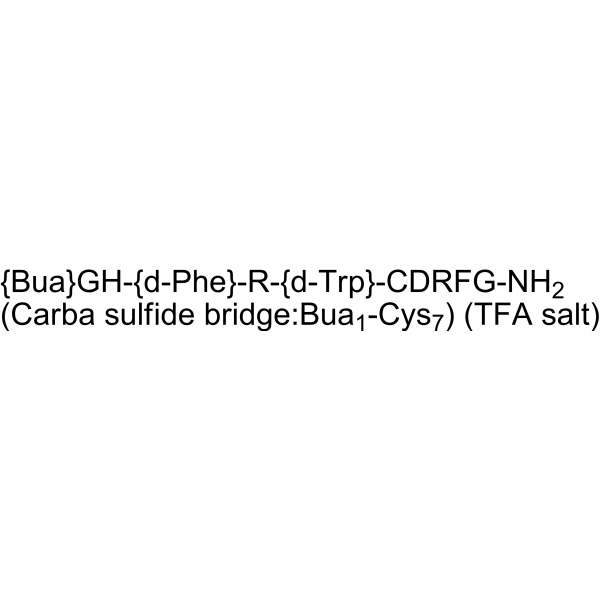
{Bua}GH-{d-Phe}-R-{d-Trp}-CDRFG-NH2 (Carba sulfide bridge:Bua1-Cys7)
-
선적
Room temperature in continental US; may vary elsewhere.
-
보관
Please store the product under the recommended conditions in the Certificate of Analysis.


순도&문서
References
[1]. Xu W, et al. Activation of Melanocortin 1 Receptor Attenuates Early Brain Injury in a Rat Model of Subarachnoid Hemorrhage viathe Suppression of Neuroinflammation through AMPK/TBK1/NF-κB Pathway in Rats. Neurotherapeutics. 2020 Jan;17(1):294-308. [Content Brief]
[2]. Juni A, et al. Sex-specific mediaion of opioid-induced hyperalgesia by the melanocortin-1 receptor. Anesthesiology. 2010 Jan;112(1):181-8. [Content Brief]
[3]. Chelakkot VS, et al. MC1R signaling through the cAMP-CREB/ATF-1 and ERK-NFκB pathways accelerates G1/S transition promoting breast cancer progression. NPJ Precis Oncol. 2023 Sep 7;7(1):85. [Content Brief]
[4]. Rinne P, et al. Melanocortin 1 Receptor Signaling Regulates Cholesterol Transport in Macrophages. Circulation. 2017 Jul 4;136(1):83-97. [Content Brief]

Calculators
Concentration (start) × Volume (start) = Concentration (final) × Volume (final)


MSG606 TFA Related Classifications
HY-P1726A Related Classifications
 Powered by Bioz