



Tanezumab
Based on 2 publication(s) in Google Scholar
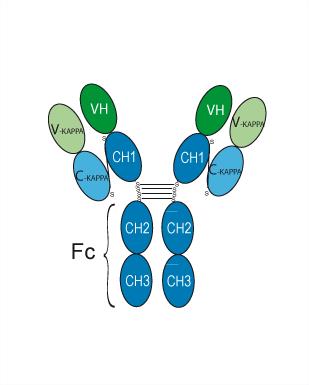
Tanezumab (RN-624) is a humanized anti-NGF mAb with high affinity and specificity. Tanezumab blocks NGF binding to its receptors, p75 and TrkA, in the peripheral nervous system. Tanezumab can be used in studies of acute and chronic pain such as osteoarthritis, knee and neuralgia, as well as post-herpetic neuralgia.
연구목적의 판매만을 진행합니다. 환자를 대상으로 한 판매는 하지 않습니다.
- Purity : 99.52%
- CAS No.: 880266-57-9
- 분자량:145.44 kDa
-
보관:
Please store the product under the recommended conditions in the Certificate of Analysis.


To place orders, for customer services and technical support, please contact: MedChemExpress USA
Tel: 609-228-6898 E-mail: [email protected] [email protected]


-
 Biological Activity
-
Chemical Information
- Protocol
- 순도&문서
- References
-
 Help & FAQs






Publications Citing Use of MedChemExpress (MCE) Tanezumab
More

Biological Activity
제품 설명
Isotype
Human IgG2 kappa
Recommend Isotype Controls
Species Reactivity
Human
IC50 & Target
NGF/bNGF
In Vitro
Tanezumab (100 ng/mL, 48 h) decreases the expression of NGF proteins, inhibits the migration and invasion of cells MiaPaCa-2 and CFPAC-1[3].
MedChemExpress (MCE) has not independently confirmed the accuracy of these methods. They are for reference only.
-
Cell Line:MiaPaCa-2 and CFPAC-1
-
Concentration:100 ng/mL
-
Incubation Time:48 h
-
Result:Inhibited cell migration.
In Vivo
Tanezumab (2.5-5 mg/kg, sc, once a week for 4 weeks) exhibits anti-inflammatory and analgesic effects in rats Kashin-Beck Disease models[4].
MedChemExpress (MCE) has not independently confirmed the accuracy of these methods. They are for reference only.
-
Animal Model:MiaPaCa-2 xenograft mouse models[3]
-
Dosage:10 mg/kg
-
Administration:sc, once a day for 8 weeks
-
Result:Reduced the tumor volume and invasive nerve diameter.
Alleviated hindlimb dysfunction.
-
Animal Model:Sprague-Dawley rat Kashin-Beck Disease models[4]
-
Dosage:2.5-5 mg/kg
-
Administration:sc, once a week for 4 weeks
-
Result:Increased the paw withdrawal mechanical threshold (PWT) and thermal paw withdrawal latency (PWL).
Decreased serum TNF-α and IL-1β levels.
Clinical Trial
| NCT Number | Sponsor | Condition | Start Date |
Phase

|
|---|---|---|---|---|
| NCT01329991 | Plexxikon| | 2011-05 | PHASE1 |
Gene ID
Accession
Conjugated
Unconjugated
Reconsititution
The product can be reconstituted/diluted with sterile PBS or saline.
Format
-
Human IgG2 kappa
신청
ELISA, FACS, Functional assay
Verified Bioactivity
-
 Immobilized Beta-NGF Protein, Human, HEK293, HY-P7660 can bind Tanezumab. The EC50 for this effect is 5.218 ng/mL.
 -
 Flow cytometric analysis of 1.5×10⁶ SHSY5Y cells labeling Tanezumab (HY-P99221, red). Cells were fixed with 4% paraformaldehyde and permeabilised with 90% methanol. Then stained with the primary antibody at 1/200 dilution for an hour at 4℃. Alexa Goat Anti-Human IgG H&L (AF488) (HY-P83776) was used as the secondary antibody at 1/1,000 dilution for 30 minutes at 4℃. Human IgG2 kappa Isotype Control (HY-P99002, blue) was used as the isotype control, cells without incubation with primary antibody were used as the unlabeled control (black).


Chemical Information
-
CAS No. 880266-57-9
-
Appearance Liquid
-
분자량 145.44 kDa
-
Color Colorless to light yellow
-
SMILES
[Tanezumab]
-
Synonyms
RN-624; PF 4383119
-
선적
Shipping with dry ice.
-
Formulation
Please refer to the lot-specific COA for specific buffer information.
-
보관
Please store the product under the recommended conditions in the Certificate of Analysis.


Publications (2)
-
Journal Impact Factor
-
Most Recent
-
Adv Sci (Weinh)
Depletion of p75NTR in Schwann Cells Driven by Inflammation Mediates Cutaneous Pain in Psoriasis. [Abstract]2026 Jun;13(34):e23189. PMID: 41933938 -


순도&문서
-
Data Sheet (263 KB)
-
SDS (251 KB)
- English - EN (251 KB)
- Français - FR (251 KB)
- Deutsch - DE (251 KB)
- Norwegian - NO (251 KB)
- Español - ES (251 KB)
- Swedish - SV (251 KB)
- Italian - IT (251 KB)
- Korean - KR (251 KB)
- Portuguese - PT (251 KB)
-
Inhibitory Antibodies User Guide (603 KB)
References
[1]. Evans M, et al. Effects of tanezumab on satellite glial cells in the cervicothoracic ganglion of cynomolgus monkeys: A 26-week toxicity study followed by an 8-week recovery period. Auton Neurosci. 2019 May;218:51-53. [Content Brief]
[3]. Peng T, et al., Nerve Growth Factor (NGF) Encourages the Neuroinvasive Potential of Pancreatic Cancer Cells by Activating the Warburg Effect and Promoting Tumor Derived Exosomal miRNA-21 Expression. Oxid Med Cell Longev. 2022 Oct 15;2022:8445093. [Content Brief]

Calculators
Concentration (start) × Volume (start) = Concentration (final) × Volume (final)


Tanezumab Related Classifications
HY-P99221 Related Classifications
 Powered by Bioz