



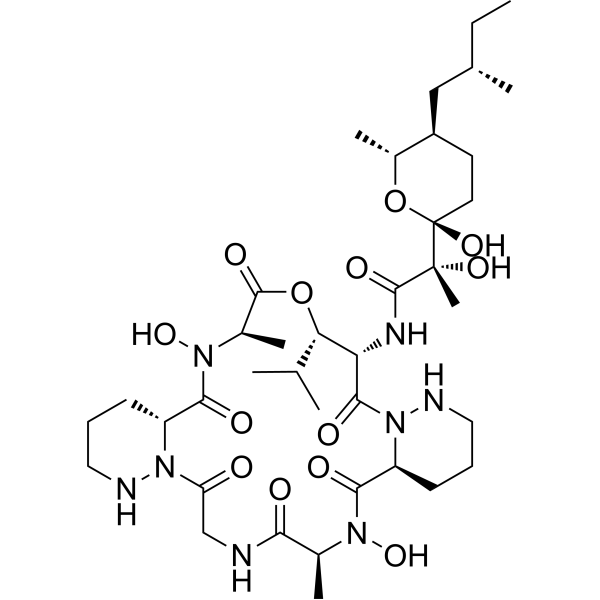
L-156602
L-156602 is a C5a receptor antagonist. L-156602 inhibits inflammation, and the migration of monocytes and neutrophils to the infiltrating site in mouse inflammatory models. L-156602 suppresses the efferent phase of delayed-type hypersensitivity (DTH).
For research use only. We do not sell to patients.
- CAS No.: 125228-51-5
- Formula: C38H64N8O13
- Molecular Weight:840.96
-
Storage:
Please store the product under the recommended conditions in the Certificate of Analysis.

To place orders, for customer services and technical support, please contact: MedChemExpress USA
Tel: 609-228-6898 E-mail: [email protected] [email protected]


-
 Biological Activity
-
Chemical Information
- Protocols
- Purity & Documentation
- References
-
 Help & FAQs




Biological Activity
Description
IC50 & Target
In Vivo
L-156602 (0.2-0.5 mg/kg, i.p.) suppressed the infiltration of mononuclear leukocytes and neutrophils into the site of inflammation in PCI-induced inflammation of DBA/1 mice[2].
MedChemExpress (MCE) has not independently confirmed the accuracy of these methods. They are for reference only.
-
Animal Model:
-
Dosage:0.1, 0.5 mg/kg, once daily for 3 days
-
Administration:Intraperitoneal injection (i.p.)
-
Result:Suppressed the swelling completely after 4 h at 0.1 mg/kg, and the effect was still statistical after 24 h at 0.5 mg/kg.
Reduced the number of migrated leukocytes.
Suppressed the migration of neutrophils, macrophages and lymphocytes non-specifically.
-
Animal Model:MDP-induced acute joint inflammation of BALB/c mice[1]
-
Dosage:0.25, 0.5 mg/kg, once daily for 3 days
-
Administration:Intraperitoneal injection (i.p.)
-
Result:Suppressed adjuvant arthritis although a slight reduction of body weight at the dose of 0.5 mg/kg after 24 h.
-
Animal Model:0.5% PCI-induced inflammation of DBA/1 mice[2]
-
Dosage:0.2, 0.5 mg/kg
-
Administration:Intraperitoneal injection (i.p.)
-
Result:Suppressed ear swelling significantly and the infiltration of mononuclear leukocytes and neutrophils into the site of inflammation.
-
Animal Model:5% PCI-induced inflammation of DBA/1 mice[2]
-
Dosage:0.4 mg/kg
-
Administration:Intraperitoneal injection (i.p.)
-
Result:Suppressed the infiltration of mononuclear leukocytes and neutrophils into the site of inflammation non-specifically.


Chemical Information
-
CAS No. 125228-51-5
-
Molecular Weight 840.96
-
Formula C38H64N8O13
-
SMILES
CC[C@@H](C[C@H]1CC[C@@]([C@@](C(N[C@H]2[C@H](C(C)C)OC([C@@H](C)N(O)C([C@H]3CCCNN3C(CNC([C@H](C)N(O)C([C@@H]4CCCNN4C2=O)=O)=O)=O)=O)=O)=O)(O)C)(O)O[C@@H]1C)C
-
Synonyms
Antibiotic L 156602; PD 124966
-
Shipping
Room temperature in continental US; may vary elsewhere.
-
Storage
Please store the product under the recommended conditions in the Certificate of Analysis.

Protocols
-
Cell migration
Cell migration is a method that plays an important role in wound healing, cell differentiation, embryonic development, etc.
-
Contact Hypersensitivity Dermatitis
Contact hypersensitivity (CHS) dermatitis is a T cell-mediated delayed-type (Type IV) immune reaction in which low-molecular-weight haptens applied to the skin bind host proteins to form complete antigens, triggering sensitization followed by a secondary inflammatory response upon re-exposure (elicitation phase), which is commonly quantified by ear swelling as a readout of skin inflammation in murine models. This model is widely used to study allergic contact dermatitis because it is antigen-specific, reproducible, and reflects key immunological events including dendritic cell activation, T cell priming in draining lymph nodes, and effector T cell-driven tissue inflammation. DNFB- and oxazolone-induced CHS models are standard systems for evaluating both acute and chronic T cell-dependent skin inflammation and for testing immunomodulatory interventions.
-
Research Protocol for Inflammation-related Diseases
The NLRP3 inflammasome is a cytosolic innate immune signaling platform that integrates priming signals and danger-signal activation to promote caspase-1 activation, maturation of IL-1β and IL-18, and gasdermin D-mediated pyroptotic cell death. The core experimental logic is to determine whether inflammatory disease phenotypes are driven by increased NLRP3 expression, ASC-containing inflammasome assembly, caspase-1 cleavage, GSDMD cleavage, and extracellular release of IL-1β/IL-18 rather than by nonspecific cell injury alone. The pathway is strongly linked to inflammation-related disease phenotypes because monosodium urate crystals activate NALP3/NLRP3 inflammasome signaling in gout-like crystal inflammation, cholesterol crystals activate NLRP3 inflammasomes in atherogenesis models, and DSS-induced intestinal inflammation has been reported to involve NLRP3 inflammasome activity. However, experimental colitis studies also show context-dependent protective effects of NLRP3 inflammasome co


Purity & Documentation
References
[1]. Tsuji RF, et al. Effects of L-156,602, a C5a receptor antagonist, on mouse experimental models of inflammation. Biosci Biotechnol Biochem. 1992 Dec;56(12):2034-6. [Content Brief]
[2]. Tsuji RF, et al. Anti-inflammatory effects and specificity of L-156,602: comparison of effects on concanavalin A and zymosan-induced footpad edema, and contact sensitivity response. Immunopharmacology. 1995 Feb;29(1):79-87. [Content Brief]

Calculators
Concentration (start) × Volume (start) = Concentration (final) × Volume (final)


L-156602 Related Classifications
HY-16384 Related Classifications
 Powered by Bioz