



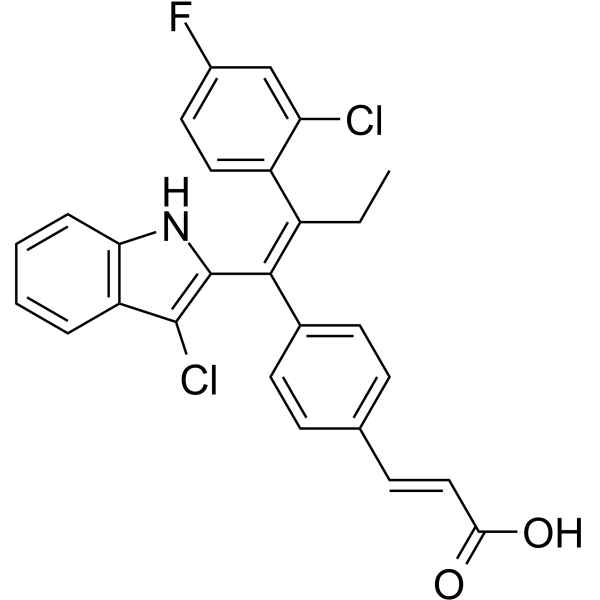
LX-039
LX-039 is a highly potent, selective and orally active estrogen receptor degrader with EC50 value of 2.29 nM. LX-039 has indole C-3 chlorine atom. LX-039 exhibits excellent mouse pharmacokinetics, low clearance, high Cmax and oral exposure. LX-039 has anti-tumor activity.
Nos produits utilisent uniquement pour la recherche. Nous ne vendons pas aux patients.
- CAS No.: 2135341-09-0
- Formule: C27H20Cl2FNO2
- Masse moléculaire:480.36
-
Stockage:
Please store the product under the recommended conditions in the Certificate of Analysis.

To place orders, for customer services and technical support, please contact: MedChemExpress USA
Tel: 609-228-6898 E-mail: [email protected] [email protected]


-
 Activité biologique
-
Chemical Information
- Protocole
- Pureté et documentation
- Références
-
 Help & FAQs




Activité biologique
Description
IC50 & Target
[1]|
Estrogen receptor 2.29 nM (EC50) |
In Vivo
LX-039 (6.5 mg/kg, 20 mg/kg and 60 mg/kg; PO; daily for 21 days) inhibits tumor growth in a dose-dependent manner[1].
LX-039 (1 mg/kg; PO and IV; single) displays a moderate to low clearance (Cl) plus good oral bioavailability (F%) in both rat and dog[1].
Pharmacokinetic Parameters of LX-039 in CD-1 mouse[1].
| IV | PO (2.5 mg/kg) | |
| Vd (L/kg) | 0.5 | |
| CL (mL/min/kg) | 1.4 | |
| Cmax (nM) | 1873 | |
| AUC0-24 (nM·h) | 15329 | |
| F (%) | 60.1 |
Pharmacokinetic Parameters of LX-039 in SD rat and Beagle dog[1].
| SD Rat | Beagle Dog | |
| Vd (L/kg, iv) | 2 | 0.42 |
| CL (mL/min/kg, iv) | 7.7 | 0.84 |
| C0, iv (nM), 1 mg/kg | 2610 | 12800 |
| AUC0-24, iv (nM·h), 1 mg/kg | 4820 | 43800 |
| Cmax, po (nM), 1 mg/kg | 381 | 2550 |
| AUC0-24, po (nM·h), 1 mg/kg | 2700 | 24200 |
| F (%) | 56 | 55 |
MedChemExpress (MCE) has not independently confirmed the accuracy of these methods. They are for reference only.
Essai clinique
| NCT Number | Sponsor | Condition | Start Date |
Phase

|
|---|---|---|---|---|
| NCT01329991 | 2011-05 | PHASE1 |


Chemical Information
-
CAS No. 2135341-09-0
-
Masse moléculaire 480.36
-
Formule C27H20Cl2FNO2
-
SMILES
O=C(O)/C=C/C1=CC=C(/C(C(N2)=C(Cl)C3=C2C=CC=C3)=C(C4=CC=C(F)C=C4Cl)\CC)C=C1
-
Livraison
Room temperature in continental US; may vary elsewhere.
-
Stockage
Please store the product under the recommended conditions in the Certificate of Analysis.


Pureté et documentation
Références

Calculators
Concentration (start) × Volume (start) = Concentration (final) × Volume (final)


LX-039 Related Classifications
HY-143439 Related Classifications
 Powered by Bioz