



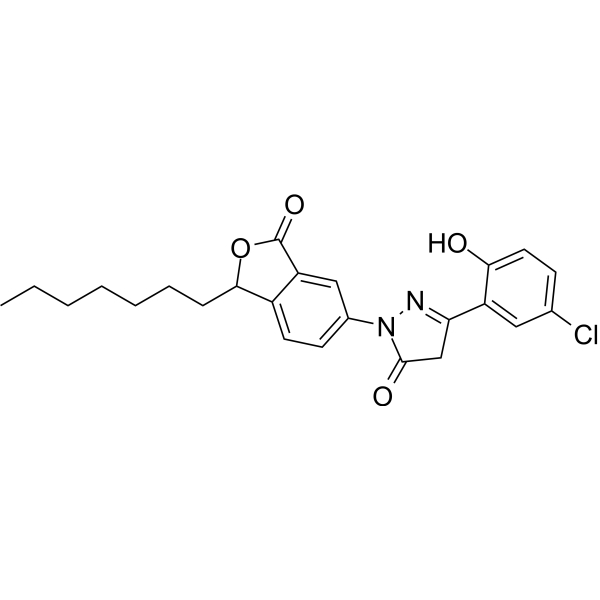
MAO-B-IN-21
MAO-B-IN-21 is an excellent MAO-B inhibitor with antioxidant activity and anti-Aβ aggregation activity. MAO-B-IN-21 also exhibits metal-ion chelating ability, anti-neuroinflammation (NO, TNF-α), neuroprotective activity and BBB permeability. MAO-B-IN-21 significantly improves the memory and cognitive impairment in Aβ1-42 induced Alzheimer's disease mice model.
For research use only. We do not sell to patients.
- CAS No.: 2956426-18-7
- Formula: C24H25ClN2O4
- Molecular Weight:440.92
-
Storage:
Please store the product under the recommended conditions in the Certificate of Analysis.

To place orders, for customer services and technical support, please contact: MedChemExpress USA
Tel: 609-228-6898 E-mail: [email protected] [email protected]


-
 Biological Activity
-
Chemical Information
- Protocols
- Purity & Documentation
- References
-
 Help & FAQs




Biological Activity
Description
IC50 & Target
[1]|
MAO-B |
In Vitro
MAO-B-IN-21 (37.5 μM in methanol) blocks Cu2+-induced ROS production, due to metal-chelating property and/or its antioxidant capacity to capture the free radicals from Cu2+-Ascorbate redox system[1].
MAO-B-IN-21 (25 μM; 24 h; 37 °C) inhibits self-induced Aβ1-42 aggregation and disaggregate self-induced Aβ1-42 fibrils[1].
MAO-B-IN-21 (2.5-25 μM; 24 h) inhibits ROS production in LPS-stimulated BV-2 microglia cells[1].
MedChemExpress (MCE) has not independently confirmed the accuracy of these methods. They are for reference only. Further protocols information, click here.
In Vivo
MAO-B-IN-21 (8 mg/kg and 32 mg/kg; ig; single dose) shortenes the escape latency time (ELT), reduced Aβ1-42 level, indicating the improvement in learning and memory ability in Aβ-induced AD mice model[1].
Pharmacokinetic Analysis in Balb/C mice[1]
| Tissue | T1/2 | Tmax | Cmax | AUC0-t | AUCbrain/plasma |
| Plasma | 1.15 h | 0.5 h | 1539 ng/mL | 2941 ng·h/mL | 0.69 |
| Brain | 2.07 h | 1.0 h | 922.7 ng/g | 2032.5 ng·h/g |
MedChemExpress (MCE) has not independently confirmed the accuracy of these methods. They are for reference only.


Chemical Information
-
CAS No. 2956426-18-7
-
Molecular Weight 440.92
-
Formula C24H25ClN2O4
-
SMILES
CCCCCCCC1OC(C2=CC(N3N=C(CC3=O)C4=CC(Cl)=CC=C4O)=CC=C21)=O
-
Shipping
Room temperature in continental US; may vary elsewhere.
-
Storage
Please store the product under the recommended conditions in the Certificate of Analysis.

Protocols
-
Transepithelial/transendothelial electrical resistance assay
TEER measures electrical resistance across epithelial or endothelial monolayers cultured on permeable supports, and the readout reflects ionic conductance through the cell barrier, especially the paracellular pathway regulated by junctional integrity. TEER can be measured without destroying the monolayer and is commonly used before or during transport, permeability, barrier-disruption, and barrier-maturation experiments. TEER values are influenced by biological maturation and technical conditions; reported factors include temperature, medium formulation, passage number, electrode geometry, membrane properties, and junctional length during early monolayer maturation. Therefore, TEER should be interpreted with blank-insert subtraction, area normalization, repeated readings, and, when possible, orthogonal barrier readouts such as FITC-dextran flux or tight-junction staining.
-
Research Protocol for Neurological Diseases
PINK1/Parkin-mediated mitophagy pathway is a mitochondrial quality-control signaling axis in which mitochondrial depolarization stabilizes PINK1 on damaged mitochondria, activates Parkin recruitment and E3 ubiquitin ligase activity, promotes ubiquitination of outer mitochondrial membrane proteins, recruits selective autophagy adaptors, and drives lysosomal degradation of damaged mitochondria. In neurological disease research, this pathway is experimentally important because neurons, especially dopaminergic neurons, are highly dependent on mitochondrial integrity, and defective mitochondrial turnover can lead to mitochondrial dysfunction, oxidative stress, impaired neuronal survival, α-synuclein accumulation, and neuroinflammatory damage-associated signals. The genetic disease link is strongest in Parkinson’s disease because mutations in PRKN/parkin cause autosomal recessive juvenile parkinsonism, mutations in PINK1 cause hereditary early-onset Parkinson’s disease, and Drosophila studie
-
Alzheimer’s Disease Modeling
Alzheimer’s Disease (AD) is a neurodegenerative disorder characterized by a progressive decline in cognitive functions and loss of specific types of neurons and synapses. Alzheimer's symptoms can be simulated in mice by injecting drugs (such as Aβ) or genetically modified.


Purity & Documentation
References

Calculators
Concentration (start) × Volume (start) = Concentration (final) × Volume (final)


MAO-B-IN-21 Related Classifications
HY-149984 Related Classifications
 Powered by Bioz