



Maridebart cafraglutide

Based on 1 Customer Validation
Maridebart cafraglutide (AMG 133) is a long-acting peptide-antibody conjugate that combines GLP-1 receptor agonist with glucose-dependent insulinotropic polypeptide (GIP) receptor antagonism. Maridebart cafraglutide shows antagonist activity against human, cynomolgus monkey and rat GIPR with IC50 values of 46.4 nM, 26.5 nM, 822.3 nM, respectively. Maridebart cafraglutide shows agonist activity against human, cynomolgus monkey, rat and mouse GLP-1R with EC50 values of 24.4 pM, 5.7 pM, 2.4 pM and 123 pM, respectively. Maridebart cafraglutide can be used for the study of obesity and type 2 diabetes.
Nur für Forschungszwecke. Wir verkaufen nicht an Patienten.
- Reinheit : 98.67%
- CAS. Nr.: 2887445-76-1
- Molecular Weight:153,514 (average)
-
Speicherung:
-80°C, protect from light


To place orders, for customer services and technical support, please contact: MedChemExpress USA
Tel: 609-228-6898 E-mail: [email protected] [email protected]


-
 Biologische Aktivität
-
Chemical Information
- Protokoll
- Reinheit & Dokumentation
- Verweise
-
 Help & FAQs




Biologische Aktivität
Beschreibung
IC50 & Target
[1]|
GIPR 42.4 nM (IC50, Human) |
GIPR 26.5 nM (IC50, Cynomolgus monkey) |
GIPR 822.3 nM (IC50, Rat) |
GLP-1R 24.4 pM (EC50, Human) |
GLP-1R 5.7 pM (EC50, Cynomolgus monkey) |
GLP-1R 2.4 pM (EC50, Rat) |
GLP-1R 123 pM (EC50, Mice) |
In Vitro
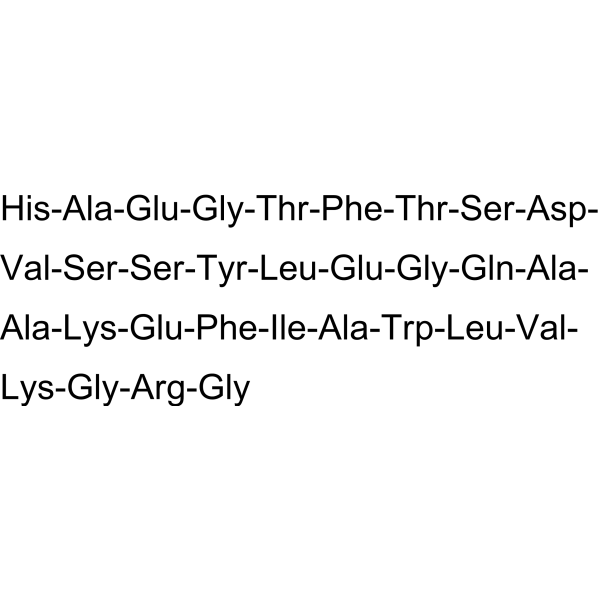
Maridebart cafraglutide is an optimized GIPR/GLP-1R bispecific molecule engineered by conjugating a fully human monoclonal anti-human GIPR-Ab with two GLP-1 analogue agonist peptides using amino acid linkers[1][2].
Maridebart cafraglutide (AMG 133) functionally inhibits GIP signalling through human and cynomolgus monkey GIPR with similar potency, whereas it has more than 20-fold lower potency for inhibition of GIP signalling through rat GIPR and does not fully antagonize mouse GIPR with concentrations of up to 3 µM[1].
Maridebart cafraglutide, prolongs half-life by engaging neonatal Fc receptor (FcRn) recycling and reducing renal clearance, enabling sustained GLP-1 receptor activation with infrequent injections[2].
MedChemExpress (MCE) has not independently confirmed the accuracy of these methods. They are for reference only.
Parmacokinetics
In Vivo
MedChemExpress (MCE) has not independently confirmed the accuracy of these methods. They are for reference only.
-
Animal Model:Cynomolgus Monkey (male, diet-induced obesity)[1]
-
Dosage:0.25 mg/kg, 0.75 mg/kg
-
Administration:s.c.; weekly; 6 weeks
-
Result:Reduced body weight by 11% and 13% from baseline at the end of the treatment period, decreased total energy intake, fasting triglycerides, fasting insulin, total cholesterol, and low-density lipoprotein cholesterol.
Clinical Trial
| NCT Number | Sponsor | Condition | Start Date |
Phase

|
|---|---|---|---|---|
| NCT01329991 | 2011-05 | PHASE1 |


Chemical Information
-
CAS. Nr. 2887445-76-1
-
Appearance Liquid
-
Molecular Weight 153,514 (average)
-
Color Colorless to light yellow
-
SMILES
[Maridebart cafraglutide]
-
Synonyms
AMG 133
-
Versand
Shipping with dry ice.
-
Speicherung
-80°C, protect from light


Reinheit & Dokumentation
-
Data Sheet (277 KB)
-
SDS (252 KB)
- English - EN (252 KB)
- Français - FR (252 KB)
- Deutsch - DE (252 KB)
- Norwegian - NO (252 KB)
- Español - ES (252 KB)
- Swedish - SV (252 KB)
- Italian - IT (252 KB)
- Korean - KR (252 KB)
- Portuguese - PT (252 KB)
-
Handling Instructions (2659 KB)
Verweise

Calculators
Konzentration (Stammlösung) × Volumen (Stammlösung) = Konzentration (Ziellösung) × Volumen (Ziellösung)


Maridebart cafraglutide Related Classifications
HY-164535 Related Classifications
 Powered by Bioz