



Metyltetraprole

Based on 1 Customer Validation
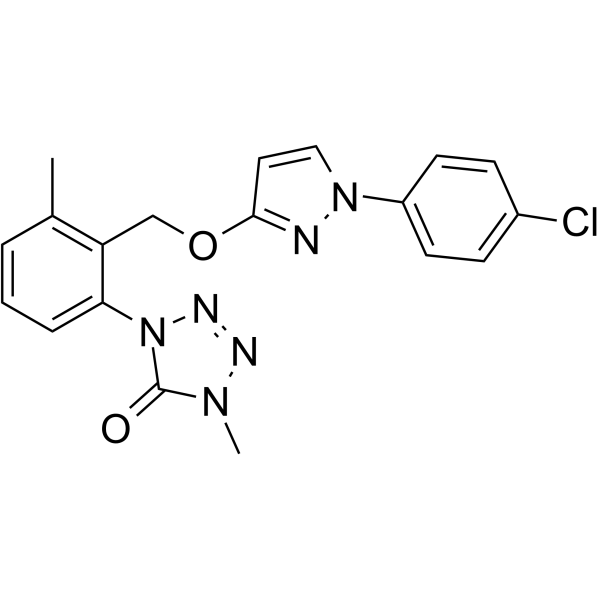
Metyltetraprole is a QoI fungicide containing a tetrazolinone pharmacophore that binds to the Qo site of the cytochrome bc1 complex (complex III), blocks D-Panthenol (HY-B1391) oxidation, and inhibits mitochondrial electron transport, while retaining antifungal activity against QoI-resistant isolates and exhibiting broad-spectrum antifungal effects. Metyltetraprole is used in the study of wheat Septoria leaf blotch, net blotch, cucumber downy mildew, and powdery mildew.
For research use only. We do not sell to patients.
- Purity : 99.53%
- CAS No.: 1472649-01-6
- Formula: C19H17ClN6O2
- Molecular Weight:396.83
-
Storage:Powder -20°C, 3 years , 4°C, 2 years ; In solvent -80°C, 6 months , -20°C, 1 month

To place orders, for customer services and technical support, please contact: MedChemExpress USA
Tel: 609-228-6898 E-mail: [email protected] [email protected]


-
 Biological Activity
-
Chemical Information
-
Solvent & Solubility
- Purity & Documentation
- References
-
 Help & FAQs




Biological Activity
Description
In Vitro
Metyltetraprole (0.000061-1 ppm; 5 days) exhibits equally potent in vitro activity against both wild-type and G143A mutant Zymoseptoria tritici strains, with an EC50 of 0.002 ppm for both[2].
Metyltetraprole (1 ppm; 20 min) binds to the Qo site of the cytochrome bc1 complex in the submitochondrial fraction of Zymoseptoria tritici[2].
Metyltetraprole is slightly more sensitive to QoI-R strains that may carry the G143A mutation than to QoI-S strains of Pyrenophora tritici-repentis, whereas no effect is observed in Ramularia collo-cygni[3].
Metyltetraprole (0.0003-3 mg/L; 3 days for P. tritici-repentis and 7 days for V. effusa) retains potent inhibitory activity against QoI-resistant Pyrenophora tritici-repentis and Venturia effusa isolates carrying non-wild-type cytochrome b haplotypes, with resistance factors ranging from 0.7 to 2.9[4].
Metyltetraprole (0.0001-10 mg/L; 2 h and 18 h) retains potent inhibitory activity against Puccinia horiana carrying the L299F, N256S + L299F, and L275F + L299F cytochrome b substitutions, with resistance factors ranging from 0.7 to 2.9[4].
Metyltetraprole exhibits potent inhibitory activity against Saccharomyces cerevisiae CIII with a Ki of 0.92 nM and an IC50 of 0.001 μM, but shows significantly lower activity against porcine CIII with a Ki of 298.87 nM and an IC50 of 0.312 μM[5].
Metyltetraprole binds to the Qo site in Saccharomyces cerevisiae CIII, but binds to the Qi site in porcine CIII, indicating species-specific differences in the binding site[5].
Metyltetraprole acts as a Pm-type inhibitor at the Qo site in Saccharomyces cerevisiae CIII, whereas in porcine CIII, it functions as a dual-target inhibitor that binds to both the Qo and Qi sites[5].
Metyltetraprole maintains its binding mode and retains a favorable binding energy of -49.20 kcal/mol with the G143A mutant of Saccharomyces cerevisiae CIII, resulting in a low resistance factor of 1.6[5].
Metyltetraprole (0.0001-3 mg/L) effectively inhibits the in vitro growth of Zymoseptoria tritici (EC50 0.0022 mg/L), Ramularia collo-cygni (EC50 0.0020 mg/L), Parastagonospora nodorum (EC50 0.0025 mg/L), and Ustilago maydis (EC50 0.040 mg/L)[6].
Metyltetraprole (0.0001-3 mg/L) effectively inhibits the growth of Pyrenophora teres in vitro (EC50 0.0048 mg/L), while showing lower activity against basidiomycetes and oomycetes[6].
Metyltetraprole (0.0001-3 mg/L) retains potent antifungal activity against field isolates of Zymoseptoria tritici and Pyrenophora teres that are resistant to other fungicide classes, with EC50 values ranging from 0.0025 to 0.0088 mg L−1 for Z. tritici and from 0.007 to 0.015 mg L−1 for P. teres[6].
MedChemExpress (MCE) has not independently confirmed the accuracy of these methods. They are for reference only. .
In Vivo
Metyltetraprole (0.1-10 µg/L; immersion; 7 consecutive days) alters the expression of mitochondrial electron transport chain genes, in which mt-nd3 is upregulated at 1 µg/L, while uqcrc2 expression decreases in a dose-dependent manner[1].
MedChemExpress (MCE) has not independently confirmed the accuracy of these methods. They are for reference only.
-
Animal Model:AB × Tübingen strain (embryos/larvae)[1]
-
Dosage:0.1, 1, 10, and 100 µg/L
-
Administration:immersion; continuous; from ~6 hpf until 7 days post-fertilization
-
Result:Showed a significant difference in combined survival rates between the DMSO control and Metyltetraprole concentrations (Log-rank Mantel-Cox test, Chi-square = 30.98, d.f. = 5).
Observed high overall survival of 94-97% across all groups.
Recorded few deformities in each group (> 5%), with no significant reoccurring deformities (< 3%).
Detected no significant effect on ROS levels at any concentration tested [F(4,15) = 0.9010].
Found no differences in transcripts cat, sod1, sod2, cox5a1, cox4i1, cycl1, mt-nd1, mt-nd2, ndufs3, uqcrb, uqcrc2, uqcrc2b, and uqcrh among groups.
Observed significant upregulation of mt-nd3 in fish exposed to 1 µg/L Metyltetraprole.
Revealed a reduction in uqcrc2 expression with increasing concentration of Metyltetraprole via regression analysis.
Induced hyperactivity in larval zebrafish following 100 µg/L Metyltetraprole during the first dark period [F(4,145) = 7.960].
-
Animal Model:AB × Tübingen strain (embryos)[1]
-
Dosage:0.1, 1, and 10 µg/L
-
Administration:immersion; continuous; from 6 hpf until 7 days post-fertilization
-
Result:Observed significant upregulation of mt-nd3 in fish exposed to 1 µg/L MTP.
Revealed a dose-dependent change in uqcrc2 expression in 7-day old larval zebrafish exposed to 0.1, 1, or 10 µg/L MTP, with a regression analysis revealing a reduction in uqcrc2 expression with increasing concentration of MTP.
-
Animal Model:Rat[7]
-
Dosage:1000 mg/kg bw per day
-
Administration:dermal; 28-day study
-
Result:Reported a systemic dermal no observed adverse effect level (NOAEL) of 1000 mg/kg bw per day.
-
Animal Model:Dog[7]
-
Dosage:100 mg/kg bw per day
-
Administration:oral; 13-week study
-
Result:Reported a short-term oral LOAEL of 100 mg/kg bw per day based on liver effects and decreased thymus weight.
-
Animal Model:Mice[7]
-
Dosage:82.2 mg/kg bw per day
-
Administration:oral; 18-month study
-
Result:Reported a long-term and carcinogenic NOAEL of 82.2 mg/kg bw per day based on increased liver weight and malignant lymphomas.
-
Animal Model:Rat[7]
-
Dosage:83.9 mg/kg bw per day
-
Administration:oral; 2-year study
-
Result:Reported a carcinogenic NOAEL of 83.9 mg/kg bw per day.
-
Animal Model:Rat[7]
-
Dosage:409 mg/kg bw per day (parental and offspring NOAEL); 1385 mg/kg bw per day (reproductive NOAEL)
-
Administration:oral; multigeneration study
-
Result:Reported parental and offspring NOAELs of 409 mg/kg bw per day and a reproductive NOAEL of 1385 mg/kg bw per day.
-
Animal Model:Rat[7]
-
Dosage:500 mg/kg bw per day (developmental NOAEL); 1000 mg/kg bw per day (maternal NOAEL)
-
Administration:oral; teratogenicity study
-
Result:Reported a developmental NOAEL of 500 mg/kg bw per day and a maternal NOAEL of 1000 mg/kg bw per day.
-
Animal Model:Rabbit[7]
-
Dosage:100 mg/kg bw per day
-
Administration:oral; teratogenicity study
-
Result:Reported maternal and developmental NOAELs of 100 mg/kg bw per day.
-
Animal Model:Rat[7]
-
Dosage:500 mg/kg bw per day (neurotoxicity NOAEL); 2000 mg/kg bw per day (systemic toxicity NOAEL)
-
Administration:oral; acute study
-
Result:Reported an acute neurotoxicity NOAEL of 500 mg/kg bw per day and a systemic toxicity NOAEL of 2000 mg/kg bw per day.


Chemical Information
-
CAS No. 1472649-01-6
-
Appearance Solid
-
Molecular Weight 396.83
-
Formula C19H17ClN6O2
-
Color White to off-white
-
SMILES
O=C1N(C)N=NN1C2=CC=CC(C)=C2COC3=NN(C4=CC=C(Cl)C=C4)C=C3
-
Shipping
Room temperature in continental US; may vary elsewhere.
-
Storage
Powder -20°C 3 years 4°C 2 years In solvent -80°C 6 months -20°C 1 month


Solvent & Solubility
In Vitro:
DMSO : 100 mg/mL (252.00 mM; Need ultrasonic; Hygroscopic DMSO has a significant impact on the solubility of product, please use newly opened DMSO)
Please refer to the solubility information to select the appropriate solvent. Once prepared, please aliquot and store the solution to prevent product inactivation from repeated freeze-thaw cycles.
Storage method and period of stock solution: -80°C, 6 months; -20°C, 1 month. When stored at -80°C, please use it within 6 months. When stored at -20°C, please use it within 1 month.
Please refer to the solubility information to select the appropriate solvent. Once prepared, please aliquot and store the solution to prevent product inactivation from repeated freeze-thaw cycles.
Storage method and period of stock solution: -80°C, 6 months; -20°C, 1 month. When stored at -80°C, please use it within 6 months. When stored at -20°C, please use it within 1 month.
Concentration (start) × Volume (start) = Concentration (final) × Volume (final)
In Vivo:
Select the appropriate dissolution method based on your experimental animal and administration route.
- For the following dissolution methods, please ensure to first prepare a clear stock solution using an In Vitro approach and then sequentially add co-solvents:
- To ensure reliable experimental results, the clarified stock solution can be appropriately stored based on storage conditions. As for the working solution for In Vivo experiments, it is recommended to prepare freshly and use it on the same day.
- The percentages shown for the solvents indicate their volumetric ratio in the final prepared solution. If precipitation or phase separation occurs during preparation, heat and/or sonication can be used to aid dissolution.
Add each solvent one by one: 10% DMSO 40% PEG300 5% Tween-80 45% Saline
Solubility: ≥ 5 mg/mL (12.60 mM); Clear solution
This protocol yields a clear solution of ≥ 5 mg/mL (saturation unknown).
Taking 1 mL working solution as an example, add 100 μL DMSO stock solution (50.0 mg/mL) to 400 μL PEG300, and mix evenly; then add 50 μL Tween-80 and mix evenly; then add 450 μL Saline to adjust the volume to 1 mL.
Preparation of Saline: Dissolve 0.9 g sodium chloride in ddH₂O and dilute to 100 mL to obtain a clear Saline solution.
Add each solvent one by one: 10% DMSO 90% (20% SBE-β-CD in Saline)
Solubility: ≥ 5 mg/mL (12.60 mM); Clear solution
This protocol yields a clear solution of ≥ 5 mg/mL (saturation unknown).
Taking 1 mL working solution as an example, add 100 μL DMSO stock solution (50.0 mg/mL) to 900 μL 20% SBE-β-CD in Saline, and mix evenly.
Preparation of 20% SBE-β-CD in Saline (4°C, storage for one week): 2 g SBE-β-CD powder is dissolved in 10 mL Saline, completely dissolve until clear.
In Vivo Dissolution Calculator
Please enter the basic information of animal experiments:
-
-
-
-
Recommended: Prepare an additional quantity of animals to account for potential losses during experiments.
Please enter your animal formula composition:
-
%DMSO +
Recommended: Keep the proportion of DMSO in working solution below 2% if your animal is weak.
-
%+
-
+%Tween-80 + +
-
%Saline +
The co-solvents required include: DMSO, . All of co-solvents are available by MedChemExpress (MCE). , Tween 80. All of co-solvents are available by MedChemExpress (MCE).
Working solution concentration: 0.22 mg/mL
Method for preparing stock solution: mg drug dissolved in μL DMSO. Stock solution concentration: mg/mL.
1. Take μL DMSO stock solution;
2. Add μL .
μL , mix evenly;
3. Then add μL Tween 80, mix evenly;
4. Then add μL
Please ensure that the stock solution in the first step is dissolved to a clear state, and add co-solvents in sequence. You can use ultrasonic heating (ultrasonic cleaner, recommended frequency 20-40 kHz), vortexing, etc. to assist dissolution.


Purity & Documentation
-
Data Sheet (290 KB)
-
SDS (251 KB)
- English - EN (251 KB)
- Français - FR (251 KB)
- Deutsch - DE (251 KB)
- Norwegian - NO (251 KB)
- Español - ES (251 KB)
- Swedish - SV (251 KB)
- Italian - IT (251 KB)
- Korean - KR (251 KB)
- Portuguese - PT (251 KB)
-
Handling Instructions (2659 KB)
References
[2]. Matsuzaki Y, et al. Discovery of metyltetraprole: Identification of tetrazolinone pharmacophore to overcome QoI resistance. Bioorg Med Chem. 2020 Jan 1;28(1):115211. [Content Brief]
[6]. Suemoto H, et al. Metyltetraprole, a novel putative complex III inhibitor, targets known QoI-resistant strains of Zymoseptoria tritici and Pyrenophora teres. Pest management science. 2019 Apr;75(4):1181-1189. [Content Brief]


Complete Stock Solution Preparation Table
Please refer to the solubility information to select the appropriate solvent. Once prepared, please aliquot and store the solution to prevent product inactivation from repeated freeze-thaw cycles.
Storage method and period of stock solution: -80°C, 6 months; -20°C, 1 month. When stored at -80°C, please use it within 6 months. When stored at -20°C, please use it within 1 month.
| Optional Solvent | Concentration Solvent Mass | 1 mg | 5 mg | 10 mg | 25 mg |
|---|---|---|---|---|---|
| DMSO | 1 mM | 2.5200 mL | 12.5999 mL | 25.1997 mL | 62.9993 mL |
| 5 mM | 0.5040 mL | 2.5200 mL | 5.0399 mL | 12.5999 mL | |
| 10 mM | 0.2520 mL | 1.2600 mL | 2.5200 mL | 6.2999 mL | |
| 15 mM | 0.1680 mL | 0.8400 mL | 1.6800 mL | 4.2000 mL | |
| 20 mM | 0.1260 mL | 0.6300 mL | 1.2600 mL | 3.1500 mL | |
| 25 mM | 0.1008 mL | 0.5040 mL | 1.0080 mL | 2.5200 mL | |
| 30 mM | 0.0840 mL | 0.4200 mL | 0.8400 mL | 2.1000 mL | |
| 40 mM | 0.0630 mL | 0.3150 mL | 0.6300 mL | 1.5750 mL | |
| 50 mM | 0.0504 mL | 0.2520 mL | 0.5040 mL | 1.2600 mL | |
| 60 mM | 0.0420 mL | 0.2100 mL | 0.4200 mL | 1.0500 mL | |
| 80 mM | 0.0315 mL | 0.1575 mL | 0.3150 mL | 0.7875 mL | |
| 100 mM | 0.0252 mL | 0.1260 mL | 0.2520 mL | 0.6300 mL |


Metyltetraprole Related Classifications
HY-146145 Related Classifications
 Powered by Bioz