



Mitochondria degrader-1

Based on 1 Customer Validation
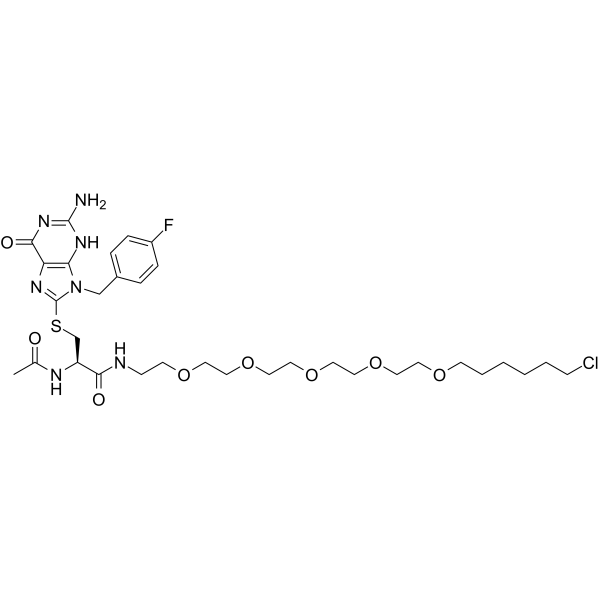
Mitochondria degrader-1 is a mitochondria-targeted degrader that promotes the degradation of damaged mitochondria via autophagic machinery. Mitochondria degrader-1 is generated by intracellular binding between an FBnNAC-containing HaloTag-reactive molecule and mitochondrially localized EmGFP-HaloTag-Omp25. Mitochondria degrader-1 can be used in studies related to mitophagy and the clearance of damaged mitochondria.
For research use only. We do not sell to patients.
- Purity : 95.10%
- CAS No.: 2241669-05-4
- Formula: C33H49ClFN7O8S
- Molecular Weight:758.30
-
Storage:
4°C, sealed storage, away from moisture
* In solvent : -80°C, 6 months; -20°C, 1 month (sealed storage, away from moisture)

To place orders, for customer services and technical support, please contact: MedChemExpress USA
Tel: 609-228-6898 E-mail: [email protected] [email protected]


-
 Biological Activity
-
Chemical Information
-
Solvent & Solubility
- Protocols
- Purity & Documentation
- References
-
 Help & FAQs




Biological Activity
Description
In Vitro
Mitochondria degrader-1 (exp5) (4 h) reduces the level of the mitochondrial matrix protein UQCRC1 and promotes the degradation of damaged mitochondria[1].
Mitochondria degrader-1 (4 h) enhances cell survival following CCCP (HY-100941)-induced mitochondrial damage and reduces cell death detected by TUNEL[1].
MedChemExpress (MCE) has not independently confirmed the accuracy of these methods. They are for reference only. Further protocols information, click here.


Chemical Information
-
CAS No. 2241669-05-4
-
Appearance Oil
-
Molecular Weight 758.30
-
Formula C33H49ClFN7O8S
-
Color Light yellow to yellow
-
SMILES
ClCCCCCCOCCOCCOCCOCCOCCNC([C@@H](NC(C)=O)CSC1=NC(C(N=C(N2)N)=O)=C2N1CC3=CC=C(C=C3)F)=O
-
Shipping
Room temperature in continental US; may vary elsewhere.
-
Storage
4°C, sealed storage, away from moisture
* In solvent : -80°C, 6 months; -20°C, 1 month (sealed storage, away from moisture)


Solvent & Solubility
In Vitro:
DMSO : 100 mg/mL (131.87 mM; Need ultrasonic; Hygroscopic DMSO has a significant impact on the solubility of product, please use newly opened DMSO)
Please refer to the solubility information to select the appropriate solvent. Once prepared, please aliquot and store the solution to prevent product inactivation from repeated freeze-thaw cycles.
Storage method and period of stock solution: -80°C, 6 months; -20°C, 1 month (sealed storage, away from moisture). When stored at -80°C, please use it within 6 months. When stored at -20°C, please use it within 1 month.
Please refer to the solubility information to select the appropriate solvent. Once prepared, please aliquot and store the solution to prevent product inactivation from repeated freeze-thaw cycles.
Storage method and period of stock solution: -80°C, 6 months; -20°C, 1 month (sealed storage, away from moisture). When stored at -80°C, please use it within 6 months. When stored at -20°C, please use it within 1 month.
Concentration (start) × Volume (start) = Concentration (final) × Volume (final)

Protocols
-
Autophagy
Autophagy is a process in which eukaryotic cells use lysosomes to degrade their own cytoplasmic proteins and damaged organelles under the regulation of autophagy related gene (Atg). Microtubule-associated proteins light chain 3 (LC3) is recognized as autophagy marker, which transfers from cytoplasmic LC3 (LC3-I) to membrane type (LC3-II). LC3-II/I ratio could be detected by Western Blot and fluorescence microscopy.
-
Protocol for Pharmacokinetic Study
Pharmacokinetic studies quantify how an organism handles a drug over time through absorption, distribution, metabolism, and excretion, and the core experimental readout is the concentration-time profile of parent drug and, when relevant, metabolites in biological matrices such as plasma, whole blood, urine, bile, or tissue. Pharmacokinetic analysis links dose, route, exposure, clearance, half-life, distribution, bioavailability, and systemic exposure to drug efficacy and toxicity hypotheses rather than measuring a signaling pathway directly. The literature links pharmacokinetics to drug-development phenotypes by showing that drug metabolism and pharmacokinetics influence compound progression, exposure-response interpretation, safety margins, dosing strategy, and failure risk during discovery and development. DMPK science contributes to compound optimization by integrating physicochemical properties, in vitro metabolism, transporter behavior, in vivo exposure, and pharmacodynamic contex
-
Mitophagy Solutions
Mitophagy is the selective autophagic degradation of mitochondria and functions as a mitochondrial quality-control pathway that removes damaged, depolarized, excess, or developmentally programmed mitochondria. The pathway links mitochondrial damage recognition, autophagosome recruitment, lysosomal delivery, and mitochondrial turnover to phenotypes such as mitochondrial homeostasis, oxidative-stress control, metabolic remodeling, differentiation, and neurodegeneration-related mitochondrial fidelity. The best-characterized damage-induced pathway is the PINK1-Parkin axis. Parkin is recruited selectively to impaired mitochondria and promotes their autophagic elimination, while mitochondrial depolarization stabilizes PINK1 on damaged mitochondria, recruits Parkin, and activates Parkin-dependent mitophagy. PINK1 also phosphorylates ubiquitin to activate Parkin E3 ubiquitin ligase activity, and PINK1-driven ubiquitin phosphorylation creates a feed-forward signal for recruiting autophagy machi


Purity & Documentation
-
Data Sheet (272 KB)
-
SDS (251 KB)
- English - EN (251 KB)
- Français - FR (251 KB)
- Deutsch - DE (251 KB)
- Norwegian - NO (251 KB)
- Español - ES (251 KB)
- Swedish - SV (251 KB)
- Italian - IT (251 KB)
- Korean - KR (251 KB)
- Portuguese - PT (251 KB)
-
Handling Instructions (2659 KB)
References
[1]. HY-147108.pdf


Complete Stock Solution Preparation Table
Please refer to the solubility information to select the appropriate solvent. Once prepared, please aliquot and store the solution to prevent product inactivation from repeated freeze-thaw cycles.
Storage method and period of stock solution: -80°C, 6 months; -20°C, 1 month (sealed storage, away from moisture). When stored at -80°C, please use it within 6 months. When stored at -20°C, please use it within 1 month.
| Optional Solvent | Concentration Solvent Mass | 1 mg | 5 mg | 10 mg | 25 mg |
|---|---|---|---|---|---|
| DMSO | 1 mM | 1.3187 mL | 6.5937 mL | 13.1874 mL | 32.9685 mL |
| 5 mM | 0.2637 mL | 1.3187 mL | 2.6375 mL | 6.5937 mL | |
| 10 mM | 0.1319 mL | 0.6594 mL | 1.3187 mL | 3.2968 mL | |
| 15 mM | 0.0879 mL | 0.4396 mL | 0.8792 mL | 2.1979 mL | |
| 20 mM | 0.0659 mL | 0.3297 mL | 0.6594 mL | 1.6484 mL | |
| 25 mM | 0.0527 mL | 0.2637 mL | 0.5275 mL | 1.3187 mL | |
| 30 mM | 0.0440 mL | 0.2198 mL | 0.4396 mL | 1.0989 mL | |
| 40 mM | 0.0330 mL | 0.1648 mL | 0.3297 mL | 0.8242 mL | |
| 50 mM | 0.0264 mL | 0.1319 mL | 0.2637 mL | 0.6594 mL | |
| 60 mM | 0.0220 mL | 0.1099 mL | 0.2198 mL | 0.5495 mL | |
| 80 mM | 0.0165 mL | 0.0824 mL | 0.1648 mL | 0.4121 mL | |
| 100 mM | 0.0132 mL | 0.0659 mL | 0.1319 mL | 0.3297 mL |


Mitochondria degrader-1 Related Classifications
HY-147108 Related Classifications
 Powered by Bioz