



Musk tibetene

Based on 1 Customer Validation
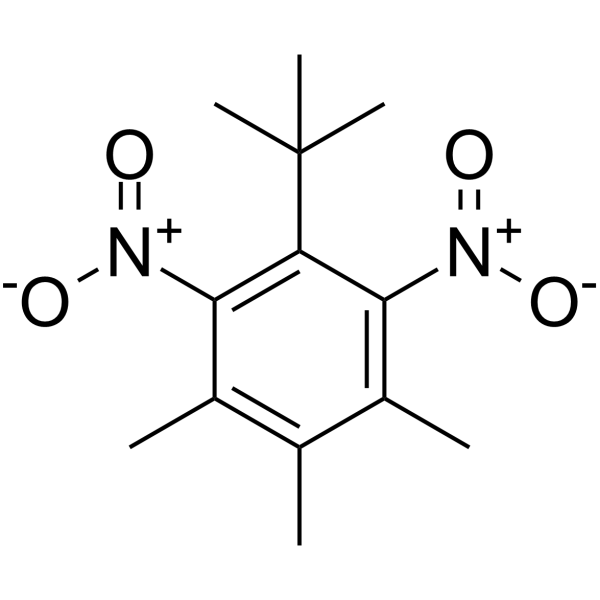
Musk tibetene (Musk tibetine) is a nitro musk compound with carcinogenic activity. Musk tibetine reveals no genotoxicity in the micronucleus test with human lymphocytes and human hepatoma cell line.
For research use only. We do not sell to patients.
- Purity : 98.0%
- CAS No.: 145-39-1
- Formula: C13H18N2O4
- Molecular Weight:266.29
-
Storage:Powder -20°C, 3 years , 4°C, 2 years ; In solvent -80°C, 6 months , -20°C, 1 month

To place orders, for customer services and technical support, please contact: MedChemExpress USA
Tel: 609-228-6898 E-mail: [email protected] [email protected]


-
 Biological Activity
-
Chemical Information
- Protocols
- Purity & Documentation
- References
-
 Help & FAQs




Biological Activity
Description
In Vitro
Musk tibetene reveals no genotoxicity in the micronucleus test with human lymphocytes and with the human hepatoma cell line Hep G2[1].
Musk tibetene reveals a cell-transforming potential that showed a dose-dependent response in our host-mediated assay system[2].
MedChemExpress (MCE) has not independently confirmed the accuracy of these methods. They are for reference only. Further protocols information, click here.


Chemical Information
-
CAS No. 145-39-1
-
Appearance Solid
-
Molecular Weight 266.29
-
Formula C13H18N2O4
-
Color White to off-white
-
SMILES
O=[N+]([O-])C1=C(C([N+]([O-])=O)=C(C(C)=C1C)C)C(C)(C)C
-
Synonyms
Musk tibetine
-
Structure Classification
-
Initial Source
milk
-
Shipping
Room temperature in continental US; may vary elsewhere.
-
Storage
Powder -20°C 3 years 4°C 2 years In solvent -80°C 6 months -20°C 1 month

Protocols
-
Liver Cancer Modeling
Liver cancer can be classified into primary liver cancer and secondary liver cancer. Secondary liver cancer is the metastatic liver cancer. Primary liver cancer includes hepatocellular carcinoma (HCC), intrahepatic cholangiocarcinoma (ICC) and fibrolamellar HCC, of which HCC is the most common form, accounting for approximately 90% of primary liver cancers[1]. HCC mouse models include chemical agent-induced models, transplanted tumor models, and genetic engineered models.
-
Genotoxicity/Mutagenicity Study
The bacterial reverse mutation assay detects point mutations that restore amino-acid prototrophy in auxotrophic Salmonella typhimurium or Escherichia coli tester strains; after exposure to a test article, mutagenic activity is read out as an increased number of revertant colonies on minimal agar compared with the vehicle control. The assay uses tester strains with different mutation targets so that base-substitution and frameshift mutagens can be detected, and testing is performed with and without exogenous mammalian metabolic activation because some chemicals require biotransformation to become mutagenic.


Purity & Documentation
-
Data Sheet (270 KB)
-
SDS (254 KB)
- English - EN (254 KB)
- Français - FR (254 KB)
- Deutsch - DE (254 KB)
- Norwegian - NO (254 KB)
- Español - ES (254 KB)
- Swedish - SV (254 KB)
- Italian - IT (254 KB)
- Korean - KR (254 KB)
- Portuguese - PT (254 KB)
-
Handling Instructions (2659 KB)
References
[1]. Kevekordes S, et al. Genotoxicity of nitro musks in the micronucleus test with human lymphocytes in vitro and the human hepatoma cell line Hep G2. Toxicol Lett. 1997 Mar 14;91(1):13-7. [Content Brief]
[2]. Apostolidis S, et al. Evaluation of carcinogenic potential of two nitro-musk derivatives, musk xylene and musk tibetene in a host-mediated in vivo/in vitro assay system. Anticancer Res. 2002 Sep-Oct;22(5):2657-62. [Content Brief]

Calculators
Concentration (start) × Volume (start) = Concentration (final) × Volume (final)


Musk tibetene Related Classifications
HY-116108 Related Classifications
 Powered by Bioz