



N-Acetylprocainamide hydrochloride (Standard)
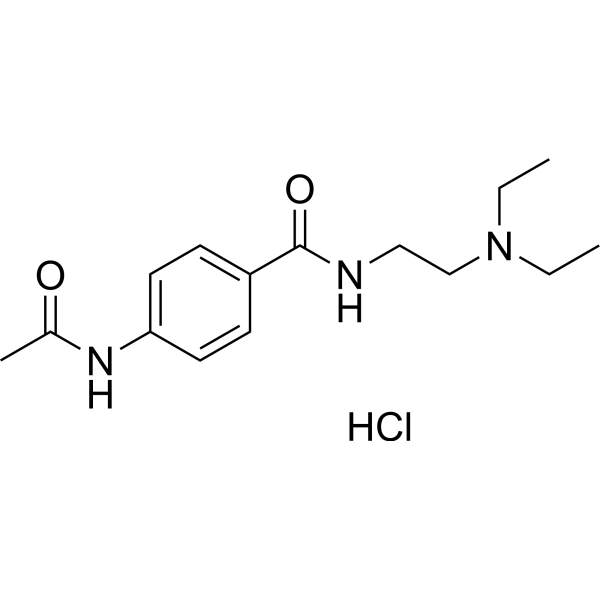
N-Acetylprocainamide (Acecainide) hydrochloride (Standard) is the analytical standard of N-Acetylprocainamide hydrochloride (HY-101433). This product is intended for research and analytical applications. N-Acetylprocainamide hydrochloride is a class III antiarrhythmic, which blocks K+ channels. N-Acetylprocainamide hydrochloride exerts inhibitory effects on the maximum following frequency (MFF) of isolated rabbit atria. N-Acetylprocainamide hydrochloride can be used for the study of arrhythmias.
For research use only. We do not sell to patients.
- CAS No.: 34118-92-8
- Formula: C15H24ClN3O2
- Molecular Weight:313.82
-
Storage:
Please store the product under the recommended conditions in the Certificate of Analysis.


To place orders, for customer services and technical support, please contact: MedChemExpress USA
Tel: 609-228-6898 E-mail: [email protected] [email protected]


-
 Product Information
-
Chemical Information
- Purity & Documentation
-
 Help & FAQs


-
HY-101433
N-Acetylprocainamide hydrochlorideK+ Channel Inhibitor -

HY-114914
3-HydroxylidocaineDrug Metabolic -
HY-137397
8-HydroxyefavirenzApoptosis Inducer -
HY-131637
Desacetyl bisacodylActive Metabolite -

HY-16738
EleclazineSodium Current Inhibitor -
HY-101245
Pilsicainide hydrochlorideSodium Channel Blocker -

HY-Z18056
Norpropranolol hydrochloridePropranolol Active Metabolite -

HY-131637R
Desacetyl bisacodyl (Standard)Active Metabolite -

HY-137110
Axitinib sulfoxideBiochemical Reagent -

HY-134290A
8-Chloro-ATP tetrasodiumTopoisomerase II Inhibitor -

HY-124091
Methyl 2-hydroxytricosanoateEster Product


Product Information
Information
Application
The compound is the grade of analytical standard, which is the reference standard supplied assay. It is commonly used in qualitative, quantitative and methodological research experiments in HPLC, GC and MS.


Chemical Information
-
CAS No. 34118-92-8
-
Molecular Weight 313.82
-
Formula C15H24ClN3O2
-
SMILES
O=C(NCCN(CC)CC)C1=CC=C(NC(C)=O)C=C1.Cl
-
Synonyms
Acecainide hydrochloride (Standard); NAPA hydrochloride (Standard)
-
Shipping
Room temperature in continental US; may vary elsewhere.
-
Storage
Please store the product under the recommended conditions in the Certificate of Analysis.


Purity & Documentation
References
[1]. Minchin RF, et al. Antiarrhythmic potency of procainamide and N-acetylprocainamide in rabbits. Eur J Pharmacol. 1978 Jan 1;47(1):51-6. [Content Brief]
[2]. Nakahara T, et al. Role of K+ channels in N-acetylprocainamide-induced relaxation of bovine tracheal smooth muscle. Eur J Pharmacol. 2001 Mar 9;415(1):73-8. [Content Brief]
[3]. Okumura K, et al. Effects of N-acetylprocainamide on experimental atrial flutter and atrial electrophysiologic properties in conscious dogs with sterile pericarditis: comparison with the effects of quinidine. J Am Coll Cardiol. 1987 Jun;9(6):1332-8. [Content Brief]

Calculators
Concentration (start) × Volume (start) = Concentration (final) × Volume (final)


N-Acetylprocainamide hydrochloride (Standard) Related Classifications
HY-101433R Related Classifications
 Powered by Bioz