



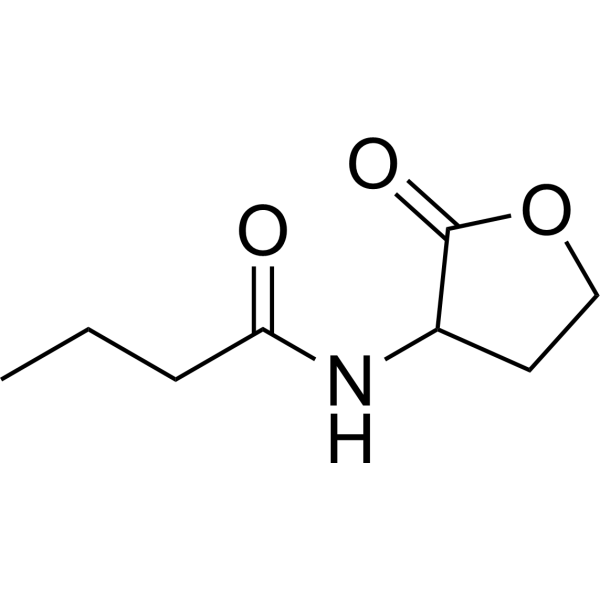
N-Butanoyl-DL-homoserine lactone

Based on 1 Customer Validation
N-Butanoyl-DL-homoserine lactone ((Rac)-C4-HSL) is a racemic mixture of N-Butanoyl-D-homoserine lactone and N-Butanoyl-L-homoserine lactone. N-Butanoyl-L-homoserine lactone is a cleavable ADC linker used in the synthesis of antibody-drug conjugates (ADCs). N-Butanoyl-L-homoserine lactone has antibacterial activity and is used in antibacterial biofilm. N-Butanoyl-L-homoserine lactone aptamers blocks qurom sensing and inhibits biofilm formation in Pseudomonas aeruginosa.
For research use only. We do not sell to patients.
- Purity : 98.0%
- CAS No.: 98426-48-3
- Formula: C8H13NO3
- Molecular Weight:171.20
-
Storage:Powder -20°C, 3 years , 4°C, 2 years ; In solvent -80°C, 6 months , -20°C, 1 month

To place orders, for customer services and technical support, please contact: MedChemExpress USA
Tel: 609-228-6898 E-mail: [email protected] [email protected]


-
 Biological Activity
-
Chemical Information
-
Solvent & Solubility
- Protocols
- Purity & Documentation
- References
-
 Help & FAQs




Biological Activity
Description
In Vitro
A racemic mixture is a mixture composed of equal amounts of a pair of enantiomers, resulting in a mixture that exhibits no overall optical activity.
MedChemExpress (MCE) has not independently confirmed the accuracy of these methods. They are for reference only. Further protocols information, click here.


Chemical Information
-
CAS No. 98426-48-3
-
Appearance Solid
-
Molecular Weight 171.20
-
Formula C8H13NO3
-
Color White to off-white
-
SMILES
CCCC(NC1C(OCC1)=O)=O
-
Synonyms
(Rac)-C4-HSL
-
Shipping
Room temperature in continental US; may vary elsewhere.
-
Storage
Powder -20°C 3 years 4°C 2 years In solvent -80°C 6 months -20°C 1 month


Solvent & Solubility
In Vitro:
DMSO : 100 mg/mL (584.11 mM; Need ultrasonic; Hygroscopic DMSO has a significant impact on the solubility of product, please use newly opened DMSO)
Please refer to the solubility information to select the appropriate solvent. Once prepared, please aliquot and store the solution to prevent product inactivation from repeated freeze-thaw cycles.
Storage method and period of stock solution: -80°C, 6 months; -20°C, 1 month. When stored at -80°C, please use it within 6 months. When stored at -20°C, please use it within 1 month.
Please refer to the solubility information to select the appropriate solvent. Once prepared, please aliquot and store the solution to prevent product inactivation from repeated freeze-thaw cycles.
Storage method and period of stock solution: -80°C, 6 months; -20°C, 1 month. When stored at -80°C, please use it within 6 months. When stored at -20°C, please use it within 1 month.
Concentration (start) × Volume (start) = Concentration (final) × Volume (final)

Protocols
-
Research Protocol for Infectious Diseases
Infectious-disease experiments test how pathogens interact with host barriers, innate immune receptors, inflammatory signaling, pathogen replication, and tissue injury; pattern-recognition receptors such as TLRs, RIG-I-like receptors, NOD-like receptors, and inflammasomes detect microbial molecules and activate NF-κB, interferon, and cytokine responses. The central hypothesis is that infection severity reflects the balance between pathogen burden and host response: protective inflammation restricts pathogen growth, whereas excessive or mislocalized inflammation contributes to tissue damage and disease phenotype. Unresolved questions include which host pathways are protective versus pathogenic, why some infection models fail to translate to human disease, and which combined readouts best predict clinically relevant infection outcomes.
-
Bacterial live/dead nucleic-acid viability staining
The LIVE/DEAD bacterial viability staining method is based on differential permeability of nucleic-acid-binding fluorescent dyes, most commonly SYTO 9 and propidium iodide (PI), which enables discrimination of bacterial populations with intact versus compromised cytoplasmic membranes. SYTO 9 penetrates both intact and damaged bacterial membranes and binds nucleic acids to produce green fluorescence, whereas propidium iodide penetrates only cells with compromised membranes and fluoresces red while also reducing SYTO 9 signal through competitive binding and fluorescence interactions. The resulting fluorescence pattern is interpreted as a proxy for membrane integrity, which is widely used as an indicator of bacterial viability in microscopy, flow cytometry, and spectroscopic platforms. However, mechanistic studies show that SYTO 9 and PI interactions involve displacement and fluorescence resonance energy transfer effects, which can influence signal interpretation depending on dye ratios a
-
Fungal Biofilm Culture
Fungal biofilm culture is an in vitro method for growing surface-attached fungal communities, most commonly Candida albicans, on abiotic substrates such as polystyrene wells, silicone elastomer, or polymethylmethacrylate; the assay models adhesion, proliferation, filamentation, extracellular-matrix-associated maturation, and dispersion. Biofilm output can be read by optical density at 600 nm for adherent biomass, XTT reduction for metabolic activity, CFU recovery for viable attached or dispersed cells, and microscopy for architecture.


Purity & Documentation
-
Data Sheet (281 KB)
-
SDS (393 KB)
- English - EN (393 KB)
- Français - FR (393 KB)
- Deutsch - DE (393 KB)
- Norwegian - NO (393 KB)
- Español - ES (393 KB)
- Swedish - SV (393 KB)
- Italian - IT (393 KB)
- Korean - KR (393 KB)
- Portuguese - PT (393 KB)
-
Handling Instructions (2659 KB)
References


Complete Stock Solution Preparation Table
Please refer to the solubility information to select the appropriate solvent. Once prepared, please aliquot and store the solution to prevent product inactivation from repeated freeze-thaw cycles.
Storage method and period of stock solution: -80°C, 6 months; -20°C, 1 month. When stored at -80°C, please use it within 6 months. When stored at -20°C, please use it within 1 month.
| Optional Solvent | Concentration Solvent Mass | 1 mg | 5 mg | 10 mg | 25 mg |
|---|---|---|---|---|---|
| DMSO | 1 mM | 5.8411 mL | 29.2056 mL | 58.4112 mL | 146.0280 mL |
| 5 mM | 1.1682 mL | 5.8411 mL | 11.6822 mL | 29.2056 mL | |
| 10 mM | 0.5841 mL | 2.9206 mL | 5.8411 mL | 14.6028 mL | |
| 15 mM | 0.3894 mL | 1.9470 mL | 3.8941 mL | 9.7352 mL | |
| 20 mM | 0.2921 mL | 1.4603 mL | 2.9206 mL | 7.3014 mL | |
| 25 mM | 0.2336 mL | 1.1682 mL | 2.3364 mL | 5.8411 mL | |
| 30 mM | 0.1947 mL | 0.9735 mL | 1.9470 mL | 4.8676 mL | |
| 40 mM | 0.1460 mL | 0.7301 mL | 1.4603 mL | 3.6507 mL | |
| 50 mM | 0.1168 mL | 0.5841 mL | 1.1682 mL | 2.9206 mL | |
| 60 mM | 0.0974 mL | 0.4868 mL | 0.9735 mL | 2.4338 mL | |
| 80 mM | 0.0730 mL | 0.3651 mL | 0.7301 mL | 1.8254 mL | |
| 100 mM | 0.0584 mL | 0.2921 mL | 0.5841 mL | 1.4603 mL |


N-Butanoyl-DL-homoserine lactone Related Classifications
HY-113764 Related Classifications
 Powered by Bioz