



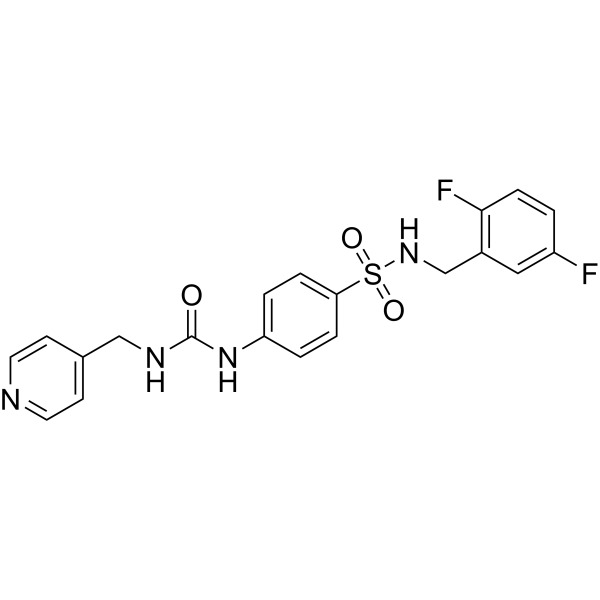
Nampt activator-5
Nampt activator-5 is a NAMPT activator with a KD value of 6.19 μM. Nampt activator-5 activates the rate-limiting enzyme in NAD+ biosynthesis and promotes NAD+ production. Nampt activator-5 delays the senescence process of senescent hepatocytes, extends the lifespan of *Caenorhabditis elegans*, and alleviates age-related dysfunction and abnormal biomarkers in naturally aged mice. Nampt activator-5 can be used in aging research.
Nos produits utilisent uniquement pour la recherche. Nous ne vendons pas aux patients.
- CAS No.: 3041005-21-1
- Formule: C20H18F2N4O3S
- Masse moléculaire:432.44
-
Stockage:
Please store the product under the recommended conditions in the Certificate of Analysis.

To place orders, for customer services and technical support, please contact: MedChemExpress USA
Tel: 609-228-6898 E-mail: [email protected] [email protected]


-
 Activité biologique
-
Chemical Information
- Protocole
- Pureté et documentation
- Références
-
 Help & FAQs




Activité biologique
Description
Cellular Effect
|
Cell Line

|
Type | Value | Description | References |
|---|---|---|---|---|
| HUVEC | IC50 |
282.7 μM
Compound: C8
|
Cytotoxicity against HUVEC cells assessed as reduction in cell viability incubated for 72 hrs by CCK-8 assay
Cytotoxicity against HUVEC cells assessed as reduction in cell viability incubated for 72 hrs by CCK-8 assay
|
[PMID: 38367219] |
In Vitro
Nampt activator-5 (Compound C8) (0-12 μM) increases intracellular NAD+ levels in A549 cells to 184% at 10 μM, with levels rising in a concentration-dependent manner[1].
Nampt activator-5 increases intracellular NAD+ levels in HEK-293T cells in a concentration-dependent manner[1].
Nampt activator-5 (72 h) exhibits minimal cytotoxicity in HUVEC cells with an IC50 of 282.7 μM after 72 h, and antagonizes FK866-induced cytotoxicity[1].
Nampt activator-5 (20 μM; 24 h) effectively improves lysosomal senescence in Doxorubicin (HY-15142A)-induced senescent HL-7702 cells, normalizing the red/green fluorescence ratio to match young HL-7702 cells[1].
MedChemExpress (MCE) has not independently confirmed the accuracy of these methods. They are for reference only.
In Vivo
Nampt activator-5 (20 mg/kg; i.p.; every 2 days; 2 months) improves age-related physical dysfunctions, reduces senescence biomarkers, and increases brain NAD+ levels in naturally aged female C57BL/6J mice[1].
MedChemExpress (MCE) has not independently confirmed the accuracy of these methods. They are for reference only.
-
Animal Model:wild-type N2[1]
-
Dosage:100 μM
-
Administration:incorporation into NGM growth medium; continuous exposure
-
Result:Extended the mean lifespan of C.
elegans by 8.37% compared to the control group, with a statistically significant difference.
-
Animal Model:C57BL/6J (female, 20-month-old, naturally aged)[1]
-
Dosage:20 mg/kg
-
Administration:i.p.; every 2 days; 2 months
-
Result:Improved muscle strength (grip strength/body weight ratio), hanging endurance (suspension duration × body weight), rotarod performance (running time, distance, maximum speed) compared to aged control mice, with results approaching those of young control mice.
Significantly reduced serum levels of CXCL1, IL-1β, MMP-1, p21, and p53 compared to aged control mice.
Reduced protein levels of p21, p53, and γ-H2AX in kidney tissue compared to aged control mice.
Significantly elevated NAD+ levels in the brain compared to aged control mice.


Chemical Information
-
CAS No. 3041005-21-1
-
Masse moléculaire 432.44
-
Formule C20H18F2N4O3S
-
SMILES
O=C(NCC1=CC=NC=C1)NC2=CC=C(S(NCC3=C(C=CC(F)=C3)F)(=O)=O)C=C2
-
Livraison
Room temperature in continental US; may vary elsewhere.
-
Stockage
Please store the product under the recommended conditions in the Certificate of Analysis.


Pureté et documentation
Références

Calculators
Concentration (start) × Volume (start) = Concentration (final) × Volume (final)


Nampt activator-5 Related Classifications
HY-162269 Related Classifications
 Powered by Bioz