



Nampt-IN-7
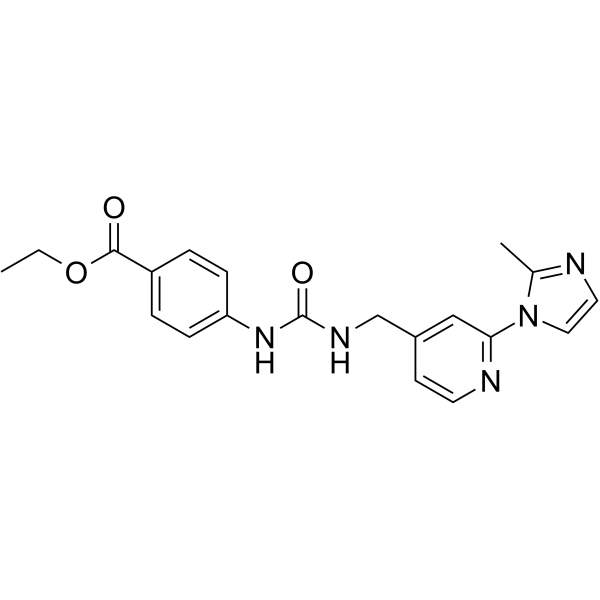
Nampt-IN-7 (compound GF8) is a potent NAMPT inhibitor, with an IC50 of 7.31 μM. Nampt-IN-7 also displays cytotoxic activity against human HepG2 hepatocellular carcinoma cell line with an IC50 of 24.28 μM.
Nur für Forschungszwecke. Wir verkaufen nicht an Patienten.
- CAS. Nr.: 1223378-42-4
- Formel: C20H21N5O3
- Molecular Weight:379.41
-
Speicherung:
Please store the product under the recommended conditions in the Certificate of Analysis.

To place orders, for customer services and technical support, please contact: MedChemExpress USA
Tel: 609-228-6898 E-mail: [email protected] [email protected]


-
 Biologische Aktivität
-
Chemical Information
- Protokoll
- Reinheit & Dokumentation
- Verweise
-
 Help & FAQs




Biologische Aktivität
Beschreibung
IC50 & Target
IC50: 7.31 ± 1.59 μM (NAMPT)[1]
Cellular Effect
|
Cell Line

|
Type | Value | Description | References |
|---|---|---|---|---|
| HepG2 | IC50 |
24.28 μM
Compound: GF8
|
Cytotoxicity against human HepG2 cells assessed as reduction in cell viability measured after 72 hrs by SRB assay
Cytotoxicity against human HepG2 cells assessed as reduction in cell viability measured after 72 hrs by SRB assay
|
[PMID: 31818629] |


Chemical Information
-
CAS. Nr. 1223378-42-4
-
Molecular Weight 379.41
-
Formel C20H21N5O3
-
SMILES
CCOC(C1=CC=C(C=C1)NC(NCC2=CC(N3C=CN=C3C)=NC=C2)=O)=O
-
Versand
Room temperature in continental US; may vary elsewhere.
-
Speicherung
Please store the product under the recommended conditions in the Certificate of Analysis.


Reinheit & Dokumentation
Verweise

Calculators
Konzentration (Stammlösung) × Volumen (Stammlösung) = Konzentration (Ziellösung) × Volumen (Ziellösung)


Nampt-IN-7 Related Classifications
HY-147756 Related Classifications
 Powered by Bioz