



Oxidized ATP trisodium salt

Based on 1 Customer Validation
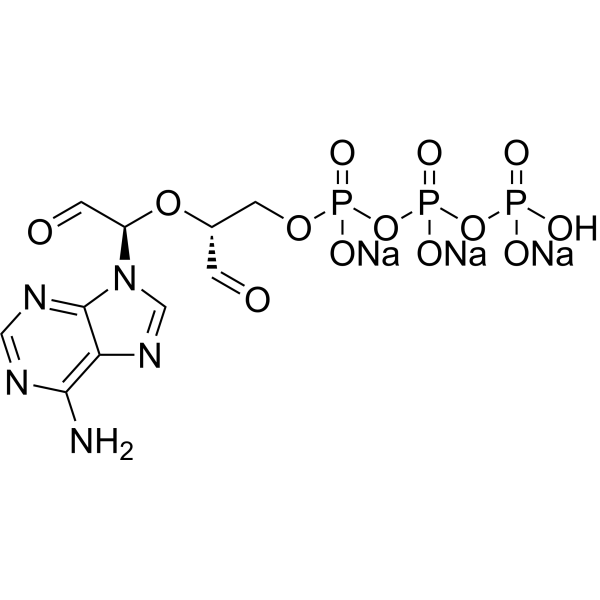
Oxidized ATP (oATP) trisodium salt is a broad-spectrum P2 receptor inhibitor. Oxidized ATP trisodium salt irreversibly antagonizes P2X7R activation. Oxidized ATP trisodium salt inhibits c-reactive protein (CRP)-induced NLRP3 inflammasome activation. Oxidized ATP trisodium salt can be used for research of atherosclerosis.
For research use only. We do not sell to patients.
- Purity : 98%
- CAS No.: 71997-40-5
- Formula: C10H11N5Na3O13P3
- Molecular Weight:571.11
-
Storage:
-20°C, sealed storage, away from moisture
* In solvent : -80°C, 6 months; -20°C, 1 month (sealed storage, away from moisture)

To place orders, for customer services and technical support, please contact: MedChemExpress USA
Tel: 609-228-6898 E-mail: [email protected] [email protected]


-
 Biological Activity
-
Chemical Information
-
Solvent & Solubility
- Protocols
- Purity & Documentation
- References
-
 Help & FAQs


-
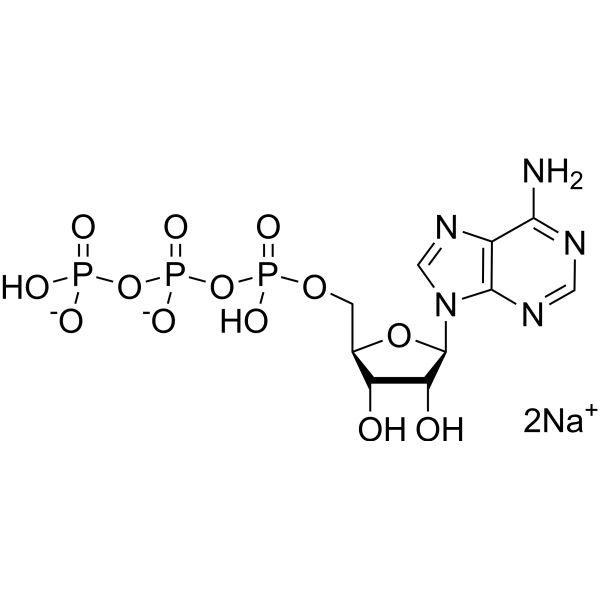
HY-B0345A
ATP disodium saltEndogenous Metabolite -

HY-B2176I
ATP disodium salt, 100 mM Solution, PCR GradeEndogenous Metabolite -

HY-B0345AR
ATP disodium (Standard)Endogenous Metabolite -
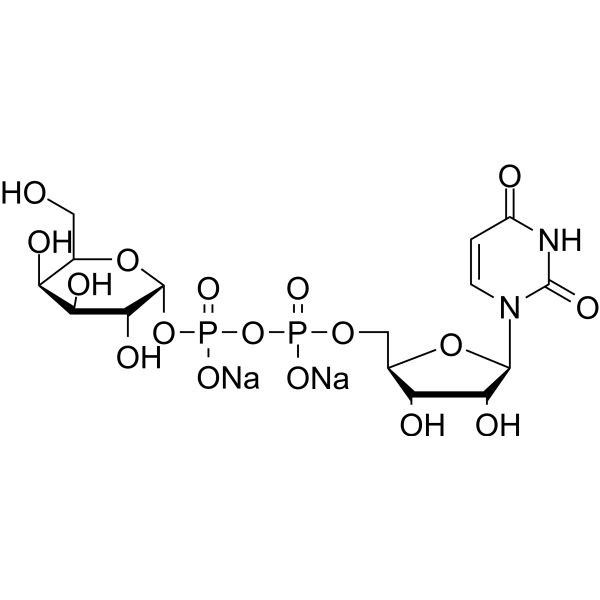
HY-114364
UDP-Galactose disodiumP2Y14 Receptor Agonist -
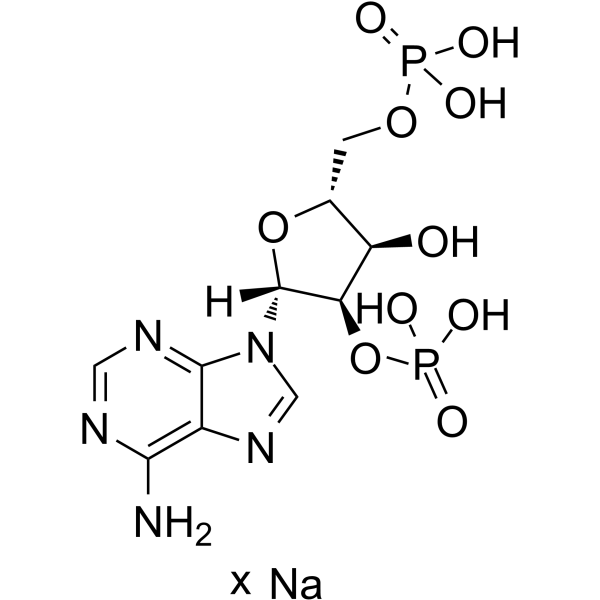
HY-N7740
Adenosine 2',5'-diphosphate sodiumP2Y1 Antagonist
All P2X Receptor Isoforms
More

Biological Activity
Description
|
NLRP3 inflammasome |
P2X7 Receptor |
In Vitro
In Vivo
MedChemExpress (MCE) has not independently confirmed the accuracy of these methods. They are for reference only.
-
Animal Model:Induced mouse experimental autoimmune uveitis (EAU)[2]
-
Dosage:300 μg/mouse
-
Administration:i.p.
-
Result:Showed almost undetected EAU, as shown by fundoscopic and pathologic examination.
Decreased serum IL-17 level.
Mitigated the autoreactive T cell response.


Chemical Information
-
CAS No. 71997-40-5
-
Appearance Solid
-
Molecular Weight 571.11
-
Formula C10H11N5Na3O13P3
-
Color White to off-white
-
SMILES
O=P(O)(O[Na])OP(OP(OC[C@H](C=O)O[C@@H](N1C2=NC=NC(N)=C2N=C1)C=O)(O[Na])=O)(O[Na])=O
-
Synonyms
oATP trisodium salt
-
Shipping
Room temperature in continental US; may vary elsewhere.
-
Storage
-20°C, sealed storage, away from moisture
* In solvent : -80°C, 6 months; -20°C, 1 month (sealed storage, away from moisture)


Solvent & Solubility
In Vitro:
H2O : 50 mg/mL (87.55 mM; Need ultrasonic and warming)
Please refer to the solubility information to select the appropriate solvent. Once prepared, please aliquot and store the solution to prevent product inactivation from repeated freeze-thaw cycles.
Storage method and period of stock solution: -80°C, 6 months; -20°C, 1 month (sealed storage, away from moisture). When stored at -80°C, please use it within 6 months. When stored at -20°C, please use it within 1 month.
* Note: If you choose water as the stock solution, please dilute it to the working solution, then filter and sterilize it with a 0.22 μm filter before use.
Please refer to the solubility information to select the appropriate solvent. Once prepared, please aliquot and store the solution to prevent product inactivation from repeated freeze-thaw cycles.
Storage method and period of stock solution: -80°C, 6 months; -20°C, 1 month (sealed storage, away from moisture). When stored at -80°C, please use it within 6 months. When stored at -20°C, please use it within 1 month.
* Note: If you choose water as the stock solution, please dilute it to the working solution, then filter and sterilize it with a 0.22 μm filter before use.
Concentration (start) × Volume (start) = Concentration (final) × Volume (final)

Protocols
-
Research Protocol for Cardiovascular Diseases
Cardiovascular disease can be modeled as maladaptive cardiac remodeling, where ischemic injury or pressure overload activates inflammatory signaling, fibroblast activation, extracellular-matrix deposition, cardiomyocyte hypertrophy, vascular remodeling, and progressive ventricular dysfunction. The TGF-β/SMAD axis is a central profibrotic pathway after myocardial injury and pressure overload, while innate immune and cytokine pathways regulate leukocyte recruitment, scar formation, and adverse remodeling. Key unresolved questions include which inflammatory signals are reparative versus harmful, when fibrosis is protective versus maladaptive, and whether pathway inhibition improves function without weakening necessary infarct healing or compensatory remodeling.
-
Pyroptosis Solutions
Pyroptosis is a lytic inflammatory cell-death pathway executed by gasdermin pores, most classically through inflammasome-mediated activation of caspase-1, cleavage of gasdermin D, membrane pore formation, LDH release, and secretion of IL-1β and IL-18. The canonical pathway is commonly modeled by priming cells with an inflammatory signal such as LPS to induce pro-IL-1β and inflammasome components, followed by an activation signal such as ATP or nigericin to activate NLRP3, ASC speck formation, caspase-1 cleavage, GSDMD cleavage, cytokine release, and pyroptotic membrane rupture. The non-canonical pathway is triggered when cytosolic LPS activates mouse caspase-11 or human caspase-4/5, leading to GSDMD cleavage and pyroptosis, and this can secondarily activate NLRP3-dependent IL-1β release. Pyroptosis is linked to inflammatory injury, infection, cancer, liver disease, ocular disease, placental inflammation, and other disease phenotypes, but unresolved questions include which gasdermin fam


Purity & Documentation
-
Data Sheet (277 KB)
-
SDS (252 KB)
- English - EN (252 KB)
- Français - FR (252 KB)
- Deutsch - DE (252 KB)
- Norwegian - NO (252 KB)
- Español - ES (252 KB)
- Swedish - SV (252 KB)
- Italian - IT (252 KB)
- Korean - KR (252 KB)
- Portuguese - PT (252 KB)
-
Handling Instructions (2659 KB)
References
[1]. Bian F, et al. CRP-Induced NLRP3 Inflammasome Activation Increases LDL Transcytosis Across Endothelial Cells. Front Pharmacol. 2019 Jan 30;10:40. [Content Brief]
[2]. Zhao R, et al. Blockade of Extracellular ATP Effect by Oxidized ATP Effectively Mitigated Induced Mouse Experimental Autoimmune Uveitis (EAU). PLoS One. 2016 May 19;11(5):e0155953. [Content Brief]


Complete Stock Solution Preparation Table
Please refer to the solubility information to select the appropriate solvent. Once prepared, please aliquot and store the solution to prevent product inactivation from repeated freeze-thaw cycles.
Storage method and period of stock solution: -80°C, 6 months; -20°C, 1 month (sealed storage, away from moisture). When stored at -80°C, please use it within 6 months. When stored at -20°C, please use it within 1 month.
| Optional Solvent | Concentration Solvent Mass | 1 mg | 5 mg | 10 mg | 25 mg |
|---|---|---|---|---|---|
| H2O | 1 mM | 1.7510 mL | 8.7549 mL | 17.5098 mL | 43.7744 mL |
| 5 mM | 0.3502 mL | 1.7510 mL | 3.5020 mL | 8.7549 mL | |
| 10 mM | 0.1751 mL | 0.8755 mL | 1.7510 mL | 4.3774 mL | |
| 15 mM | 0.1167 mL | 0.5837 mL | 1.1673 mL | 2.9183 mL | |
| 20 mM | 0.0875 mL | 0.4377 mL | 0.8755 mL | 2.1887 mL | |
| 25 mM | 0.0700 mL | 0.3502 mL | 0.7004 mL | 1.7510 mL | |
| 30 mM | 0.0584 mL | 0.2918 mL | 0.5837 mL | 1.4591 mL | |
| 40 mM | 0.0438 mL | 0.2189 mL | 0.4377 mL | 1.0944 mL | |
| 50 mM | 0.0350 mL | 0.1751 mL | 0.3502 mL | 0.8755 mL | |
| 60 mM | 0.0292 mL | 0.1459 mL | 0.2918 mL | 0.7296 mL | |
| 80 mM | 0.0219 mL | 0.1094 mL | 0.2189 mL | 0.5472 mL |
* Note: If you choose water as the stock solution, please dilute it to the working solution, then filter and sterilize it with a 0.22 μm filter before use.


Oxidized ATP trisodium salt Related Classifications
HY-137888A Related Classifications
 Powered by Bioz