



PEG10000-bis-amine
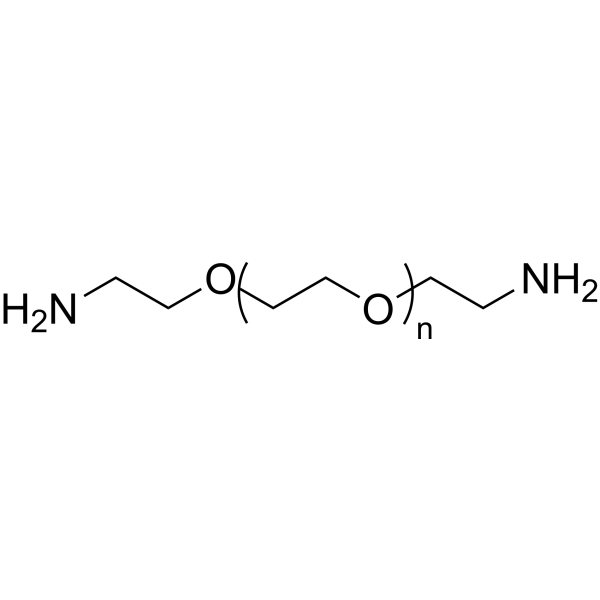
PEG10000-bis-amine is a bisamine-terminated polyethylene glycol that serves as a key starting material for the preparation of cholesterol-conjugated polyethylene glycol derivatives. After radioiodination modification, PEG10000-bis-amine significantly prolongs plasma retention time and exhibits enhanced tumor accumulation in a subcutaneous melanoma mouse model. PEG10000-bis-amine has important application value in studies of tumor-targeted delivery and drug modification.
For research use only. We do not sell to patients.
- CAS No.: 24991-53-5
- Molecular Weight:10000 (Average)
-
Storage:
Please store the product under the recommended conditions in the Certificate of Analysis.


To place orders, for customer services and technical support, please contact: MedChemExpress USA
Tel: 609-228-6898 E-mail: [email protected] [email protected]


-
 Biological Activity
-
Chemical Information
- Protocols
- Purity & Documentation
- References
-
 Help & FAQs


-
HY-W591632
PEG1000-bis-aminePEG Derivative -
HY-W115607
PEG4000-bis-amineLinker -
HY-140646
PEG2000-bis-aminePEG Derivative -
HY-140649
PEG20000-bis-aminePEG Derivative -
HY-Y0873
PEG300Neutral Polymer -
HY-Y0873A
PEG400 -
HY-Y0873J
PEG8000Biochemical reagent -
HY-Y0873C
PEG3350Neutral Polymer -
HY-140647
PEG3400-bis-aminePEG Derivative -

HY-172351
PEG400-bis-aminePEG Derivative -

HY-172351A
PEG6000-bis-amineConjugate Linker -
HY-Y0873I
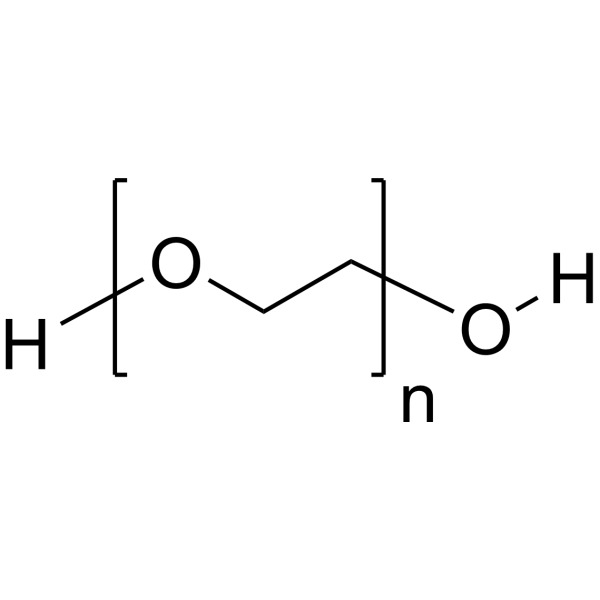
PEG6000Pharmaceutical Excipient


Biological Activity
Description
In Vivo
MedChemExpress (MCE) has not independently confirmed the accuracy of these methods. They are for reference only.
-
Animal Model:C57 black (male)[1]
-
Dosage:1.4 mg/kg
-
Administration:i.v.; single dose
-
Result:Showed 2.7% dose/mL in blood, 1.19% dose/g in tumor, 4.34% dose/g in liver, 0.58% dose/g in heart, 0.47% dose/g in spleen, 0.90% dose/g in lungs, and 1.57% dose/g in kidneys at 1 hour post-administration.
Showed 1.22% dose/mL in blood, 1.06% dose/g in tumor, 3.89% dose/g in liver, 0.18% dose/g in heart, 0.26% dose/g in spleen, 0.39% dose/g in lungs, and 0.74% dose/g in kidneys at 5 hours post-administration.
Showed 0.57% dose/mL in blood, 0.26% dose/g in tumor, 1.79% dose/g in liver, 0.08% dose/g in heart, 0.16% dose/g in spleen, 0.19% dose/g in lungs, and 0.20% dose/g in kidneys at 24 hours post-administration.


Chemical Information
-
CAS No. 24991-53-5
-
Molecular Weight 10000 (Average)
-
SMILES
NCCOCCOCCN.[n]
-
Shipping
Room temperature in continental US; may vary elsewhere.
-
Storage
Please store the product under the recommended conditions in the Certificate of Analysis.

Protocols
-
How to Select the Route of Administration for Mammals
Route-of-administration selection in mammals is a pharmacokinetic, pharmacodynamic, formulation, animal-welfare, and translational decision, not a default technical choice. The selected route should match the study goal: intravenous dosing is most useful when complete systemic exposure and rapid onset are required, oral dosing is most translational for orally intended medicines but is affected by absorption and first-pass metabolism, subcutaneous or intramuscular dosing can provide slower systemic exposure, and intraperitoneal dosing can be useful in rodent proof-of-concept studies but may have limited clinical translation. Published route-comparison studies show that the same compound can produce different exposure, onset, bioavailability, tissue distribution, and tolerability depending on route; therefore, route choice should be supported by pilot pharmacokinetic or pharmacodynamic evidence when the literature is insufficient. Unresolved questions include how to standardize route sel
-
How to Choose the Right Model Animal
Choosing the right model animal is a validity-driven decision in which the species, strain, sex, age, genetic background, disease-induction method, outcome measures, and welfare burden must match the scientific question rather than laboratory tradition or convenience. A model should be selected by judging face validity, construct validity, and predictive validity: whether it resembles the human phenotype, whether it reproduces relevant mechanisms, and whether results are likely to predict human biology or treatment response. Animal studies often fail to translate because of species differences, weak disease resemblance, poor experimental design, inadequate reporting, publication bias, and underuse of randomization, blinding, and sample-size justification. Unresolved questions include how to rank competing models objectively, how much human-disease complexity must be reproduced for a given objective, and when non-animal systems such as organoids, ex vivo tissue, or computational models


Purity & Documentation
References

Calculators
Concentration (start) × Volume (start) = Concentration (final) × Volume (final)


PEG10000-bis-amine Related Classifications
HY-172351B Related Classifications
 Powered by Bioz