



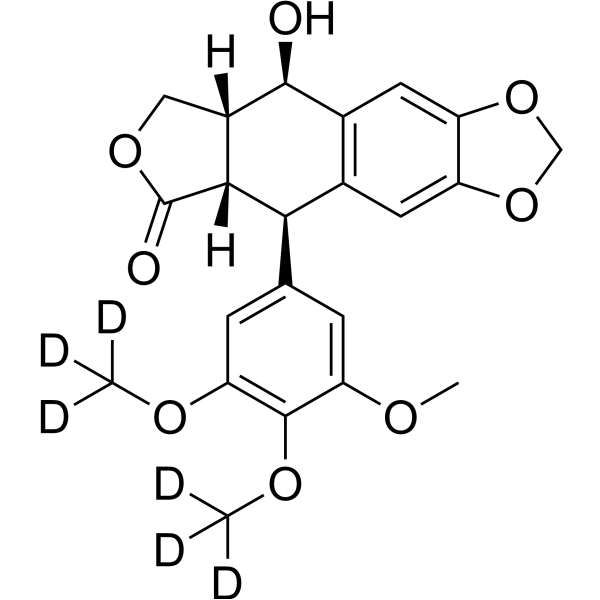
Picropodophyllin-d6
Picropodophyllin-d6 (AXL1717-d6) is deuterium labeled Picropodophyllin. Picropodophyllin (AXL1717) is a selective insulin-like growth factor-1 receptor (IGF-1R) inhibitor with an IC50 of 1 nM.
For research use only. We do not sell to patients.
- Formula: C22H16D6O8
- Molecular Weight:420.44
-
Storage:
Please store the product under the recommended conditions in the Certificate of Analysis.

To place orders, for customer services and technical support, please contact: MedChemExpress USA
Tel: 609-228-6898 E-mail: [email protected] [email protected]


-
 Biological Activity
-
Chemical Information
- Protocols
- Purity & Documentation
- References
-
 Help & FAQs




Biological Activity
Description
In Vitro
Stable heavy isotopes of hydrogen, carbon, and other elements have been incorporated into drug molecules, largely as tracers for quantitation during the drug development process. Deuteration has gained attention because of its potential to affect the pharmacokinetic and metabolic profiles of drugs[1].
MedChemExpress (MCE) has not independently confirmed the accuracy of these methods. They are for reference only.
Application
1. This compound can be used as a tracer
2. This compound can be used as an internal standard for quantitative analysis by NMR, GC-MS, or LC-MS.


Chemical Information
-
Unlabeled CAS 477-47-4
-
Molecular Weight 420.44
-
Formula C22H16D6O8
-
SMILES
O=C1OC[C@]2([H])[C@@H](O)C3=C(C=C4OCOC4=C3)[C@@H](C5=CC(OC([2H])([2H])[2H])=C(OC([2H])([2H])[2H])C(OC)=C5)[C@@]21[H]
-
Synonyms
AXL1717-d6; Picropodophyllotoxin-d6; PPP-d6
-
Shipping
Room temperature in continental US; may vary elsewhere.
-
Storage
Please store the product under the recommended conditions in the Certificate of Analysis.


Purity & Documentation
References
[1]. Russak EM, et al. Impact of Deuterium Substitution on the Pharmacokinetics of Pharmaceuticals. Ann Pharmacother. 2019;53(2):211-216. [Content Brief]
[2]. Girnita A, et al. Cyclolignans as inhibitors of the insulin-like growth factor-1 receptor and malignant cell growth. Cancer Res. 2004 Jan 1;64(1):236-42. [Content Brief]
[3]. Menu E, et al. Inhibiting the IGF-1 receptor tyrosine kinase with the cyclolignan PPP: an in vitro and in vivo study in the 5T33MM mouse model. Blood. 2006 Jan 15;107(2):655-60. Epub 2005 Jul 26. [Content Brief]
[4]. Bieghs L, et al. The IGF-1 receptor inhibitor picropodophyllin potentiates the anti-myeloma activity of a BH3-mimetic. Oncotarget. 2014 Nov 30;5(22):11193-208. [Content Brief]
[5]. Tomizawa M, et al. Picropodophyllin and sorafenib synergistically suppress the proliferation and motility of hepatocellular carcinoma cells. Oncol Lett. 2014 Nov;8(5):2023-2026. Epub 2014 Aug 27. [Content Brief]
[6]. Stromberg T, et al. IGF-1 receptor tyrosine kinase inhibition by the cyclolignan PPP induces G2/M-phase accumulation and apoptosis in multiple myeloma cells. Blood. 2006 Jan 15;107(2):669-78. Epub 2005 Sep 15. [Content Brief]
[7]. Kong YL, et al. Insulin deficiency induces rat renal mesangial cell dysfunction via activation of IGF-1/IGF-1R pathway. Acta Pharmacol Sin. 2016 Feb;37(2):217-27. [Content Brief]

Calculators
Concentration (start) × Volume (start) = Concentration (final) × Volume (final)


Picropodophyllin-d6 Related Classifications
HY-15494S1 Related Classifications
 Powered by Bioz