



Ranibizumab (anti-VEGF)
Based on 2 publication(s) in Google Scholar
Ranibizumab (RG-6321) (anti-VEGF) is a humanized anti-VEGF monoclonal antibody fragment and can recognize all VEGF-A isoforms (VEGF110, VEGF121, and VEGF165). Ranibizumab (anti-VEGF) slows vision loss in vivo and is used for wet age-related macular degeneration (AMD) research.
For research use only. We do not sell to patients.
- Purity : 99.60%
- CAS No.: 347396-82-1
- Molecular Weight:49.19 kDa
-
Storage:
Please store the product under the recommended conditions in the Certificate of Analysis.

To place orders, for customer services and technical support, please contact: MedChemExpress USA
Tel: 609-228-6898 E-mail: [email protected] [email protected]


-
 Biological Activity
-
Chemical Information
- Purity & Documentation
- References
-
 Help & FAQs


-

HY-P9906
BevacizumabVEGF-A Inhibitor -
HY-P9906A
Bevacizumab (Anti-VEGFA)VEGF-A Inhibitor -
HY-P9920A
Ramucirumab (anti-VEGFR)VEGFR-2 Antagonist -

HY-P9907
TrastuzumabHER2 Blocking Antibody -

HY-P9917
TocilizumabIL-6R Neutralizing Antibody -

HY-P9931
GuselkumabIL-23 Neutralizing Antibody -
HY-P99364
IcrucumabVEGFR-1/FLT1 Inhibitor -
HY-108801
AfliberceptVEGFR Inhibitor -
HY-P99116
FaricimabAng2/VEGF-A Bispecific Antibody -

HY-P9902
PembrolizumabPD-1 Inhibitor -
HY-108801A
Aflibercept (VEGF Trap)VEGFR Inhibitor -

HY-P9908
AdalimumabTNF-α Inhibitor
Publications Citing Use of MedChemExpress (MCE) Ranibizumab (anti-VEGF)
More Customer Validation & Images

-
WB
All VEGFR Isoforms
More

Biological Activity
Description
Isotype
Fab-G1-kappa
Species Reactivity
Human
IC50 & Target
VEGFA
In Vitro
Ranibizumab (RG-6321) is a humanized anti-VEGF monoclonal antibody fragment (IgG antigen-binding fragment (Fab-Y0317)[2]. Ranibizumab (0.0625-0.25 mg/ml; 72 hours) results in increased necrosis and apoptosis at in rat retinal cell cultures[3].
MedChemExpress (MCE) has not independently confirmed the accuracy of these methods. They are for reference only. .
In Vivo
MedChemExpress (MCE) has not independently confirmed the accuracy of these methods. They are for reference only.
Gene ID
Accession
Conjugated
Unconjugated
Reconsititution
The product can be reconstituted/diluted with sterile PBS or saline.
Format
-
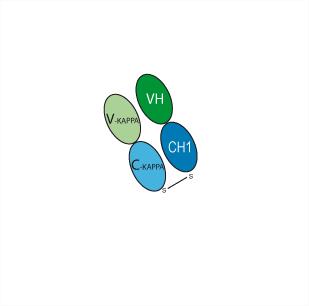
Fab-G1-kappa
Application
ELISA, FACS, Functional assay
Verified Bioactivity
-
 Immobilized VEGFA-FC can bind Ranibizumab (anti-VEGF). The EC50 for this effect is 10.14 ng/mL.
 -
 Flow cytometric analysis of 1X10⁶ Hela cells with Ranibizumab (anti-VEGF) (HY-P9951A, red). Cells were fixed with 4% paraformaldehyde and permeabilised with 90% methanol. Then stained with the primary antibody at 1/200 dilution for an hour at 4℃. Alexa Fluor 488-conjugated AffiniPure Goat Anti-Human IgG H&L (HY-P83776) was used as the secondary antibody at 1/1,000 dilution for 30 minutes at 4℃. Human IgG1 kappa (HY-P99001, blue) was used as the isotype control, cells without incubation with primary antibody were used as the unlabeled control (black).


Chemical Information
-
CAS No. 347396-82-1
-
Appearance Liquid
-
Molecular Weight 49.19 kDa
-
Color Colorless to light yellow
-
SMILES
[Ranibizumab (anti-VEGF)]
-
Synonyms
RG-6321 (anti-VEGF)
-
Shipping
Shipping with dry ice.
-
Formulation
Please refer to the lot-specific COA for specific buffer information.
-
Storage
Please store the product under the recommended conditions in the Certificate of Analysis.


Publications (2)
-
Journal Impact Factor
-
Most Recent
-
Diabetologia
MAP4K4 aggravates microvascular anomalies in diabetic retinopathy in a YTHDF2-dependent manner. [Abstract]2025 Jun;68(6):1335-1351. PMID: 40072537
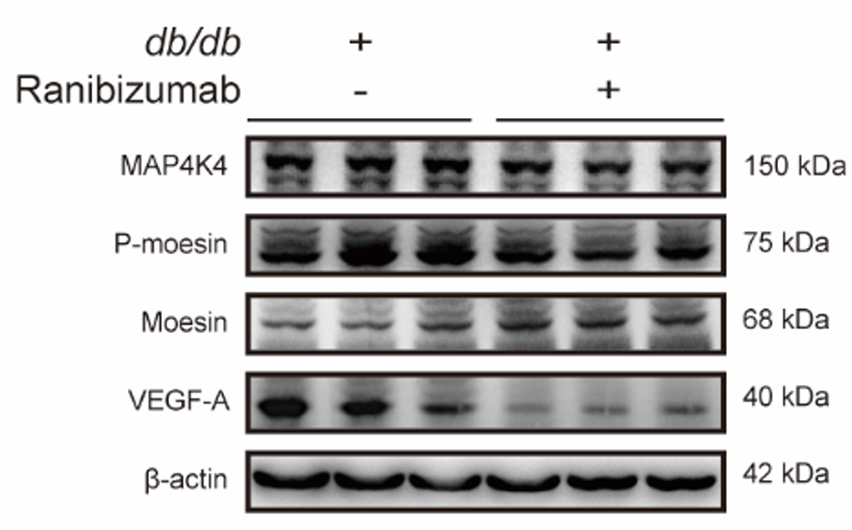
Ranibizumab (anti-VEGF) purchased from MedChemExpress. Usage Cited in: Diabetologia. 2025 Jun;68(6):1335-1351. [Abstract]
Retina lysates from db/db mice treated with anti-VEGF (Ranibizumab) (500 ng/mouse; intravitreal injection; single injection into 20-week-old mice) or vehicle (PBS) were analyzed for MAP4K4 expression and activity by immunoblotting. Moesin is a direct substrate of MAP4K4.
-


Purity & Documentation
-
Data Sheet (261 KB)
-
SDS (394 KB)
- English - EN (394 KB)
- Français - FR (394 KB)
- Deutsch - DE (394 KB)
- Norwegian - NO (394 KB)
- Español - ES (394 KB)
- Swedish - SV (394 KB)
- Italian - IT (394 KB)
- Korean - KR (394 KB)
- Portuguese - PT (394 KB)
-
Inhibitory Antibodies User Guide (603 KB)
References
[1]. Mustafa Şahiner, et al. The Effects of Anti-Vascular Endothelial Growth Factor Drugs on Retinal Pigment Epithelial Cell Culture. Turk J Ophthalmol. 2018 Aug;48(4):190-195. [Content Brief]
[2]. K J Kim, et al. The vascular endothelial growth factor proteins: identification of biologically relevant regions by neutralizing monoclonal antibodies. Growth Factors. 1992;7(1):53-64. [Content Brief]
[3]. Richard Filek, et al. Safety of anti-VEGF treatments in a diabetic rat model and retinal cell culture. Clin Ophthalmol. 2019 Jul 1;13:1097-1114. [Content Brief]

Calculators
Concentration (start) × Volume (start) = Concentration (final) × Volume (final)


Ranibizumab (anti-VEGF) Related Classifications
HY-P9951A Related Classifications
 Powered by Bioz