



BST2 Protein, Mouse (HEK293, His)

Based on 1 Customer Validation
The BST2 protein is an IFN-induced antiviral factor that inhibits mammalian enveloped viruses by tethering viral particles to infected cell membranes. BST2 acts as a physical tether connecting virions, limiting their release and spread. BST2 Protein, Mouse (HEK293, His) is the recombinant mouse-derived BST2 protein, expressed by HEK293 , with N-His labeled tag.
- Species: Mouse
- Source: HEK293
-
Storage:Stored at -20°C for 2 years from date of receipt. After reconstitution, it is stable at 4°C for 1 week or -20°C for longer (with carrier protein). It is recommended to freeze aliquots at -20°C or -80°C for extended storage.


To place orders, for customer services and technical support, please contact: MedChemExpress USA
Tel: 609-228-6898 E-mail: [email protected] [email protected]


-
 Biological Activity
-
Technical Parameters
-
Product Properties
- Documentation
- Help & FAQs




Biological Activity
Description
The BST2 protein is an IFN-induced antiviral factor that inhibits mammalian enveloped viruses by tethering viral particles to infected cell membranes. BST2 acts as a physical tether connecting virions, limiting their release and spread. BST2 Protein, Mouse (HEK293, His) is the recombinant mouse-derived BST2 protein, expressed by HEK293 , with N-His labeled tag.
Background
BST2 Protein, an IFN-induced antiviral host restriction factor, serves as a potent inhibitor of diverse mammalian enveloped viruses by directly tethering nascent virions to the membranes of infected cells. Functioning as a direct physical tether, BST2 holds virions to the cell membrane, facilitating their linkage to each other. This unique mechanism restrains the release of virions, which can be internalized by endocytosis and subsequently degraded, or remain on the cell surface, limiting their spread as cell-free virions. Targeting viruses from various families, including retroviridae (e.g., HIV-1, MMTV, MLV), filoviridae (e.g., EBOV), arenaviridae (e.g., LASV), and rhabdoviridae (e.g., VSV), BST2 demonstrates broad antiviral activity. Beyond its role in viral restriction, BST2 also inhibits the cell surface proteolytic activity of MMP14, leading to decreased activation of MMP15 and consequent inhibition of cell growth and migration. Additionally, BST2 can stimulate signaling by LILRA4/ILT7, providing negative feedback to the production of IFN by plasmacytoid dendritic cells in response to viral infection. Furthermore, BST2 contributes to the organization of the subapical actin cytoskeleton in polarized epithelial cells. Structurally, BST2 forms a parallel homodimer that is disulfide-linked, and its dimerization is essential for its antiviral activity. The protein interacts with ARHGAP44, MMP14, and LILRA4/ILT7, revealing its involvement in diverse cellular processes and signaling pathways.
Verified Bioactivity
Measured by its binding ability in a functional ELISA. When Recombinant Mouse BST-2/Tetherin is immobilized at 1 µg/mL (100 µL/well) can bind Biotinylated Recombinant Viral Dengue Virus 4 Envelope. The ED50 for this effect is 0.349 μg/mL.
MCE Validation Data
-
Purity - SDS-PAGE
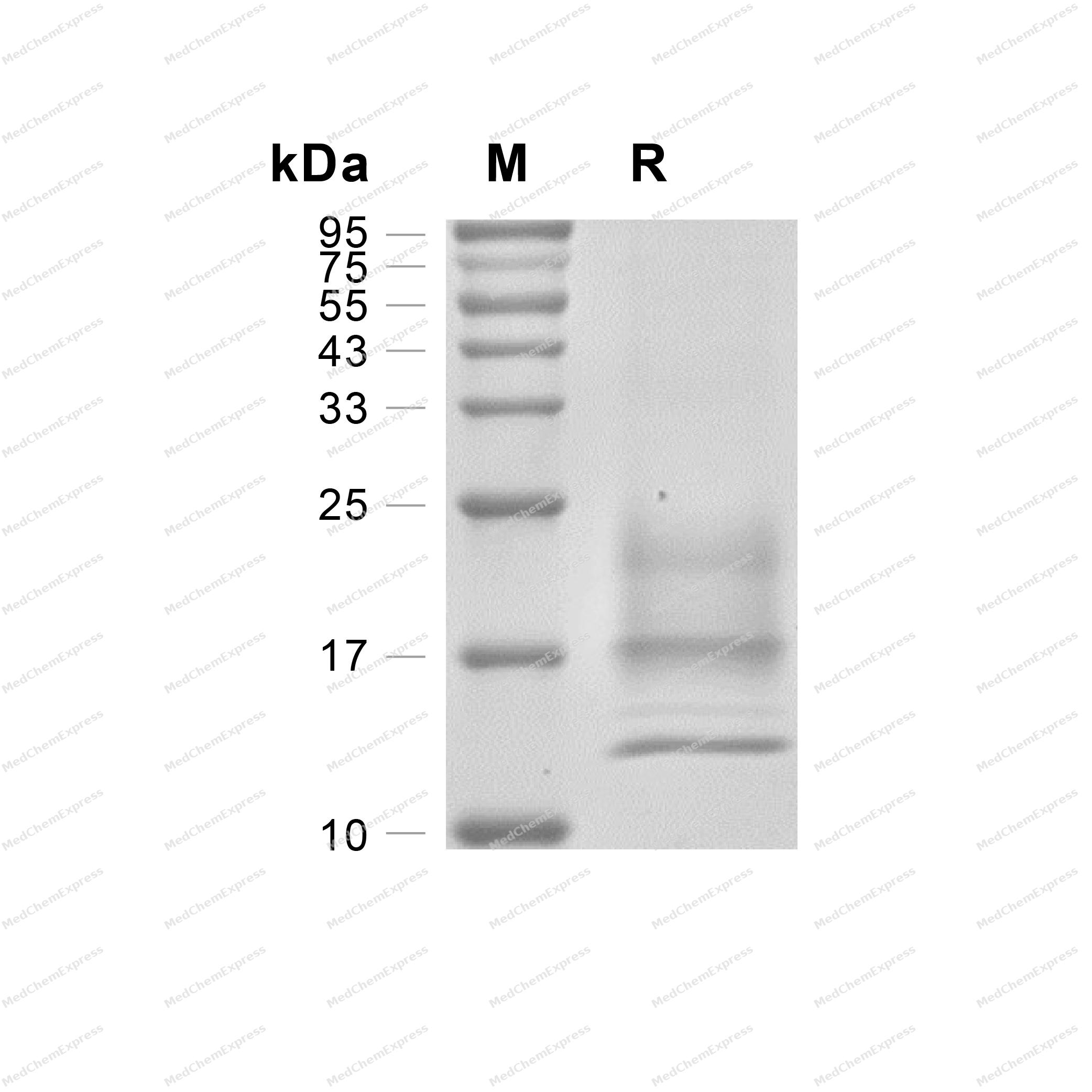
Purity - SDS-PAGE
-
Bioactivity - ELISA
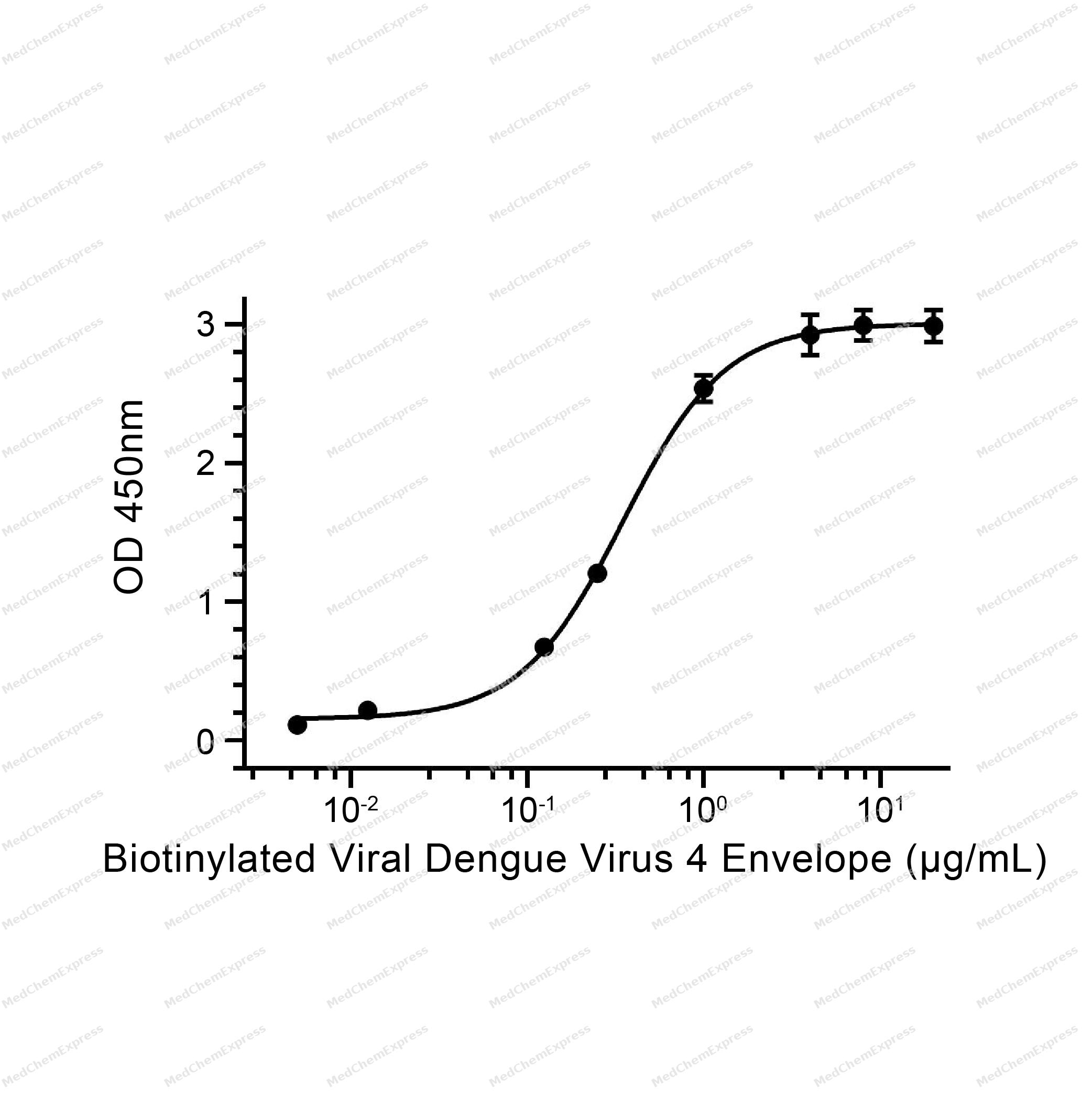
Bioactivity - ELISA


Technical Parameters
-
Species Mouse
-
Source HEK293
-
Tag N-His
-
Accession
Q8R2Q8 (T52-N151)
-
Molecular Construction
-
N-term
-
His
-
BST2 (T52-N151)
Accession # Q8R2Q8 -
C-term
-
-
Protein Length
Extracellular Domain
-
Synonyms
BST2; HM1.24; Bone Marrow Stromal Cell Antigen 2; Antiviral Factor Tetherin; Tetherin; HM1.24 Antigen; CD317; CD317 Antigen; BST-2; NPC-A-7; Bone Marrow Stromal Antigen 2
-
AA Sequence
TANSVACRDGLRAQAECRNTTHLLQRQLTRTQDSLLQAETQANSCNLTVVTLQESLEKKVSQALEQQARIKELENEVTKLNQELENLRIQKETSSTVQVN
-
Molecular Weight
Approximately 13.6-24 kDa
-
Glycosylation
Yes
-
Purity
≥ 90%, as determined by reducing SDS-PAGE.


Product Properties
Lyophilized powder.
Lyophilized from a 0.22 μm filtered solution of PBS, pH 7.5, 5% trehalose, 5% mannitol and 0.01% Tween 80.
<1 EU/μg, determined by LAL method.
It is not recommended to reconstitute to a concentration less than 100 μg/mL in ddH2O. For long term storage it is recommended to add a carrier protein (0.1% BSA, 5% HSA, 10% FBS or 5% Trehalose).
Stored at -20°C for 2 years from date of receipt. After reconstitution, it is stable at 4°C for 1 week or -20°C for longer (with carrier protein). It is recommended to freeze aliquots at -20°C or -80°C for extended storage.
Room temperature in continental US; may vary elsewhere.


Documentation
-
Data Sheet (236 KB)
-
SDS (252 KB)
- English - EN (252 KB)
- Français - FR (252 KB)
- Deutsch - DE (252 KB)
- Norwegian - NO (252 KB)
- Español - ES (252 KB)
- Swedish - SV (252 KB)
- Italian - IT (252 KB)
- Korean - KR (252 KB)
- Portuguese - PT (252 KB)
-
Handling Instructions (2659 KB)

Calculators
Concentration (start) × Volume (start) = Concentration (final) × Volume (final)


 Powered by Bioz

