



CD24 Protein, Rat (HEK293, Fc)

Based on 1 Customer Validation
The CD24 protein plays a critical role in cellular differentiation in various cell types, possibly triggered by binding of lectin-like ligands to the CD24 carbohydrate.This signal is transduced through second messengers released from GPI anchors.CD24 Protein, Rat (HEK293, Fc) is the recombinant rat-derived CD24 protein, expressed by HEK293 , with C-hFc labeled tag.
- Species: Rat
- Source: HEK293
-
Storage:Stored at -20°C for 2 years from date of receipt. After reconstitution, it is stable at 4°C for 1 week or -20°C for longer (with carrier protein). It is recommended to freeze aliquots at -20°C or -80°C for extended storage.


To place orders, for customer services and technical support, please contact: MedChemExpress USA
Tel: 609-228-6898 E-mail: [email protected] [email protected]


-
 Biological Activity
-
Technical Parameters
-
Product Properties
- Documentation
- Help & FAQs




Biological Activity
Description
The CD24 protein plays a critical role in cellular differentiation in various cell types, possibly triggered by binding of lectin-like ligands to the CD24 carbohydrate.This signal is transduced through second messengers released from GPI anchors.CD24 Protein, Rat (HEK293, Fc) is the recombinant rat-derived CD24 protein, expressed by HEK293 , with C-hFc labeled tag.
Background
The CD24 protein appears to play a pivotal role in the cell differentiation of various cell types, with signaling potentially initiated by the binding of a lectin-like ligand to CD24 carbohydrates. This signal is transduced through the release of second messengers derived from the GPI-anchor. Additionally, CD24 is involved in modulating B-cell activation responses and, in association with SIGLEC10, may contribute to the selective suppression of the immune response to danger-associated molecular patterns (DAMPs) like HMGB1, HSP70, and HSP90. These findings suggest a multifaceted role for CD24, encompassing its influence on cell differentiation, immune response regulation, and potential contributions to the control of autoimmunity. Further exploration into the specific mechanisms underlying these functions could provide valuable insights into the diverse roles played by CD24 in cellular processes.
Verified Bioactivity
When Recombinant Rat CD24 Protein is immobilized at 2 µg/mL (100 µL/well) can bind Anti-CD24 antibody, The ED50 for this effect is 2.235 µg/mL.
MCE Validation Data
-
Purity - SDS-PAGE
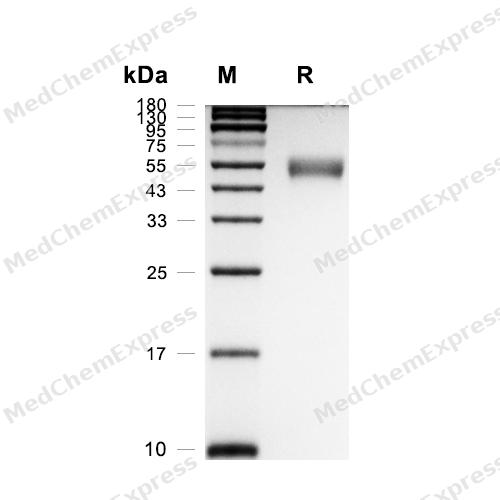
Purity - SDS-PAGE
-
Bioactivity - ELISA
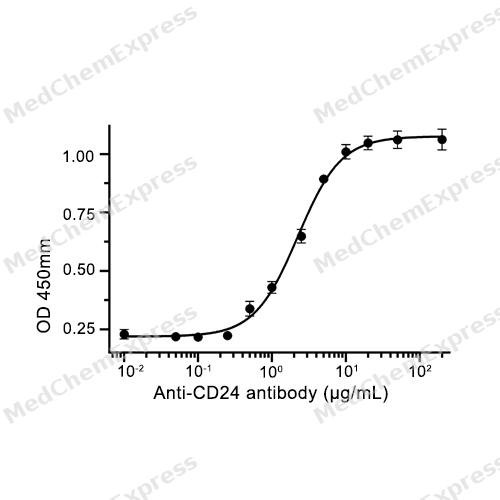
Bioactivity - ELISA


Technical Parameters
-
Species Rat
-
Source HEK293
-
Tag C-hFc
-
Accession
Q07490 (N27-C55)
-
Molecular Construction
-
N-term
-
CD24 (M1-C55)
Accession # Q07490 -
hFc
-
C-term
-
-
Protein Length
Full Length of Mature Protein
-
Synonyms
CD24; Signal Transducer CD24; CD24 Molecule; Small Cell Lung Carcinoma Cluster 4 Antigen; CD24A; CD24 Antigen; CD24 Antigen (Small Cell Lung Carcinoma Cluster 4 Antigen)
-
AA Sequence
NQTSVAPFSGNQSISAAPNPTNATTRSGC
-
Molecular Weight
Approximately 43-48 kDa, based on SDS-PAGE under reducing conditions.
-
Glycosylation
Yes
-
Purity
≥ 90%, as determined by reducing SDS-PAGE.


Product Properties
Lyophilized powder.
Lyophilized from a 0.22 μm filtered solution of PBS, pH 7.4.
<1 EU/μg, determined by LAL method.
It is not recommended to reconstitute to a concentration less than 100 μg/mL in ddH2O. For long term storage it is recommended to add a carrier protein (0.1% BSA, 5% HSA, 10% FBS or 5% Trehalose).
Stored at -20°C for 2 years from date of receipt. After reconstitution, it is stable at 4°C for 1 week or -20°C for longer (with carrier protein). It is recommended to freeze aliquots at -20°C or -80°C for extended storage.
Room temperature in continental US; may vary elsewhere.


Documentation
-
Data Sheet (235 KB)
-
SDS (251 KB)
- English - EN (251 KB)
- Français - FR (251 KB)
- Deutsch - DE (251 KB)
- Norwegian - NO (251 KB)
- Español - ES (251 KB)
- Swedish - SV (251 KB)
- Italian - IT (251 KB)
- Korean - KR (251 KB)
- Portuguese - PT (251 KB)
-
Handling Instructions (2659 KB)

Calculators
Concentration (start) × Volume (start) = Concentration (final) × Volume (final)


 Powered by Bioz

