



CDK1-CCNE1 Heterodimer Protein, Human (Inactive, sf9, His-GST)

Based on 1 Customer Validation
The FGF-9 protein undergoes autoproteolysis and cholesterol attachment in the endoplasmic reticulum. It acts as a morphogen during development, inducing ventral cell fate, participating in limb bud patterning, and aiding in axon guidance. FGF-9 binds to the PTCH1 receptor and activates target gene transcription when in association with SMO, while PTCH1 represses SMO signaling in the absence of FGF-9. CDK1-CCNE1 Heterodimer Protein, Human (sf9, His-GST) is a recombinant protein dimer complex containing human-derived CDK1-CCNE1 Heterodimer protein, expressed by Sf9 insect cells , with N-10*His, N-GST labeled tag. CDK1-CCNE1 Heterodimer Protein, Human (sf9, His-GST), has molecular weight of ~109.7 (60.4+49.3) kDa.
- Species: Human
- Source: Sf9 insect cells
-
Storage:Stored at -80°C for 1 year from date of receipt. It is stable at -20°C for 3 months after opening. It is recommended to freeze aliquots at -80°C for extended storage. Avoid repeated freeze-thaw cycles.


To place orders, for customer services and technical support, please contact: MedChemExpress USA
Tel: 609-228-6898 E-mail: [email protected] [email protected]


-
 Biological Activity
-
Technical Parameters
-
Product Properties
- Documentation
- Help & FAQs




Biological Activity
Description
The FGF-9 protein undergoes autoproteolysis and cholesterol attachment in the endoplasmic reticulum. It acts as a morphogen during development, inducing ventral cell fate, participating in limb bud patterning, and aiding in axon guidance. FGF-9 binds to the PTCH1 receptor and activates target gene transcription when in association with SMO, while PTCH1 represses SMO signaling in the absence of FGF-9. CDK1-CCNE1 Heterodimer Protein, Human (sf9, His-GST) is a recombinant protein dimer complex containing human-derived CDK1-CCNE1 Heterodimer protein, expressed by Sf9 insect cells , with N-10*His, N-GST labeled tag. CDK1-CCNE1 Heterodimer Protein, Human (sf9, His-GST), has molecular weight of ~109.7 (60.4+49.3) kDa.
Background
The CDK1 Protein, a member of the Ser/Thr protein kinase family, serves as the catalytic subunit in the highly conserved M-phase promoting factor (MPF) complex crucial for G2/M phase transitions in the eukaryotic cell cycle. Mitotic cyclins form stable associations with this protein, acting as regulatory subunits. The kinase activity is finely regulated through the accumulation and degradation of cyclins across the cell cycle. Phosphorylation and dephosphorylation events further contribute to the intricate regulatory mechanisms governing cell cycle control. Notably, the CDK1 Protein demonstrates broad expression, particularly prevalent in the lymph nodes (RPKM 12.8), bone marrow (RPKM 12.8), and 18 other tissues, suggesting its involvement in diverse physiological processes across multiple organ systems. Various alternatively spliced transcript variants encoding distinct isoforms have been identified for this gene.
Verified Bioactivity
1.The product demonstrated no detectable kinase activity in an ATP/ADP-based kinase assay.
2.Measured by its binding ability in a functional ELISA.
MCE Validation Data
-
Purity - SDS-PAGE
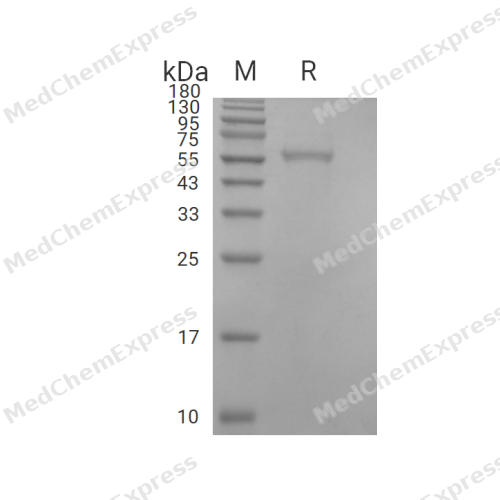
Purity - SDS-PAGE


Technical Parameters
-
Species Human
-
Source Sf9 insect cells
-
Tag N-10*His;N-GST
-
Accession
NP_001777.1 (M1-M297)&NP_001229.1 (M1-A410)
-
Synonyms
CDK1; Cell Division Protein Kinase 1; Prev. CDC2; P34 Protein Kinase; CDC28A; P34CDC2; Cell Division Cycle 2, G1 To S And G2 To M; Cell Cycle Controller CDC2; Cell Division Control Protein 2 Homolog; CDKN1; Cyclin Dependent Kinase 1; Cyclin-Dependent Kinase 1; CCNE1; Cyclin E Variant Ex7del; Prev. CCNE; Cyclin Et; G1/S-Specific Cyclin-E1; PCCNE1; Cyclin E Variant Ex5del; Cyclin E1; Cyclin Es
-
AA Sequence
MEDYTKIEKIGEGTYGVVYKGRHKTTGQVVAMKKIRLESEEEGVPSTAIREISLLKELRHPNIVSLQDVLMQDSRLYLIFEFLSMDLKKYLDSIPPGQYMDSSLVKSYLYQILQGIVFCHSRRVLHRDLKPQNLLIDDKGTIKLADFGLARAFGIPIRVYTHEVVTLWYRSPEVLLGSARYSTPVDIWSIGTIFAELATKKPLFHGDSEIDQLFRIFRALGTPNNEVWPEVESLQDYKNTFPKWKPGSLASHVKNLDENGLDLLSKMLIYDPAKRISGKMALNHPYFNDLDNQIKKM&MPRERRERDAKERDTMKEDGGAEFSARSRKRKANVTVFLQDPDEEMAKIDRTARDQCGSQPWDNNAVCADPCSLIPTPDKEDDDRVYPNSTCKPRIIAPSRGSPLPVLSWANREEVWKIMLNKEKTYLRDQHFLEQHPLLQPKMRAILLDWLMEVCEVYKLHRETFYLAQDFFDRYMATQENVVKTLLQLIGISSLFIAAKLEEIYPPKLHQFAYVTDGACSGDEILTMELMIMKALKWRLSPLTIVSWLNVYMQVAYLNDLHEVLLPQYPQQIFIQIAELLDLCVLDVDCLEFPYGILAASALYHFSSSELMQKVSGYQWCDIENCVKWMVPFAMVIRETGSSKLKHFRGVADEDAHNIQTHRDSLDLLDKARAKKAMLSEQNRASPLPSGLLTPPQSGKKQSSGPEMA
-
Predicted Molecular Mass
60.4 kDa (CCNE1) & 49.3 kDa (CDK1)
-
Molecular Weight
Approximately 53 kDa, based on SDS-PAGE under reducing conditions.
-
Purity
≥ 90%, as determined by reducing SDS-PAGE.


Product Properties
Solution.
Supplied as a 0.22 μm filtered solution of 20 mM Tris, 500 mM NaCl, 2 mM GSH, 10% Glycerol, pH 8.0, 5% trehalose, 5% mannitol and 0.01% Tween 80.
Note: For SPR assay, please replace the buffer. Primary amine components (e.g., Tris, imidazole) can affect protein-coupled chips.
<1 EU/μg, determined by LAL method.
Please use rapid thawing with running water to thaw the protein.
Stored at -80°C for 1 year from date of receipt. It is stable at -20°C for 3 months after opening. It is recommended to freeze aliquots at -80°C for extended storage. Avoid repeated freeze-thaw cycles.
Shipping with dry ice.


Documentation
-
Data Sheet (240 KB)
-
SDS (254 KB)
- English - EN (254 KB)
- Français - FR (254 KB)
- Deutsch - DE (254 KB)
- Norwegian - NO (254 KB)
- Español - ES (254 KB)
- Swedish - SV (254 KB)
- Italian - IT (254 KB)
- Korean - KR (254 KB)
- Portuguese - PT (254 KB)
-
Handling Instructions (2659 KB)

Calculators
Concentration (start) × Volume (start) = Concentration (final) × Volume (final)


 Powered by Bioz

