



Complement C5a Protein, Human
Based on 1 publication(s) in Google Scholar
Complement C5/C5a Protein, Human is a recombinant human complement C5a. C5a is a 74-amino acid glycoprotein generated on activation of the C system. Complement C5 is cleaved by proteolysis in the terminal phase of complement activation generating the pro-inflammatory C5a and membrane attack complex nucleator C5b. C5a is an inflammatory mediator generated by complement activation that positively regulates various arms of immune defense, including Toll-like receptor 4 (TLR4) signaling. Complement C5a Protein, Human is a human-derived recombinant protein that expressed by E. coli.
- Species: Human
- Source: E. coli
-
Storage:Stored at -20°C for 2 years from date of receipt. After reconstitution, it is stable at 4°C for 1 week or -20°C for longer (with carrier protein). It is recommended to freeze aliquots at -20°C or -80°C for extended storage.


To place orders, for customer services and technical support, please contact: MedChemExpress USA
Tel: 609-228-6898 E-mail: [email protected] [email protected]


-
 Biological Activity
-
Technical Parameters
-
Product Properties
- Documentation
- References
- Help & FAQs


-

HY-P7862
Complement C3a Protein, Human -
HY-106178
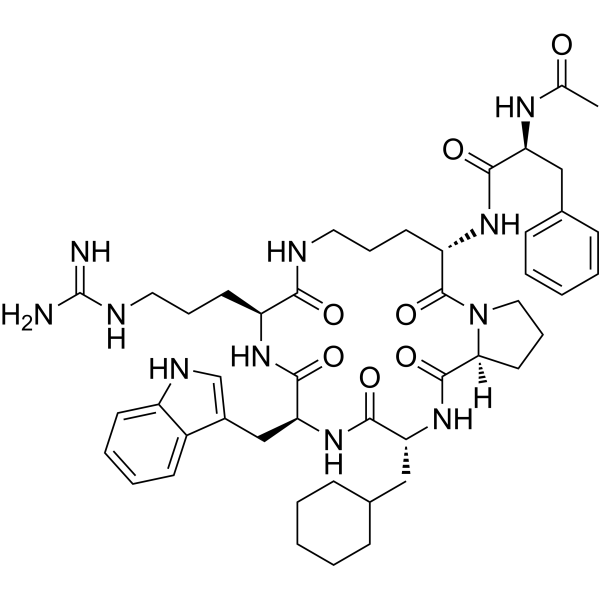
PMX-53C5a Receptor Antagonist -
HY-P7695
Complement C5a Protein, Mouse -
HY-B0015
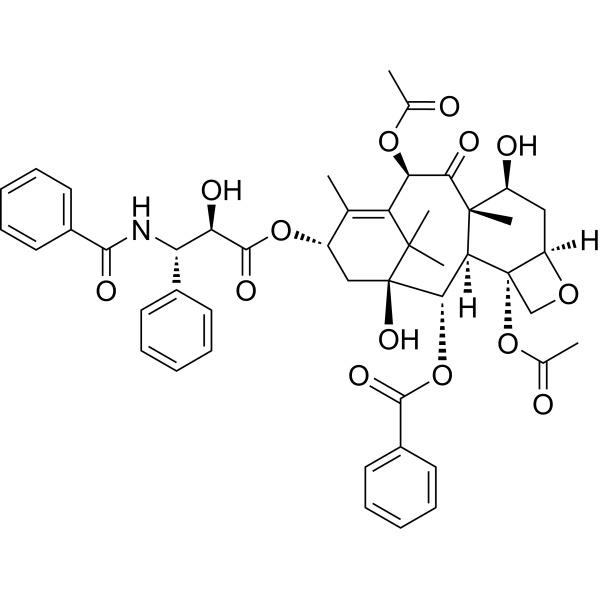
PaclitaxelAntitumor Agent -
HY-15142
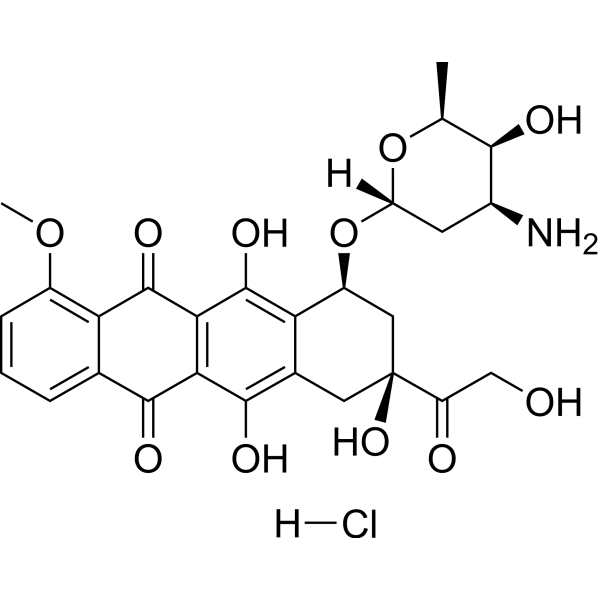
Doxorubicin hydrochlorideTopoisomerase Inhibitor -
HY-D1055
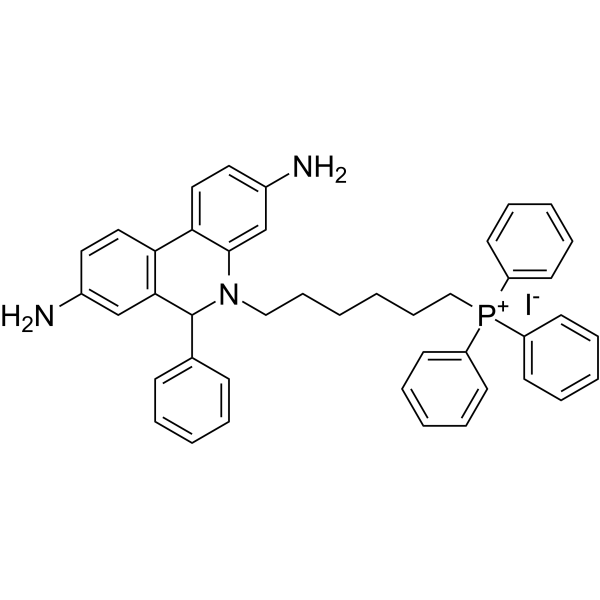
MitoSOX RedMitochondrial ROS Indicator -
HY-P7028
IL-1 beta Protein, Human -
HY-P7058
TNF-alpha/TNFSF2 Protein, Human -
HY-P70485
Vitronectin Protein, Human (HEK293, His) -
HY-P702819
Complement C3 Protein, Human (HEK293, His)


Biological Activity
Description
Complement C5/C5a Protein, Human is a recombinant human complement C5a. C5a is a 74-amino acid glycoprotein generated on activation of the C system. Complement C5 is cleaved by proteolysis in the terminal phase of complement activation generating the pro-inflammatory C5a and membrane attack complex nucleator C5b. C5a is an inflammatory mediator generated by complement activation that positively regulates various arms of immune defense, including Toll-like receptor 4 (TLR4) signaling. Complement C5a Protein, Human is a human-derived recombinant protein that expressed by E. coli[1][2].
Background
Complement component 5a (C5a) is a 74 amino acid glycoprotein and an important proinflammatory mediator that is cleaved enzymatically from its precursor, C5, on activation of the complement cascade. C5a is quickly metabolised by carboxypeptidases, forming the less-potent C5a desArg. C5a and C5a desArg interact with their receptors (C5aR and C5L2), which results in a number of effects which are essential to the immune response. C5a has a broad range of biological effects throughout the human body because the widespread expression of C5a receptors throughout the human organs enables C5a and C5a desArg to elicit a broad range of biological effects[2].
In Vitro
Complement C5/C5a Protein, Human (5 nM, 4 h) promotes the release of neutrophil extracellular traps (NETs) in human peripheral blood neutrophils with stronger fibrous and network-like structures[3].
Verified Bioactivity
1.Immobilized C5a at 2 μg/mL (100 μL/well) can bind anti-C5a. The ED50 is 41.72 ng/mL, corresponding to a specific activity is 2.39×10⁴ units/mg.
2.Measured by its ability to induce N-acetyl-beta-D-glucosaminidase release from differentiated U937 human histiocytic lymphoma cells. The ED50 for this effect is 3.332-4.647 ng/mL, corresponding to a specific activity is 2.151-3.001×10⁵ units/mg.
MCE Validation Data
-
Purity - SDS-PAGE
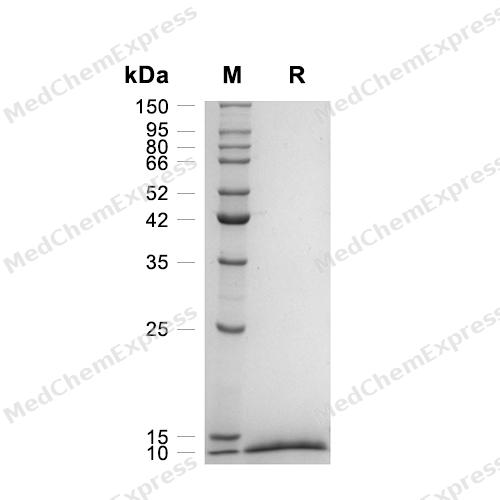
Purity - SDS-PAGE
-
Bioactivity - ELISA
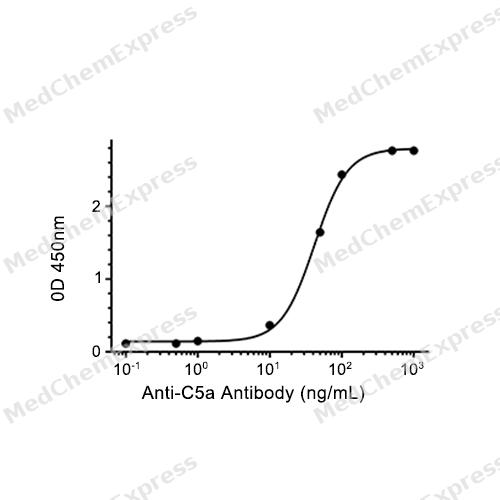
Bioactivity - ELISA


Publications (1)
-
Journal Impact Factor
-
Most Recent
-
Adv Healthc Mater
Targeted Delivery of Avacopan via Sortase A-Modified Extracellular Vesicles Attenuates Endotoxin-Induced Retinal Inflammation. [Abstract]2026 Jan 24:e04723. PMID: 41580904


Technical Parameters
-
Species Human
-
Source E. coli
-
Tag Tag Free
-
Accession
P01031 (T678-R751)
-
Molecular Construction
-
N-term
-
C5a (T678-R751)
Accession # P01031 -
C-term
-
-
Protein Length
Full Length of C5a anaphylatoxin Chain
-
Synonyms
C5; C3 And PZP-Like Alpha-2-Macroglobulin Domain-Containing Protein 4; Complement C5; C5a Anaphylatoxin; CPAMD4; Prepro-C5; Complement Component 5; Anaphylatoxin C5a Analog; C5a; ECLZB; C5b; C5D
-
AA Sequence
TLQKKIEEIAAKYKHSVVKKCCYDGACVNNDETCEQRAARISLGPRCIKAFTECCVVASQLRANISHKDMQLGR
-
Molecular Weight
Approximately 10-12 kDa, based on SDS-PAGE under reducing conditions, due to the glycosylation.
-
Purity
≥ 95%, as determined by reducing SDS-PAGE.


Product Properties
Lyophilized powder
1.Lyophilized from a 0.22 μm filtered solution of PBS, pH 7.4.
2.Lyophilized from a 0.22 μm filtered solution of 20 mM PB, 150 mM NaCl, pH 7.4, 8% trehalose.
Please refer to the lot-specific COA for specific buffer information.
<1 EU/μg, determined by LAL method.
It is not recommended to reconstitute to a concentration less than 100 μg/mL in ddH2O. For long term storage it is recommended to add a carrier protein (0.1% BSA, 5% HSA, 10% FBS or 5% Trehalose).
Stored at -20°C for 2 years from date of receipt. After reconstitution, it is stable at 4°C for 1 week or -20°C for longer (with carrier protein). It is recommended to freeze aliquots at -20°C or -80°C for extended storage.
Room temperature in continental US; may vary elsewhere.


Documentation
-
Data Sheet (262 KB)
-
SDS (252 KB)
- English - EN (252 KB)
- Français - FR (252 KB)
- Deutsch - DE (252 KB)
- Norwegian - NO (252 KB)
- Español - ES (252 KB)
- Swedish - SV (252 KB)
- Italian - IT (252 KB)
- Korean - KR (252 KB)
- Portuguese - PT (252 KB)
-
Handling Instructions (2659 KB)


References
[1]. An G, et al. Role of C5a-C5aR axis in the development of atherosclerosis. Sci China Life Sci. 2014;57(8):790-794. [Content Brief]
[2]. Haggadone MD, et al. Bidirectional Crosstalk between C5a Receptors and the NLRP3 Inflammasome in Macrophages and Monocytes. Mediators Inflamm. 2016;2016:1340156. [Content Brief]
[3]. Li Z, et al., Neutrophil extracellular traps potentiate effector T cells via endothelial senescence in uveitis. JCI Insight. 2025 Jan 23;10(2):e180248. [Content Brief]

Calculators
Concentration (start) × Volume (start) = Concentration (final) × Volume (final)


 Powered by Bioz

