



Contactin-2/CNTN2 Protein, Mouse (HEK293, His)

Based on 1 Customer Validation
Contactin-2/CNTN2 Protein collaborates with transmembrane protein CNTNAP2, crucially organizing axonal domains at nodes of Ranvier.This partnership maintains voltage-gated potassium channels at the juxtaparanodal region, emphasizing Contactin-2's pivotal role in the intricate molecular architecture essential for efficient nerve impulse propagation along myelinated axons.Contactin-2/CNTN2 Protein, Mouse (HEK293, His) is the recombinant mouse-derived Contactin-2/CNTN2 protein, expressed by HEK293 , with C-His labeled tag.
- Species: Mouse
- Source: HEK293
-
Storage:Stored at -20°C for 2 years from date of receipt. After reconstitution, it is stable at 4°C for 1 week or -20°C for longer (with carrier protein). It is recommended to freeze aliquots at -20°C or -80°C for extended storage.


To place orders, for customer services and technical support, please contact: MedChemExpress USA
Tel: 609-228-6898 E-mail: [email protected] [email protected]


-
 Biological Activity
-
Technical Parameters
-
Product Properties
- Documentation
- Help & FAQs




Biological Activity
Description
Contactin-2/CNTN2 Protein collaborates with transmembrane protein CNTNAP2, crucially organizing axonal domains at nodes of Ranvier.This partnership maintains voltage-gated potassium channels at the juxtaparanodal region, emphasizing Contactin-2's pivotal role in the intricate molecular architecture essential for efficient nerve impulse propagation along myelinated axons.Contactin-2/CNTN2 Protein, Mouse (HEK293, His) is the recombinant mouse-derived Contactin-2/CNTN2 protein, expressed by HEK293 , with C-His labeled tag.
Background
Partnering with the transmembrane protein CNTNAP2, the Contactin-2/CNTN2 protein plays a crucial role in organizing axonal domains at nodes of Ranvier. Its collaborative action involves the maintenance of voltage-gated potassium channels specifically at the juxtaparanodal region. This dynamic interplay highlights Contactin-2's pivotal contribution to the intricate molecular architecture that underlies the proper functioning of nodes of Ranvier, essential for the efficient propagation of nerve impulses along myelinated axons.
Verified Bioactivity
Measured in a cell proliferation assay using SH-SY5Y cells. The ED50 for this effect is ≤1.421 μg/mL, corresponding to a specific activity is ≥703.729 units/mg.
MCE Validation Data
-
Purity - SDS-PAGE
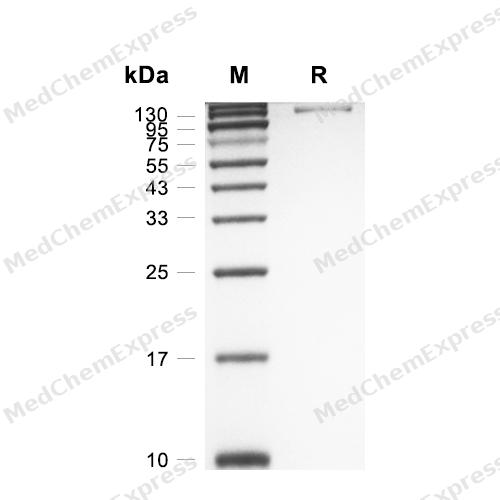
Purity - SDS-PAGE
-
Bioactivity - Cell-Based Assay
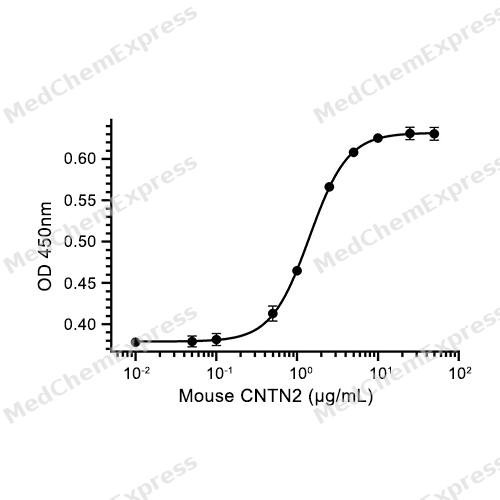
Bioactivity - Cell-Based Assay


Technical Parameters
-
Species Mouse
-
Source HEK293
-
Tag C-10*His
-
Accession
Q61330 (Q31-E1013)
-
Molecular Construction
-
N-term
-
CNTN2 (Q31-E1013)
Accession # Q61330 -
His
-
C-term
-
-
Protein Length
Full Length of Contactin-2 Chain
-
Synonyms
CNTN2; Contactin 2 (Axonal); Prev. AXT; Contactin 2 (Transiently Expressed); Prev. TAX; Axonin-1 Cell Adhesion Molecule; TAX1; Alternative Protein CNTN2; Transient Axonal Glycoprotein 1; EPEO5; Axonal Glycoprotein TAG-1; FAME5; Contactin-2; TAX-1; TAG-1;
-
AA Sequence
QGTPATFGPVFEEQPVGLLFPEESAEDQVTLACRARASPPATYRWKMNGTEMNLEPGSRHQLMGGNLVIMSPTKAQDAGVYQCLASNPVGTVVSKEAVLRFGFLQEFSKEERDPVKTHEGWGVMLPCNPPAHYPGLSYRWLLNEFPNFIPTDGRHFVSQTTGNLYIARTNASDLGNYSCLATSHLDFSTKSVFSKFAQLNLAAEDPRLFAPSIKARFPPETYALVGQQVTLECFAFGNPVPRIKWRKVDGSLSPQWGTAEPTLQIPSVSFEDEGTYECEAENSKGRDTVQGRIIVQAQPEWLKVISDTEADIGSNLRWGCAAAGKPRPMVRWLRNGEPLASQNRVEVLAGDLRFSKLNLEDSGMYQCVAENKHGTIYASAELAVQALAPDFRQNPVRRLIPAARGGEISIPCQPRAAPKATILWSKGTEILGNSTRVTVTLDGTLIIRNISRSDEGKYTCFAENFMGKANSTGILSVRDATKITLAPSSADINVGDNLTLQCHASHDPTMDLTFTWTLDDFPVDFDKPGGHYRRASVKETIGDLTILNAQLRHGGTYTCMAQTVVDGASKEATVLVRGPPGPPGGVVVRDIGDTTVQLSWSRGFDNHSPIAKYTLQARTPPSGKWKQVRTNPVNIEGNAETAQVLGLMPWMDYEFRVSASNILGTGEPSGPSSRIRTKEAVPSVAPSGLSGGGGAPGELTINWTPMSREYQNGDGFGYLLSFRRQGSSSWQTARVPGADTQYFVYSNDSIHPYTPFEVKIRSYNRRGDGPESLTAIVYSAEEEPKVAPAKVWAKGSSSSEMNVSWEPVLQDMNGILLGYEIRYWKAGDKEAAADRVRTAGLDSSARVTGLYPNTKYHVTVRAYNRAGTGPASPSADAMTMKPPPRRPPGNISWTFSSSSLSLKWDPVVPLRNESTVTGYKMLYQNDLQPTPMLHLTSKNWIEIPVPEDIGHALVQIRTTGPGGDGIPAEVHIVRNGGTSMMVE
-
Molecular Weight
Approximately 110 kDa, based on SDS-PAGE under reducing conditions, due to the glycosylation.
-
Glycosylation
Yes
-
Purity
≥ 95%, as determined by reducing SDS-PAGE.


Product Properties
Lyophilized powder
1.Lyophilized from a 0.22 μm filtered solution of PBS, pH 7.4.
2.Lyophilized from a 0.22 μm filtered solution of PBS, pH 7.4, 8% trehalose.
Please refer to the lot-specific COA for specific buffer information.
<1 EU/μg, determined by LAL method.
It is not recommended to reconstitute to a concentration less than 100 μg/mL in ddH2O. For long term storage it is recommended to add a carrier protein (0.1% BSA, 5% HSA, 10% FBS or 5% Trehalose).
Stored at -20°C for 2 years from date of receipt. After reconstitution, it is stable at 4°C for 1 week or -20°C for longer (with carrier protein). It is recommended to freeze aliquots at -20°C or -80°C for extended storage.
Room temperature in continental US; may vary elsewhere.


Documentation
-
Data Sheet (242 KB)
-
SDS (252 KB)
- English - EN (252 KB)
- Français - FR (252 KB)
- Deutsch - DE (252 KB)
- Norwegian - NO (252 KB)
- Español - ES (252 KB)
- Swedish - SV (252 KB)
- Italian - IT (252 KB)
- Korean - KR (252 KB)
- Portuguese - PT (252 KB)
-
Handling Instructions (2659 KB)

Calculators
Concentration (start) × Volume (start) = Concentration (final) × Volume (final)


 Powered by Bioz

