



EGFR Protein, Human (621a.a, CHO, His)
Based on 1 Customer Validation
EGFR is a transmembrane glycoprotein. EGFR binds to ligands, triggering receptor dimerization, inducing intracellular TK domain autophosphorylation, activating downstream Ras/MAPK, PI3K/Akt and other signaling pathways, and regulating cell proliferation, survival, migration and angiogenesis. EGFR Protein, Human (621a.a, CHO, His) is a recombinant EGFR protein expressed by CHO, with a C-His tag and glycosylation modification.
- Species: Human
- Source: CHO
-
Storage:Stored at -20°C for 2 years from date of receipt. After reconstitution, it is stable at 4°C for 1 week or -20°C for longer (with carrier protein). It is recommended to freeze aliquots at -20°C or -80°C for extended storage.


To place orders, for customer services and technical support, please contact: MedChemExpress USA
Tel: 609-228-6898 E-mail: [email protected] [email protected]


-
 Biological Activity
-
Technical Parameters
-
Product Properties
- Documentation
- References
- Help & FAQs




Biological Activity
Description
EGFR is a transmembrane glycoprotein. EGFR binds to ligands, triggering receptor dimerization, inducing intracellular TK domain autophosphorylation, activating downstream Ras/MAPK, PI3K/Akt and other signaling pathways, and regulating cell proliferation, survival, migration and angiogenesis. EGFR Protein, Human (621a.a, CHO, His) is a recombinant EGFR protein expressed by CHO, with a C-His tag and glycosylation modification[1][3][4][5].
Background
EGFR belongs to the epidermal growth factor receptor family. EGFR is a transmembrane glycoprotein. EGFR has an extracellular domain of 621 amino acids, a single transmembrane domain of 23 amino acids, and an enzymatically active intracellular domain of 542 amino acids. EGFR binds to its ligand, triggers receptor dimerization, induces autophosphorylation of the intracellular TK domain, activates downstream Ras/MAPK, PI3K/Akt and other signaling pathways, and regulates cell proliferation, survival, migration and angiogenesis. EGFR is expressed in a variety of normal epithelial tissues and tumor tissues, such as breast, lung, stomach, colon, head and neck, and its abnormal expression is associated with the malignant progression of tumors[1][2][3][4][5][6].
Verified Bioactivity
1.This product does not contain protein kinase domain.
2.The ED50 is <1 μg/mL as measured in a cell proliferation assay by 3T3 cells in the presence of 25 pg/ml human EGF.
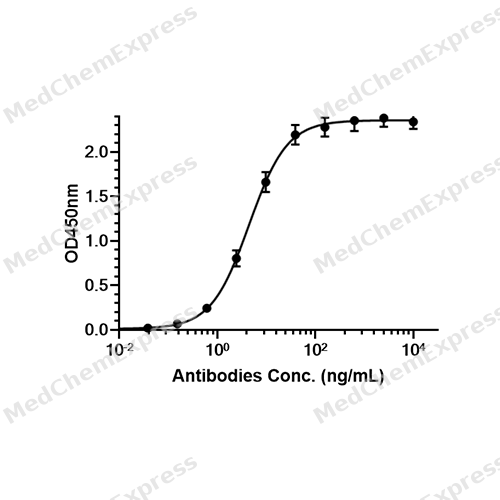
3.Immobilized EGFR Protein, Human can bind Petosemtamab (HY-P99406). The EC50 for this effect is 4.45 ng/mL.
MCE Validation Data
-
Bioactivity - ELISA
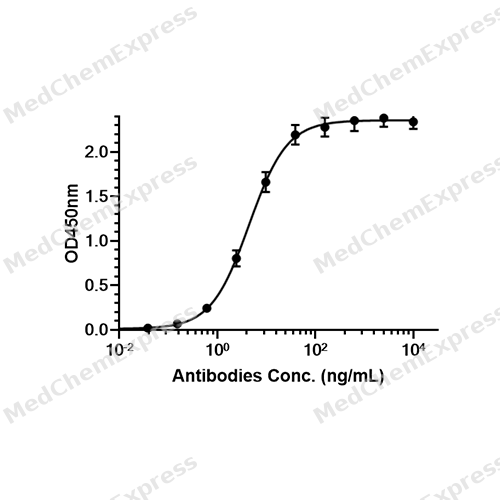
Bioactivity - ELISA


Technical Parameters
-
Species Human
-
Source CHO
-
Tag C-His
-
Accession
P00533-1 (L25-S645)
-
Molecular Construction
-
N-term
-
EGFR (L25-S645)
Accession # P00533-1 -
His
-
C-term
-
-
Protein Length
Extracellular Domain
-
Synonyms
EGFR; Epidermal Growth Factor Receptor Variant EX12_14del; Prev. ERBB; Cell Proliferation-Inducing Protein 61; ERBB1; Cell Growth Inhibiting Protein 40; ERRP; Receptor Protein-Tyrosine Kinase; Receptor Tyrosine-Protein Kinase ErbB-1; Alternative Protein E
-
AA Sequence
LEEKKVCQGTSNKLTQLGTFEDHFLSLQRMFNNCEVVLGNLEITYVQRNYDLSFLKTIQEVAGYVLIALNTVERIPLENLQIIRGNMYYENSYALAVLSNYDANKTGLKELPMRNLQEILHGAVRFSNNPALCNVESIQWRDIVSSDFLSNMSMDFQNHLGSCQKCDPSCPNGSCWGAGEENCQKLTKIICAQQCSGRCRGKSPSDCCHNQCAAGCTGPRESDCLVCRKFRDEATCKDTCPPLMLYNPTTYQMDVNPEGKYSFGATCVKKCPRNYVVTDHGSCVRACGADSYEMEEDGVRKCKKCEGPCRKVCNGIGIGEFKDSLSINATNIKHFKNCTSISGDLHILPVAFRGDSFTHTPPLDPQELDILKTVKEITGFLLIQAWPENRTDLHAFENLEIIRGRTKQHGQFSLAVVSLNITSLGLRSLKEISDGDVIISGNKNLCYANTINWKKLFGTSGQKTKIISNRGENSCKATGQVCHALCSPEGCWGPEPRDCVSCRNVSRGRECVDKCNLLEGEPREFVENSECIQCHPECLPQAMNITCTGRGPDNCIQCAHYIDGPHCVKTCPAGVMGENNTLVWKYADAGHVCHLCHPNCTYGCTGPGLEGCPTNGPKIPS
-
Molecular Weight
Approximately 95-115 kDa, based on SDS-PAGE under reducing conditions.
-
Glycosylation
Yes
-
Purity
≥ 95%, as determined by reducing SDS-PAGE.


Product Properties
Lyophilized powder
Lyophilized from a 0.2 μm filtered solution of PBS or 20 mM PB, 150 mM NaCl, pH 7.4.
<1 EU/μg, determined by LAL method.
It is not recommended to reconstitute to a concentration less than 100 μg/mL in ddH2O. For long term storage it is recommended to add a carrier protein (0.1% BSA, 5% HSA, 10% FBS or 5% Trehalose).
Stored at -20°C for 2 years from date of receipt. After reconstitution, it is stable at 4°C for 1 week or -20°C for longer (with carrier protein). It is recommended to freeze aliquots at -20°C or -80°C for extended storage.
Room temperature in continental US; may vary elsewhere.


Documentation
-
Data Sheet (266 KB)
-
SDS (251 KB)
- English - EN (251 KB)
- Français - FR (251 KB)
- Deutsch - DE (251 KB)
- Norwegian - NO (251 KB)
- Español - ES (251 KB)
- Swedish - SV (251 KB)
- Italian - IT (251 KB)
- Korean - KR (251 KB)
- Portuguese - PT (251 KB)
-
Handling Instructions (2659 KB)


References
[1]. Lemmon M A, et al. Cell signaling by receptor tyrosine kinases. Cell, 2010, 141(7): 1117-1134.
[2]. Giaccone G. HER1/EGFR-targeted agents: predicting the future for patients with unpredictable outcomes to therapy. Ann Oncol. 2005 Apr;16(4):538-48. [Content Brief]
[3]. Yarden Y, et al. Untangling the ErbB signalling network. Nat Rev Mol Cell Biol. 2001 Feb;2(2):127-37. [Content Brief]
[4]. Shepard HM, et al. Signal integration: a framework for understanding the efficacy of therapeutics targeting the human EGFR family. J Clin Invest. 2008 Nov;118(11):3574-81. [Content Brief]
[5]. Okines A, et al. Targeting the human EGFR family in esophagogastric cancer. Nat Rev Clin Oncol. 2011 Apr 5;8(8):492-503. [Content Brief]
[6]. Ho ECH, et al. Characterization of monoclonal antibodies generated to the 287-302 amino acid loop of the human epidermal growth factor receptor'. Antib Ther. 2019 Oct;2(4):88-98. [Content Brief]

Calculators
Concentration (start) × Volume (start) = Concentration (final) × Volume (final)


 Powered by Bioz

