



FGF-4 Protein, Human (136a.a)

Based on 1 Customer Validation
The FGF-4 protein coordinates embryonic development, cell proliferation and differentiation and is critical for normal limb and heart valve development. FGF-4 may promote embryonic molar tooth bud development by inducing key gene expression. FGF-4 Protein, Human (136a.a) is the recombinant human-derived FGF-4 protein, expressed by E. coli , with tag free.
- Species: Human
- Source: E. coli
-
Storage:Stored at -20°C for 2 years from date of receipt. After reconstitution, it is stable at 4°C for 1 week or -20°C for longer (with carrier protein). It is recommended to freeze aliquots at -20°C or -80°C for extended storage.


To place orders, for customer services and technical support, please contact: MedChemExpress USA
Tel: 609-228-6898 E-mail: [email protected] [email protected]


-
 Biological Activity
-
Technical Parameters
-
Product Properties
- Documentation
- Help & FAQs




Biological Activity
Description
The FGF-4 protein coordinates embryonic development, cell proliferation and differentiation and is critical for normal limb and heart valve development. FGF-4 may promote embryonic molar tooth bud development by inducing key gene expression. FGF-4 Protein, Human (136a.a) is the recombinant human-derived FGF-4 protein, expressed by E. coli , with tag free.
Background
FGF-4 Protein assumes a pivotal role in orchestrating embryonic development, cell proliferation, and cell differentiation. Its indispensability is evident in the normal development of limbs and cardiac valves during embryogenesis. Additionally, FGF-4 may contribute to embryonic molar tooth bud development by inducing the expression of key genes, including MSX1, MSX2, and SDC1, in dental mesenchyme cells, thus highlighting its diverse regulatory functions. FGF-4 engages in intricate interactions with FGFR1, FGFR2, FGFR3, and FGFR4, forming molecular alliances critical for signaling cascades. The binding affinity between FGF-4 and its receptors is potentiated by heparan sulfate glycosaminoglycans, serving as indispensable coreceptors in this complex regulatory network. These interactions underscore the multifaceted and essential role of FGF-4 in driving fundamental processes during development.
Verified Bioactivity
Measured in a cell proliferation assay using NIH-3T3 cells. The ED50 this effect is 0.1245 ng/mL, corresponding to a specific activity is 8.03×10⁶ units/mg.
MCE Validation Data
-
Purity - SDS-PAGE
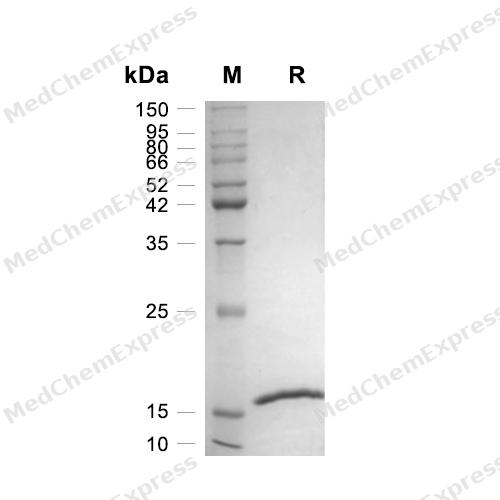
Purity - SDS-PAGE
-
Bioactivity - Cell-Based Assay
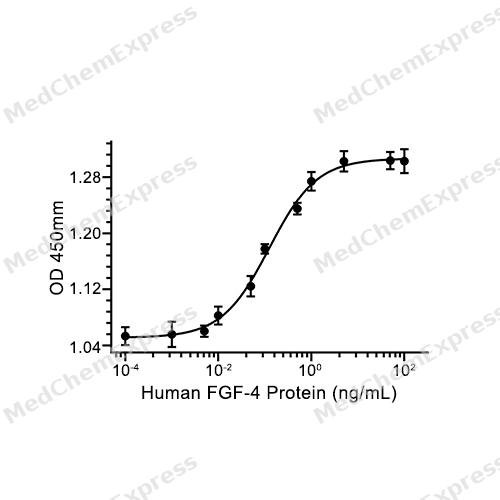
Bioactivity - Cell-Based Assay


Technical Parameters
-
Species Human
-
Source E. coli
-
Tag Tag Free
-
Accession
P08620-1 (S71-L206)
-
Molecular Construction
-
N-term
-
FGF-4 (S71-L206)
Accession # P08620-1 -
C-term
-
-
Protein Length
Partial
-
Synonyms
FGF4; Heparin-Binding Growth Factor 4; Prev. HSTF1; HSTF-1; HBGF-4; FGF-4; HST-1; Heparin Secretory-Transforming Protein 1; HST; Fibroblast Growth Factor; Transforming Protein KS3; Oncogene HST; K-FGF; SRTD22; KFGF; KS3; Human Stomach Cancer, Transforming
-
AA Sequence
SGAGDYLLGIKRLRRLYCNVGIGFHLQALPDGRIGGAHADTRDSLLELSPVERGVVSIFGVASRFFVAMSSKGKLYGSPFFTDECTFKEILLPNNYNAYESYKYPGMFIALSKNGKTKKGNRVSPTMKVTHFLPRL
-
Predicted Molecular Mass
15.1 kDa
-
Molecular Weight
Approximately 14 kDa, based on SDS-PAGE under reducing conditions.
-
Purity
≥ 95%, as determined by reducing SDS-PAGE.


Product Properties
Lyophilized powder
1.Lyophilized from a 0.22 μm filtered solution of PBS, pH 7.4.
2.Lyophilized from a 0.22 μm filtered solution of 20 mM PB, 150 mM NaCl, pH 7.4.
Please refer to the lot-specific COA for specific buffer information.
< 0.1 ng/µg (1 EU/µg) as determined by LAL test.
It is not recommended to reconstitute to a concentration less than 100 μg/mL in ddH2O. For long term storage it is recommended to add a carrier protein (0.1% BSA, 5% HSA, 10% FBS or 5% Trehalose).
Stored at -20°C for 2 years from date of receipt. After reconstitution, it is stable at 4°C for 1 week or -20°C for longer (with carrier protein). It is recommended to freeze aliquots at -20°C or -80°C for extended storage.
Room temperature in continental US; may vary elsewhere.


Documentation
-
Data Sheet (236 KB)
-
SDS (254 KB)
- English - EN (254 KB)
- Français - FR (254 KB)
- Deutsch - DE (254 KB)
- Norwegian - NO (254 KB)
- Español - ES (254 KB)
- Swedish - SV (254 KB)
- Italian - IT (254 KB)
- Korean - KR (254 KB)
- Portuguese - PT (254 KB)
-
Handling Instructions (2659 KB)

Calculators
Concentration (start) × Volume (start) = Concentration (final) × Volume (final)


 Powered by Bioz

