



Galectin-3/LGALS3 Protein, Mouse
Based on 1 publication(s) in Google Scholar
Galectin-3 (LGALS3) is involved in multiple activities, including IgE binding and signaling receptor binding. It negatively regulates T-cell receptor signaling and modulates immune responses by modulating endocytosis and lymphocyte activation. Galectin-3/LGALS3 Protein, Mouse is the recombinant mouse-derived Galectin-3/LGALS3 protein, expressed by E. coli , with tag free.
- Species: Mouse
- Source: E. coli
-
Storage:Stored at -20°C for 2 years from date of receipt. After reconstitution, it is stable at 4°C for 1 week or -20°C for longer (with carrier protein). It is recommended to freeze aliquots at -20°C or -80°C for extended storage.


To place orders, for customer services and technical support, please contact: MedChemExpress USA
Tel: 609-228-6898 E-mail: [email protected] [email protected]


-
 Biological Activity
-
Technical Parameters
-
Product Properties
- Documentation
- Help & FAQs


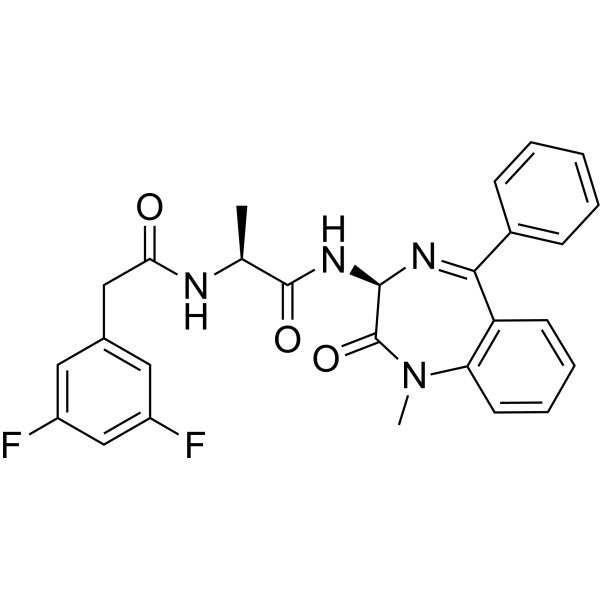


Biological Activity
Description
Galectin-3 (LGALS3) is involved in multiple activities, including IgE binding and signaling receptor binding. It negatively regulates T-cell receptor signaling and modulates immune responses by modulating endocytosis and lymphocyte activation. Galectin-3/LGALS3 Protein, Mouse is the recombinant mouse-derived Galectin-3/LGALS3 protein, expressed by E. coli , with tag free.
Background
Galectin-3 (LGALS3) is a multifunctional protein predicted to engage in diverse activities, including IgE binding, advanced glycation end-product receptor activity, and signaling receptor binding. Its involvement in negative regulation of the T cell receptor signaling pathway, endocytosis, and lymphocyte activation underscores its crucial role in modulating immune responses. Positioned in various cellular components, including the external side of the plasma membrane, glial cell projections, and immunological synapses, Galectin-3 operates upstream of processes such as extracellular matrix organization and skeletal system development. Widely expressed in anatomical structures like the alimentary and genitourinary systems, respiratory system, skeleton, and skin, Galectin-3 holds significance in diverse physiological contexts. Notably, it exhibits biased expression in specific tissues, such as the colon and duodenum, suggesting a specialized role in these anatomical regions. Studies on this protein may provide insights into its implications in conditions like asthma and fatty liver disease.
Verified Bioactivity
1.Measured by the ability of the immobilized protein to support the adhesion of CTLL-2 cells. The ED50 for this effect is 1.370 μg/mL, corresponding to a specific activity is 729.927 units/mg.
2.Measured by the ability of the immobilized protein to support the adhesion of D10.G4.1 cells. The ED50 for this effect is ≤2.375 μg/mL, corresponding to a specific activity is ≥421.053 units/mg.
MCE Validation Data
-
Purity - SDS-PAGE
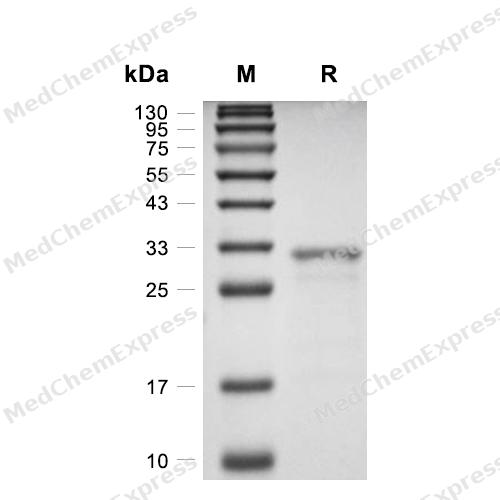
Purity - SDS-PAGE
-
Bioactivity - Cell-Based Assay
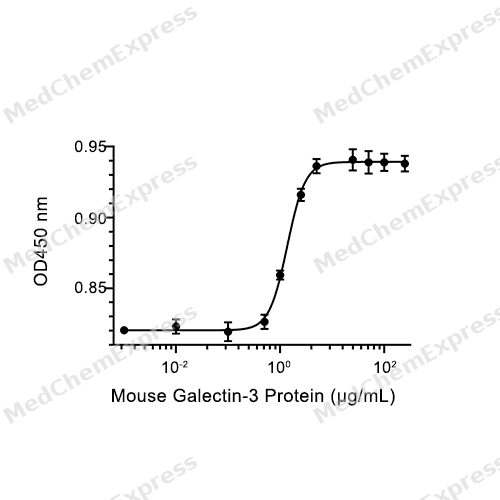
Bioactivity - Cell-Based Assay


Publications (1)
-
Journal Impact Factor
-
Most Recent
-
Brain Res
Galectin-3 activates microglia and promotes neurological impairment via NLRP3/pyroptosis pathway following traumatic brain injury. [Abstract]2025 May 15:1855:149560. PMID: 40074166


Technical Parameters
-
Species Mouse
-
Source E. coli
-
Tag Tag Free
-
Accession
NP_034835.1 (A2-I264)
-
Molecular Construction
-
N-term
-
LGALS3 (A2-I264)
Accession # NP_034835 -
C-term
-
-
Protein Length
Full Length
-
Synonyms
LGALS3; MAC-2; Prev. LGALS2; MAC2; GALIG; Galactoside-Binding Protein; Epididymis Secretory Sperm Binding Protein; MAC-2 Antigen; Advanced Glycation End-Product Receptor 3; Mac-2 Antigen; Lectin, Galactoside-Binding, Soluble, 3; Galectin; Carbohydrate-Binding Protein 35; CBP 35; Galactose-Specific Lectin 3; CBP35; Laminin-Binding Protein; Gal-3; IgE-Binding Protein; GAL3; 35 KDa Lectin; L-31; Lectin L-29; L31; Galectin-3; Galectin 3; GALBP
-
AA Sequence
ADSFSLNDALAGSGNPNPQGYPGAWGNQPGAGGYPGAAYPGAYPGQAPPGAYPGQAPPGAYPGQAPPSAYPGPTAPGAYPGPTAPGAYPGSTAPGAFPGQPGAPGAYPSAPGGYPAAGPYGVPAGPLTVPYDLPLPGGVMPRMLITIMGTVKPNANRIVLDFRRGNDVAFHFNPRFNENNRRVIVCNTKQDNNWGKEERQSAFPFESGKPFKIQVLVEADHFKVAVNDAHLLQYNHRMKNLREISQLGISGDITLTSANHAMI
-
Molecular Weight
Approximately 30 kDa, based on SDS-PAGE under reducing conditions.
-
Purity
≥ 95%, as determined by reducing SDS-PAGE.


Product Properties
Lyophilized powder.
Lyophilized from a 0.22 μm filtered solution of PBS, pH 7.4, 8% trehalose.
<1 EU/μg, determined by LAL method.
It is not recommended to reconstitute to a concentration less than 100 μg/mL in ddH2O.
Stored at -20°C for 2 years from date of receipt. After reconstitution, it is stable at 4°C for 1 week or -20°C for longer (with carrier protein). It is recommended to freeze aliquots at -20°C or -80°C for extended storage.
Room temperature in continental US; may vary elsewhere.


Documentation
-
Data Sheet (237 KB)
-
SDS (251 KB)
- English - EN (251 KB)
- Français - FR (251 KB)
- Deutsch - DE (251 KB)
- Norwegian - NO (251 KB)
- Español - ES (251 KB)
- Swedish - SV (251 KB)
- Italian - IT (251 KB)
- Korean - KR (251 KB)
- Portuguese - PT (251 KB)
-
Handling Instructions (2659 KB)

Calculators
Concentration (start) × Volume (start) = Concentration (final) × Volume (final)


 Powered by Bioz

