



GDF-15 Protein, Mouse (His)

Based on 1 Customer Validation
The GDF-15 protein regulates food intake, energy balance, and body weight by binding to its receptor GFRAL. This activates GFRAL-expressing neurons in the brainstem, triggering "emergency circuits" in the central parabrachial nucleus and amygdala during stress. GDF-15 Protein, Mouse (His) is the recombinant mouse-derived GDF-15 protein, expressed by E. coli, with N-His labeled tag.
- Species: Mouse
- Source: E. coli
-
Storage:Stored at -20°C for 2 years from date of receipt. After reconstitution, it is stable at 4°C for 1 week or -20°C for longer (with carrier protein). It is recommended to freeze aliquots at -20°C or -80°C for extended storage.


To place orders, for customer services and technical support, please contact: MedChemExpress USA
Tel: 609-228-6898 E-mail: [email protected] [email protected]


-
 Biological Activity
-
Technical Parameters
-
Product Properties
- Documentation
- Help & FAQs




Biological Activity
Description
The GDF-15 protein regulates food intake, energy balance, and body weight by binding to its receptor GFRAL. This activates GFRAL-expressing neurons in the brainstem, triggering "emergency circuits" in the central parabrachial nucleus and amygdala during stress. GDF-15 Protein, Mouse (His) is the recombinant mouse-derived GDF-15 protein, expressed by E. coli, with N-His labeled tag.
Background
GDF-15 Protein plays a crucial role in regulating food intake, energy expenditure, and body weight in response to metabolic and toxin-induced stresses. It accomplishes this by binding to its receptor, GFRAL, and activating GFRAL-expressing neurons located in the area postrema and nucleus tractus solitarius of the brainstem. This activation subsequently triggers the activation of neurons within the parabrachial nucleus and central amygdala, which are part of the 'emergency circuit' responsible for shaping feeding responses in stressful conditions. Additionally, GDF-15 Protein inhibits growth hormone signaling on hepatocytes and forms a homodimer that is disulfide-linked. It also interacts with GFRAL, acting as a ligand to facilitate GDF15 internalization and cellular signaling through its interaction with RET.
Verified Bioactivity
Measured by its binding ability in a functional ELISA. Immobilized Mouse GDF-15, His Tag at 1 μg/mL (100 μL/well) can bind Human GFR alpha-like, Fc Tag. The EC50 for this effect is 0.3-10 ng/mL.
MCE Validation Data
-
Purity - SDS-PAGE

Purity - SDS-PAGE
-
Bioactivity - ELISA
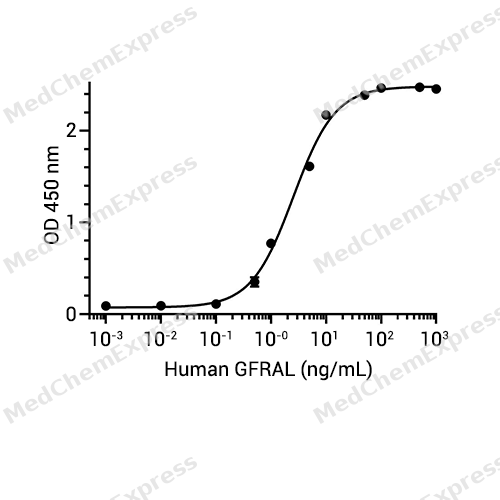
Bioactivity - ELISA


Technical Parameters
-
Species Mouse
-
Source E. coli
-
Tag N-His
-
Accession
Q9Z0J7 (S189-A303)
-
Gene ID23886
-
Molecular Construction
-
N-term
-
His
-
GDF-15 (S189-A303)
Accession # Q9Z0J7 -
C-term
-
-
Protein Length
Full Length of Mature Protein
-
Synonyms
GDF15; Placental Bone Morphogenetic Protein; Growth Differentiation Factor 15; Macrophage Inhibitory Cytokine 1; MIC-1; NSAID-Activated Gene 1 Protein; NAG-1; NSAID-Regulated Gene 1 Protein; PTGFB; Placental TGF-Beta; PLAB; GDF-15; MIC1; NRG-1; PDF; NSAID (Nonsteroidal Anti-Inflammatory Drug)-Activated Protein 1; Growth/Differentiation Factor 15; Macrophage Inhibitory Cytokine-1; Prostate Differentiation Factor; PTGF-Beta; Non-Steroidal Anti-Inflammatory Drug-Activated Gene-1; HG
-
AA Sequence
SAHAHPRDSCPLGPGRCCHLETVQATLEDLGWSDWVLSPRQLQLSMCVGECPHLYRSANTHAQIKARLHGLQPDKVPAPCCVPSSYTPVVLMHRTDSGVSLQTYDDLVARGCHCA
-
Predicted Molecular Mass
14.6 kDa
-
Molecular Weight
Approximately 16-17 kDa, based on SDS-PAGE under reducing conditions.
-
Structure/Form
Disulfide-linked homodimer
-
Purity
≥ 90%, as determined by reducing SDS-PAGE.


Product Properties
Lyophilized powder
Lyophilized from 0.22 μm filtered solution of 0.085% TFA, 30% ACN, 10% trehalose, pH 2.5.
<1 EU/μg, determined by LAL method.
It is not recommended to reconstitute to a concentration less than 100 μg/mL in ddH2O. For long term storage it is recommended to add a carrier protein (0.1% BSA, 5% HSA, 10% FBS or 5% Trehalose).
Stored at -20°C for 2 years from date of receipt. After reconstitution, it is stable at 4°C for 1 week or -20°C for longer (with carrier protein). It is recommended to freeze aliquots at -20°C or -80°C for extended storage.
Room temperature in continental US; may vary elsewhere.


Documentation
-
Data Sheet (236 KB)
-
SDS (252 KB)
- English - EN (252 KB)
- Français - FR (252 KB)
- Deutsch - DE (252 KB)
- Norwegian - NO (252 KB)
- Español - ES (252 KB)
- Swedish - SV (252 KB)
- Italian - IT (252 KB)
- Korean - KR (252 KB)
- Portuguese - PT (252 KB)
-
Handling Instructions (2659 KB)

Calculators
Concentration (start) × Volume (start) = Concentration (final) × Volume (final)


 Powered by Bioz

