



IFN-alpha 10/IFNA10 Protein, Human (HEK293, His)

Based on 1 Customer Validation
IFN-alpha 10 (IFNA10), belongs to type I interferon family, is produced by macrophages with antiviral activities. IFN-alpha 10/IFNA10 Protein, Human (HEK293, His) contains 189 a.a. (M1-D189), produced in HEK293 cells with a C-terminal His-tag.
- Species: Human
- Source: HEK293
-
Storage:Stored at -20°C for 2 years from date of receipt. After reconstitution, it is stable at 4°C for 1 week or -20°C for longer (with carrier protein). It is recommended to freeze aliquots at -20°C or -80°C for extended storage.


To place orders, for customer services and technical support, please contact: MedChemExpress USA
Tel: 609-228-6898 E-mail: [email protected] [email protected]


-
 Biological Activity
-
Technical Parameters
-
Product Properties
- Documentation
- References
- Help & FAQs




Biological Activity
Description
IFN-alpha 10 (IFNA10), belongs to type I interferon family, is produced by macrophages with antiviral activities[1]. IFN-alpha 10/IFNA10 Protein, Human (HEK293, His) contains 189 a.a. (M1-D189), produced in HEK293 cells with a C-terminal His-tag.
Background
IFN-alpha 10 (IFNA10; IFN-α10), belongs to the alpha/beta interferon (IFN) family, is produced by the macrophages with antiviral activities[1]. Interferon (IFN) is originally identified as a substance ‘interfering’ with viral replication in vitro. IFN-α/β and related molecules are classified as type I IFNs, as for the other two types of type II IFN (IFN-γ) and type III IFNs (IFN-λ), respectively[2].
Interferon stimulates the production of two enzymes: a protein kinase and an oligoadenylate synthetase. Interferon alpha (IFNa) shows significant biological activity in various cancers, paticularly haematological malignancies such as hairy cell leukaemia and chronic myelogenous leukaemia[3].
IFNα-10 involves in JAK/STAT signaling pathway with strong signaling effect (EC50=0.3 nM), is identified as potent regulators that reduces both CTLA4 and FOXP3 without affecting cell viability. Therefore, regulatory T cells (Tregs) as the key cells regulating peripheral autoreactive T lymphocytes, IFNα-10 regulates Treg functional states and destabilises Treg[4].
In Vitro
IFN-alpha 1 (1-11-1-6 M; 24-26 h) results signifcant reduction of both CTLA4 and FOXP3 gene expression in regulatory T cells (Tregs) without affecting cell viability[4].
MCE Validation Data
-
Purity - SDS-PAGE
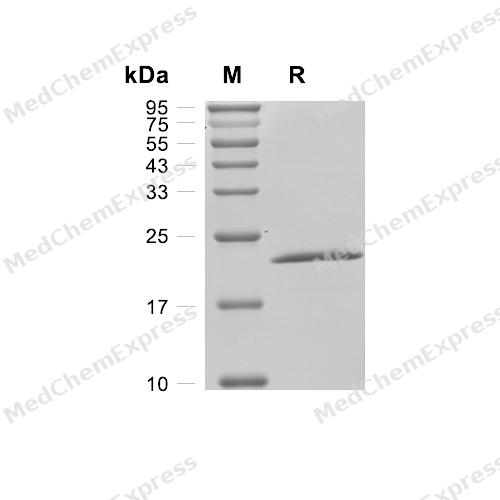
Purity - SDS-PAGE


Technical Parameters
-
Species Human
-
Source HEK293
-
Tag C-6*His
-
Accession
P01566 (C24-D189)
-
Molecular Construction
-
N-term
-
IFNA10 (C24-D189)
Accession # P01566 -
His
-
C-term
-
-
Protein Length
Full Length of Mature Protein
-
Synonyms
IFNA10; Interferon Alpha-C; Interferon Alpha 10; IFN-Alpha-10; IFN-AlphaC; LeIF C; Interferon Alpha-10; Interferon 1AA3; Interferon Alpha-6L
-
AA Sequence
CDLPQTHSLGNRRALILLGQMGRISPFSCLKDRHDFRIPQEEFDGNQFQKAQAISVLHEMIQQTFNLFSTEDSSAAWEQSLLEKFSTELYQQLNDLEACVIQEVGVEETPLMNEDSILAVRKYFQRITLYLIERKYSPCAWEVVRAEIMRSLSFSTNLQKRLRRKD
-
Predicted Molecular Mass
20.9 kDa
-
Molecular Weight
Approximately 18-25 kDa, based on SDS-PAGE under reducing conditions.
-
Purity
≥ 95%, as determined by reducing SDS-PAGE.


Product Properties
Lyophilized powder.
Lyophilized from a 0.22 μm filtered solution of PBS, pH 7.4.
<1 EU/μg, determined by LAL method.
It is not recommended to reconstitute to a concentration less than 100 μg/mL in ddH2O. For long term storage it is recommended to add a carrier protein (0.1% BSA, 5% HSA, 10% FBS or 5% Trehalose).
Stored at -20°C for 2 years from date of receipt. After reconstitution, it is stable at 4°C for 1 week or -20°C for longer (with carrier protein). It is recommended to freeze aliquots at -20°C or -80°C for extended storage.
Room temperature in continental US; may vary elsewhere.


Documentation
-
Data Sheet (264 KB)
-
SDS (251 KB)
- English - EN (251 KB)
- Français - FR (251 KB)
- Deutsch - DE (251 KB)
- Norwegian - NO (251 KB)
- Español - ES (251 KB)
- Swedish - SV (251 KB)
- Italian - IT (251 KB)
- Korean - KR (251 KB)
- Portuguese - PT (251 KB)
-
Handling Instructions (2659 KB)


References
[1]. Kumagai Y, et al. Alveolar macrophages are the primary interferon-alpha producer in pulmonary infection with RNA viruses. Immunity. 2007 Aug;27(2):240-52. [Content Brief]
[2]. Zhang SY, et al. Inborn errors of interferon (IFN)-mediated immunity in humans: insights into the respective roles of IFN-alpha/beta, IFN-gamma, and IFN-lambda in host defense. Immunol Rev. 2008 Dec;226:29-40. [Content Brief]
[3]. Raj NB, et al. Identification of a novel virus-responsive sequence in the promoter of murine interferon-alpha genes. J Biol Chem. 1991 Jun 15;266(17):11360-5. [Content Brief]
[4]. Ding M, et al. Secretome screening reveals immunomodulating functions of IFNα-7, PAP and GDF-7 on regulatory T-cells. Sci Rep. 2021 Aug 18;11(1):16767. [Content Brief]

Calculators
Concentration (start) × Volume (start) = Concentration (final) × Volume (final)


 Powered by Bioz

