



IFN-alpha 5/IFNA5 Protein, Rat (HEK293, His, solution)

Based on 1 Customer Validation
IFN-alpha 5 (IFNA5), belongs to type I interferon family, is produced by macrophages with antiviral activities.
- Species: Rat
- Source: HEK293
-
Storage:Stored at -80°C for 1 year from date of receipt. It is stable at -20°C for 3 months after opening. It is recommended to freeze aliquots at -80°C for extended storage. Avoid repeated freeze-thaw cycles.


To place orders, for customer services and technical support, please contact: MedChemExpress USA
Tel: 609-228-6898 E-mail: [email protected] [email protected]


-
 Biological Activity
-
Technical Parameters
-
Product Properties
- Documentation
- References
- Help & FAQs




Biological Activity
Description
IFN-alpha 5 (IFNA5), belongs to type I interferon family, is produced by macrophages with antiviral activities[1].
Background
IFN-alpha 5 (IFNA5; IFN-α5), belongs to the alpha/beta interferon (IFN) family, is produced by the macrophages with antiviral activities. Interferon (IFN) is originally identified as a substance ‘interfering’ with viral replication in vitro. IFN-α/β and related molecules are classified as type I IFNs, as for the other two types of type II IFN (IFN-γ) and type III IFNs (IFN-λ), respectively[1].
Interferon stimulates the production of two enzymes: a protein kinase and an oligoadenylate synthetase. Interferon alpha (IFNa) shows significant biological activity in various cancers, paticularly haematological malignancies such as hairy cell leukaemia and chronic myelogenous leukaemia[2].
IFN-alpha 5 involves in innate immunity, and is one of the genes associated with acute viral bronchiolitis (AVB) caused by respiratory syncytial virus (RSV), determining susceptibility to RSV bronchiolitis[3][4].
The excessively expressed interferon-α (IFN-α) might contribute to the uncontrolled inflammatory responses, causing pathological damage during influenza virus infection. However IFN-alpha 5 is dominantly expressed in respiratory epithelial cells from the patients infected with less pathogenic infectious bronchitis virus (IBV)[5].
Verified Bioactivity
Measured in antiviral assay using L929 cells infected with vesicular stomatitis virus (VSV).The ED50 for this effect is typically 4-50 pg/mL.
MCE Validation Data
-
Purity - SDS-PAGE
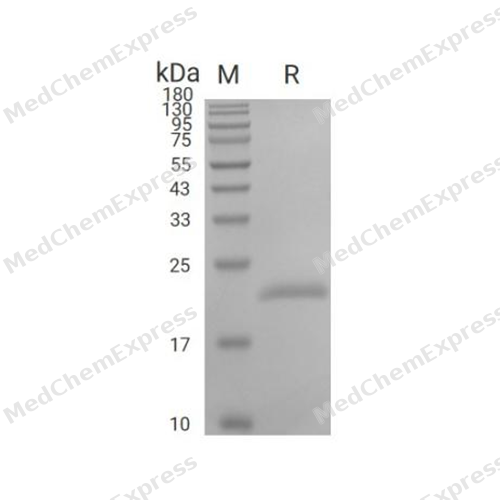
Purity - SDS-PAGE


Technical Parameters
-
Species Rat
-
Source HEK293
-
Tag C-His
-
Accession
XP_001076062 (C24-E189)
-
Molecular Construction
-
N-term
-
IFNA5 (C24-E189)
Accession # XP_001076062 -
His
-
C-term
-
-
Protein Length
Partial
-
Synonyms
IFNA5; Interferon Alpha-G; Interferon Alpha 5; IFN-Alpha-5; IFN-AlphaG; LeIF G; Interferon, Alpha 5; Interferon 1AA9; Interferon Alpha-61; INFA5; Interferon Alpha-5; INA5
-
AA Sequence
CALLQQQSLRNKRALTFLTQIRRFSPVSCLKDRKDFGFPLEKMDAQQIQKTQAIPILYELTQQVLNIFTSKDSSAAWDATLLDSFCNNLHQQLNDLKACLMQQSGVQEPPLTQEDSLLYVKEYFHRISVYLREKKHSPCAWEVVRAEVWRALSSSAKLLTRQSKEE
-
Predicted Molecular Mass
20.9 kDa
-
Molecular Weight
Approximately 21 kDa, based on SDS-PAGE under reducing conditions, due to the glycosylation.
-
Purity
≥ 95%, as determined by reducing SDS-PAGE.


Product Properties
Solution
Supplied as a 0.22 μm filtered solution of PBS, pH 7.4.
<1 EU/μg, determined by LAL method.
Stored at -80°C for 1 year from date of receipt. It is stable at -20°C for 3 months after opening. It is recommended to freeze aliquots at -80°C for extended storage. Avoid repeated freeze-thaw cycles.
Shipping with dry ice.


Documentation
-
Data Sheet (264 KB)
-
SDS (251 KB)
- English - EN (251 KB)
- Français - FR (251 KB)
- Deutsch - DE (251 KB)
- Norwegian - NO (251 KB)
- Español - ES (251 KB)
- Swedish - SV (251 KB)
- Italian - IT (251 KB)
- Korean - KR (251 KB)
- Portuguese - PT (251 KB)
-
Handling Instructions (2659 KB)


References
[1]. Zhang SY, et al. Inborn errors of interferon (IFN)-mediated immunity in humans: insights into the respective roles of IFN-alpha/beta, IFN-gamma, and IFN-lambda in host defense. Immunol Rev. 2008 Dec;226:29-40. [Content Brief]
[2]. Raj NB, et al. Identification of a novel virus-responsive sequence in the promoter of murine interferon-alpha genes. J Biol Chem. 1991 Jun 15;266(17):11360-5. [Content Brief]
[3]. Hirankarn N, et al. Genetic association of interferon-alpha subtypes 1, 2 and 5 in systemic lupus erythematosus. Tissue Antigens. 2008 Dec;72(6):588-92. [Content Brief]
[4]. Janssen R, et al. Genetic susceptibility to respiratory syncytial virus bronchiolitis is predominantly associated with innate immune genes. J Infect Dis. 2007 Sep 15;196(6):826-34. [Content Brief]
[5]. Yang L, et al. Diversity of locally produced IFN-α subtypes in human nasopharyngeal epithelial cells and mouse lung tissues during influenza virus infection. Appl Microbiol Biotechnol. 2020 Jul;104(14):6351-6361. [Content Brief]

Calculators
Concentration (start) × Volume (start) = Concentration (final) × Volume (final)


 Powered by Bioz

