



IL-1R2 Protein, Rat (HEK293, His)

Based on 1 Customer Validation
IL-1R2 is a competitive endogenous inhibitor of IL-1 signaling. IL-1R2 serves as a decoy receptor and competes with IL-1R1 for IL-1, it can also form a complex with IL-1RAP once it binds IL-1. IL-1R2 is implicated in various IL-1-mediated inflammatory diseases. IL-1R2 Protein, Rat (HEK293, His) is a recombinant rat IL-1R2 protein with a His tag at the C-terminus and is expressed in HEK293 cells. It consists of 355 amino acids (M1-E355).
- Species: Rat
- Source: HEK293
-
Storage:Stored at -20°C for 2 years from date of receipt. After reconstitution, it is stable at 4°C for 1 week or -20°C for longer (with carrier protein). It is recommended to freeze aliquots at -20°C or -80°C for extended storage.


To place orders, for customer services and technical support, please contact: MedChemExpress USA
Tel: 609-228-6898 E-mail: [email protected] [email protected]


-
 Biological Activity
-
Technical Parameters
-
Product Properties
- Documentation
- References
- Help & FAQs




Biological Activity
Description
IL-1R2 is a competitive endogenous inhibitor of IL-1 signaling. IL-1R2 serves as a decoy receptor and competes with IL-1R1 for IL-1, it can also form a complex with IL-1RAP once it binds IL-1. IL-1R2 is implicated in various IL-1-mediated inflammatory diseases[1]. IL-1R2 Protein, Rat (HEK293, His) is a recombinant rat IL-1R2 protein with a His tag at the C-terminus and is expressed in HEK293 cells. It consists of 355 amino acids (M1-E355).
Background
IL-1R2 is the non-signaling type 2 interleukin-1 receptor and is natively found on neutrophils, B-cells, monocytes and macrophages. The rat IL-1R2 can be cleaved into two forms: membrane form (14-416 a.a) and soluble form (14-? a.a).
The sequence of amino acids in IL-1R2 from rat shows low similarity (about 60%) with human IL-1R2, but has been only slightly altered with mouse IL-1R2 (90 % similarity).
IL-1R2 contains truncated cytoplasmic domain and lacks Toll-IL-1 receptor (TIR) region, making it incapable of transmembrane signaling. IL-1R2 serves as an endogenous inhibitor of IL-1 signaling. Functional IL-1 signaling requires IL-1R1 and IL-1-dependent recruitment of IL-1RAP. IL-1R2 serves as a decoy receptor and can compete with IL-1R1 for IL-1. IL-1R2 can also form a complex with IL-1RAP once it binds IL-1, preventing IL-1RAP from heterodimerizing with IL-1R1. Through these 2 ways, IL-1R2 blocks IL-1 signaling. Additionally, soluble IL-1R2 recruits soluble IL-1RAP with high affinity without impacting affinity for IL-1RA.
IL-1R2 inhibits IL-1 signaling and has been implicated in various IL-1-mediated inflammatory diseases like arthritis, diabetes, gout and so on[1][2][3].
In Vivo
IL-1R2 (8 μg of pCAGGS-IL-1RII-IgGFc; tail vein; once) inhibits IL-1-induced immune responses in Lewis rats[4].
Verified Bioactivity
Measured by its binding ability in a functional ELISA. Immobilized Rat IL-1R2 at 2 μg/mL (100 μL/well) can bind biotinylated Human IL-1 beta. The ED50 for this effect is 19.20 ng/mL.
MCE Validation Data
-
Purity - SDS-PAGE
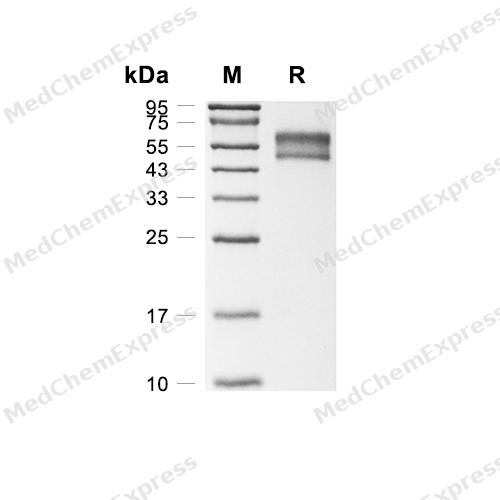
Purity - SDS-PAGE
-
Bioactivity - ELISA
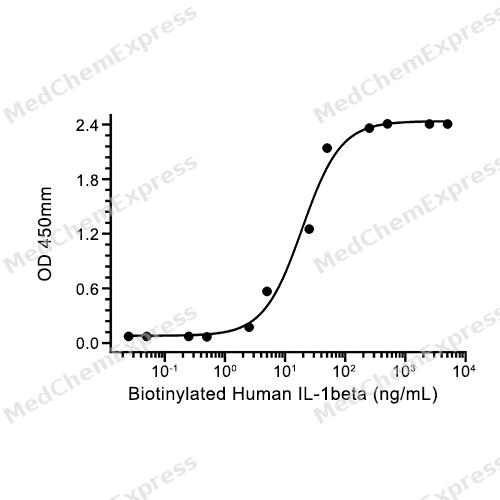
Bioactivity - ELISA


Technical Parameters
-
Species Rat
-
Source HEK293
-
Tag C-6*His
-
Accession
P43303 (F14-E355)
-
Molecular Construction
-
N-term
-
IL-1R2 (F14-E355)
Accession # P43303 -
His
-
C-term
-
-
Protein Length
Extracellular Domain
-
Synonyms
IL1R2; IL-1RT-2; Prev. IL1RB; IL-1R-2; CD121b; IL-1RT2; CD121 Antigen-Like Family Member B; Type II Interleukin-1 Receptor, Beta; Interleukin-1 Receptor Type II; Interleukin 1 Receptor, Type II; Interleukin-1 Receptor Type 2; Antigen CDw121b; Interleukin-
-
AA Sequence
FTTPAVVHTGRVSESPVTSEKHPVLGDDCWFRGRDFKSELRLEGEPVVLRCPLVPHSDTSSSSRSLLTWSKSDSSQLIPGDEPRMWVKDDTLWVLPAVQQDSGTYICTFRNASHCEQMSLELKVFKNTEASFPLVSYLQISALSSTGLLVCPDLKEFISSRTDGKIQWYKGSILLDKGNKKFLSAGDPTRLLISNTSMGDAGYYRCVMTFTYEGKEYNITRNIELRVKGITTEPIPVIISPLETIPASLGSRLIVPCKVFLGTGTSSNTIVWWMANSTFISVAYPRGRVTEGLHHQYSENDENYVEVSLIFDPVTKEDLNTDFKCVATNPRSFQSLHTTVKE
-
Molecular Weight
Approximately 55-60 kDa, based on SDS-PAGE under reducing conditions, due to the glycosylation.
-
Glycosylation
Yes
-
Purity
≥ 95%, as determined by reducing SDS-PAGE.


Product Properties
Lyophilized powder.
Lyophilized from a 0.22 μm filtered solution of PBS, pH 7.4.
<1 EU/μg, determined by LAL method.
It is not recommended to reconstitute to a concentration less than 100 μg/mL in ddH2O. For long term storage it is recommended to add a carrier protein (0.1% BSA, 5% HSA, 10% FBS or 5% Trehalose).
Stored at -20°C for 2 years from date of receipt. After reconstitution, it is stable at 4°C for 1 week or -20°C for longer (with carrier protein). It is recommended to freeze aliquots at -20°C or -80°C for extended storage.
Room temperature in continental US; may vary elsewhere.


Documentation
-
Data Sheet (265 KB)
-
SDS (251 KB)
- English - EN (251 KB)
- Français - FR (251 KB)
- Deutsch - DE (251 KB)
- Norwegian - NO (251 KB)
- Español - ES (251 KB)
- Swedish - SV (251 KB)
- Italian - IT (251 KB)
- Korean - KR (251 KB)
- Portuguese - PT (251 KB)
-
Handling Instructions (2659 KB)


References
[1]. PetersVA,etal.IL-1receptor2(IL-1R2)anditsroleinimmuneregulation.BrainBehavImmun.2013Aug;32:1-8. [Content Brief]
[2]. Molgora M, et al. Tuning inflammation and immunity by the negative regulators IL-1R2 and IL-1R8. Immunol Rev. 2018 Jan;281(1):233-247. [Content Brief]
[3]. Lin J, et al. Cardiomyocyte IL-1R2 protects heart from ischemia/reperfusion injury by attenuating IL-17RA-mediated cardiomyocyte apoptosis. Cell Death Dis. 2022 Jan 27;13(1):90. [Content Brief]
[4]. Chang H, et al. Hydrodynamics-based delivery of an interleukin-1 receptor II fusion gene ameliorates rat autoimmune myocarditis by inhibiting IL-1 and Th17 cell polarization. Int J Mol Med. 2013 Apr;31(4):833-40. [Content Brief]

Calculators
Concentration (start) × Volume (start) = Concentration (final) × Volume (final)


 Powered by Bioz

