



Mer Protein, Human (HEK293)

Based on 1 Customer Validation
Mer protein is a receptor tyrosine kinase that transduces signals by binding to ligands such as LGALS3, TUB, TULP1, or GAS6, regulating cell survival, migration, differentiation, and apoptotic cell phagocytosis (endocytosis). Ligand binding induces autophosphorylation of MERTK, creating a docking site for downstream molecules. Mer Protein, Human (HEK293) is the recombinant human-derived Mer protein, expressed by HEK293 , with tag free.
- Species: Human
- Source: HEK293
-
Storage:Stored at -80°C for 1 year from date of receipt. It is stable at -20°C for 3 months after opening. It is recommended to freeze aliquots at -80°C for extended storage. Avoid repeated freeze-thaw cycles.


To place orders, for customer services and technical support, please contact: MedChemExpress USA
Tel: 609-228-6898 E-mail: [email protected] [email protected]


-
 Biological Activity
-
Technical Parameters
-
Product Properties
- Documentation
- Help & FAQs




Biological Activity
Description
Mer protein is a receptor tyrosine kinase that transduces signals by binding to ligands such as LGALS3, TUB, TULP1, or GAS6, regulating cell survival, migration, differentiation, and apoptotic cell phagocytosis (endocytosis). Ligand binding induces autophosphorylation of MERTK, creating a docking site for downstream molecules. Mer Protein, Human (HEK293) is the recombinant human-derived Mer protein, expressed by HEK293 , with tag free.
Background
The Mer protein, a receptor tyrosine kinase, transduces signals from the extracellular matrix by binding to various ligands, including LGALS3, TUB, TULP1, or GAS6. It is involved in regulating diverse physiological processes, including cell survival, migration, differentiation, and the phagocytosis of apoptotic cells (efferocytosis). Ligand binding at the cell surface induces autophosphorylation of MERTK on its intracellular domain, creating docking sites for downstream signaling molecules. Upon activation by ligand, Mer interacts with GRB2 or PLCG2 and induces the phosphorylation of MAPK1, MAPK2, FAK/PTK2, or RAC1. MERTK signaling is implicated in macrophage clearance of apoptotic cells, platelet aggregation, cytoskeleton reorganization, and engulfment. In the retinal pigment epithelium (RPE), it serves as a regulator of rod outer segment fragments' phagocytosis. Moreover, Mer plays a crucial role in inhibiting Toll-like receptors (TLRs)-mediated innate immune responses by activating STAT1, which selectively induces the production of suppressors of cytokine signaling SOCS1 and SOCS3.
Verified Bioactivity
1.This product does not contain protein kinase domain.
2.Immobilized Human Mer at 10 μg/mL (100 μL/well) can bind Human Gas6 Protein (HY-P70470). The ED50 for this effect is 4.047 μg/mL.
MCE Validation Data
-
Bioactivity - ELISA
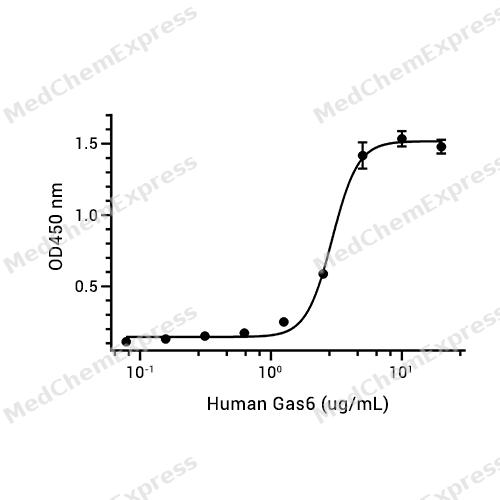
Bioactivity - ELISA


Technical Parameters
-
Species Human
-
Source HEK293
-
Tag Tag Free
-
Accession
Q12866 (A21-A499)
-
Molecular Construction
-
N-term
-
Mer (A21-A499)
Accession # Q12866 -
C-term
-
-
Protein Length
Partial Extracellular Domain
-
Synonyms
MERTK; Mer; MER Proto-Oncogene, Tyrosine Kinase; C-Mer Proto-Oncogene Tyrosine Kinase; Receptor Tyrosine Kinase MerTK; Receptor Protein-Tyrosine Kinase; Tyrosine-Protein Kinase Mer; Uncharacterized Protein MERTK; Proto-Oncogene C-Mer; MER Receptor Tyrosin
-
AA Sequence
AITEAREEAKPYPLFPGPFPGSLQTDHTPLLSLPHASGYQPALMFSPTQPGRPHTGNVAIPQVTSVESKPLPPLAFKHTVGHIILSEHKGVKFNCSISVPNIYQDTTISWWKDGKELLGAHHAITQFYPDDEVTAIIASFSITSVQRSDNGSYICKMKINNEEIVSDPIYIEVQGLPHFTKQPESMNVTRNTAFNLTCQAVGPPEPVNIFWVQNSSRVNEQPEKSPSVLTVPGLTEMAVFSCEAHNDKGLTVSKGVQINIKAIPSPPTEVSIRNSTAHSILISWVPGFDGYSPFRNCSIQVKEADPLSNGSVMIFNTSALPHLYQIKQLQALANYSIGVSCMNEIGWSAVSPWILASTTEGAPSVAPLNVTVFLNESSDNVDIRWMKPPTKQQDGELVGYRISHVWQSAGISKELLEEVGQNGSRARISVQVHNATCTVRIAAVTRGGVGPFSDPVKIFIPAHGWVDYAPSSTPAPGNA
-
Predicted Molecular Mass
54 kDa
-
Molecular Weight
Approximately 110-120 kDa, based on SDS-PAGE under reducing conditions, due to the glycosylation.
-
Glycosylation
Yes
-
Purity
≥ 90%, as determined by reducing SDS-PAGE.


Product Properties
Solution.
Supplied as a 0.22 μm filtered solution of PBS, pH 7.4.
<1 EU/μg, determined by LAL method.
Please use rapid thawing with running water to thaw the protein.
Stored at -80°C for 1 year from date of receipt. It is stable at -20°C for 3 months after opening. It is recommended to freeze aliquots at -80°C for extended storage. Avoid repeated freeze-thaw cycles.
Shipping with dry ice.


Documentation
-
Data Sheet (238 KB)
-
SDS (252 KB)
- English - EN (252 KB)
- Français - FR (252 KB)
- Deutsch - DE (252 KB)
- Norwegian - NO (252 KB)
- Español - ES (252 KB)
- Swedish - SV (252 KB)
- Italian - IT (252 KB)
- Korean - KR (252 KB)
- Portuguese - PT (252 KB)
-
Handling Instructions (2659 KB)

Calculators
Concentration (start) × Volume (start) = Concentration (final) × Volume (final)


 Powered by Bioz

