



RANTES/CCL5 Protein, Mouse (HEK293, Fc)

Based on 1 Customer Validation
RANTES/CCL5 Protein, Mouse (HEK293, Fc) is a key pro-inflammatory chemokine in the CC chemokine family that interacts with CCR1, CCR3, CCR4, and CCR5 to mediate inflammatory immune responses, viral infections, and tumorigenesis.RANTES/CCL5 Protein, Mouse (HEK293, Fc) is a recombinant mouse RANTES/CCL5 (S24-S91) protein expressed by HEK293 with a hFc tag at the N-terminu.
- Species: Mouse
- Source: HEK293
-
Storage:Stored at -20°C for 2 years from date of receipt. After reconstitution, it is stable at 4°C for 1 week or -20°C for longer (with carrier protein). It is recommended to freeze aliquots at -20°C or -80°C for extended storage.

To place orders, for customer services and technical support, please contact: MedChemExpress USA
Tel: 609-228-6898 E-mail: [email protected] [email protected]


-
 Biological Activity
-
Technical Parameters
-
Product Properties
- Documentation
- References
- Help & FAQs


-
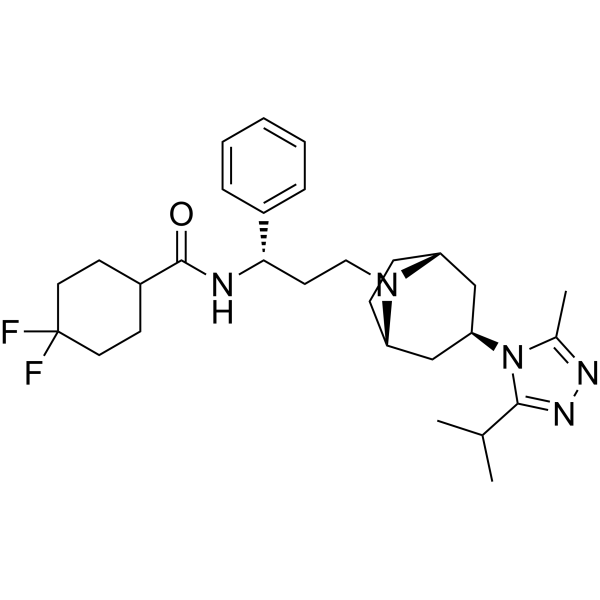
HY-13004
Maraviroc -

HY-P7764
MCP-1/CCL2 Protein, Mouse -
HY-P70571
TNF-alpha/TNFSF2 Protein, Mouse (147a.a) -
HY-P7227
IP-10/CRG-2/CXCL10 Protein, Mouse -
HY-P70450
RANTES/CCL5 Protein, Human -

HY-D1056
Lipopolysaccharides, from E. coli O55:B5 -

HY-K0010
Protease Inhibitor Cocktail (EDTA-Free, 100× in DMSO) -
HY-P7258
MIP-2/CXCL2 Protein, Mouse -
HY-P72684
GRO-alpha/CXCL1 Protein, Mouse (HEK293, His) -
HY-P70626
TSLP Protein, Mouse (HEK293, Fc) -
HY-P73215
IL-4 Protein, Mouse (Q136D, Y139D, sf9, His)


Biological Activity
Description
RANTES/CCL5 Protein, Mouse (HEK293, Fc) is a key pro-inflammatory chemokine in the CC chemokine family that interacts with CCR1, CCR3, CCR4, and CCR5 to mediate inflammatory immune responses, viral infections, and tumorigenesis.RANTES/CCL5 Protein, Mouse (HEK293, Fc) is a recombinant mouse RANTES/CCL5 (S24-S91) protein expressed by HEK293 with a hFc tag at the N-terminu[1].
Background
CCL5, also known as RANTES (Regulation of Activation, Expression and Secretion by Normal T Cells), belongs to the CC subfamily of chemokines. The CCL5 gene is located in the q11.2-q12 region of human chromosome 17 and encodes CCL5 a protein with a molecular weight of 8 kDa. CCL5 can be expressed by T cells, monocytes, NK cells, epithelial cells, fibroblasts, and CCL5 can bind to receptors CCR1, CCR3, CCR4 and CCR5, with the highest affinity for CCR5[1]. CCL5 binding to CCR5 leads to phosphorylation of phosphatidylinositol 3-kinase ( PI3K ), and the phosphorylated PI3K further acidifies protein kinase B on serine 473, and the Akt/PKB complex phosphorylates and inactivates the serine/threonine protein kinase GSK-3. In parallel, CCL5 binding to CCR5 induces Bcl2 protein expression, which promotes cell apoptosis. CCL5 can also act as a potential agonist for the G protein-coupled receptor GPR75, which, together with GPR75, may play a role in neuronal survival by activating downstream signaling pathways involving PI3, Akt, and MAP kinases, and in insulin secretion by pancreatic islet cells by activating GPR75[2]. In addition to acting as a chemotactic agent, CCL5 is also a major HIV suppressor produced by CD8+ T cells. It is involved in inflammation maintenance, transplantation, antiviral immunity, tumor development, and many human diseases and disorders such as viral hepatitis or COVID-19[3].


Technical Parameters
-
Species Mouse
-
Source HEK293
-
Tag N-hFc
-
Accession
P30882 (S24-S91)
-
Molecular Construction
-
N-term
-
hFc
-
CCL5 (S24-S91)
Accession # P30882 -
C-term
-
-
Protein Length
Full Length of Mature Protein
-
Synonyms
CCL5; T-Cell Specific Protein P288; Prev. D17S136E; C-C Motif Chemokine 5; Prev. SCYA5; MGC17164; TCP228; EoCP; SIS-Delta; Small Inducible Cytokine A5 (RANTES); RANTES; T-Cell Specific RANTES Protein; SISd; T-Cell-Specific Protein RANTES; Regulated Upon A
-
AA Sequence
SPYGSDTTPCCFAYLSLALPRAHVKEYFYTSSKCSNLAVVFVTRRNRQVCANPEKKWVQEYINYLEMS
-
Predicted Molecular Mass
35.2 kDa
-
Molecular Weight
Approximately 40-45 kDa, based on SDS-PAGE under reducing conditions, due to the glycosylation.
-
Purity
≥ 95%, as determined by Bis-Tris PAGE.


Product Properties
Lyophilized powder.
Lyophilized from a 0.22 μm filtered solution of PBS, pH 7.4, 8% trehalose.
<1 EU/μg, determined by LAL method.
It is not recommended to reconstitute to a concentration less than 100 μg/mL in ddH2O.
Stored at -20°C for 2 years from date of receipt. After reconstitution, it is stable at 4°C for 1 week or -20°C for longer (with carrier protein). It is recommended to freeze aliquots at -20°C or -80°C for extended storage.
Room temperature in continental US; may vary elsewhere.


Documentation
-
Data Sheet (263 KB)
-
SDS (252 KB)
- English - EN (252 KB)
- Français - FR (252 KB)
- Deutsch - DE (252 KB)
- Norwegian - NO (252 KB)
- Español - ES (252 KB)
- Swedish - SV (252 KB)
- Italian - IT (252 KB)
- Korean - KR (252 KB)
- Portuguese - PT (252 KB)
-
Handling Instructions (2659 KB)


References
[1]. V Appay, et al. RANTES: a versatile and controversial chemokine. Trends Immunol. 2001 Feb;22(2):83-7. [Content Brief]
[3]. F Cocchi, et al. Identification of RANTES, MIP-1 alpha, and MIP-1 beta as the major HIV-suppressive factors produced by CD8+ T cells. Science. 1995 Dec 15;270(5243):1811-5. [Content Brief]
[4]. Sara González-Rodríguez, et al. Hyperalgesic and hypoalgesic mechanisms evoked by the acute administration of CCL5 in mice. Brain Behav Immun. 2017 May;62:151-161. [Content Brief]

Calculators
Concentration (start) × Volume (start) = Concentration (final) × Volume (final)


 Powered by Bioz

