



SARS-CoV-2 3CLpro/3C-like protease Protein (Tag Free)

Based on 1 Customer Validation
SARS-CoV-2 3CLpro/3C-like protease Protein (Tag Free) is a viral cysteine protease that plays a crucial role in the co-translational proteolytic processing of coronavirus polyproteins. Since no homologous proteins with similar cleavage sites exist in the human body, SARS-CoV-2 3CLpro/3C-like protease Protein (Tag Free) is a high-quality target for the development of drugs related to COVID-19. SARS-CoV-2 3CLpro/3C-like protease Protein (Tag Free) is a recombinant, SARS-CoV-2 3CLpro/3C-like protease Protein (Tag Free) expressed by E.coli.
- Species: Virus
- Source: E. coli
-
Storage:Stored at -20°C for 2 years from date of receipt. After reconstitution, it is stable at 4°C for 1 week or -20°C for longer (with carrier protein). It is recommended to freeze aliquots at -20°C or -80°C for extended storage.


To place orders, for customer services and technical support, please contact: MedChemExpress USA
Tel: 609-228-6898 E-mail: [email protected] [email protected]


-
 Biological Activity
-
Technical Parameters
-
Product Properties
- Documentation
- References
- Help & FAQs




Biological Activity
Description
SARS-CoV-2 3CLpro/3C-like protease Protein (Tag Free) is a viral cysteine protease that plays a crucial role in the co-translational proteolytic processing of coronavirus polyproteins. Since no homologous proteins with similar cleavage sites exist in the human body, SARS-CoV-2 3CLpro/3C-like protease Protein (Tag Free) is a high-quality target for the development of drugs related to COVID-19. SARS-CoV-2 3CLpro/3C-like protease Protein (Tag Free) is a recombinant, SARS-CoV-2 3CLpro/3C-like protease Protein (Tag Free) expressed by E.coli[1][2][3].
Background
SARS-CoV-2 3CLpro/3C-like protease Protein (Tag Free) is a cysteine protease composed of three domains. Within the cleft between domain I and domain II, it contains the Cys145-His41 catalytic dimer, which cleaves pp1a and pp1ab to generate 12 functional proteins responsible for viral genome replication and transcription. SARS-CoV-2 3CLpro/3C-like protease Protein (Tag Free) lacks homologous proteins with similar cleavage sites in the human body, effectively reducing off-target risks. Its catalytic pocket is an ideal target for developing anti-coronavirus inhibitors. SARS-CoV-2 3CLpro/3C-like protease Protein (Tag Free) recognizes its peptide substrates according to the Schechter-Berger nomenclature, with the substrate cleavage site located between P1 and P1'. SARS-CoV-2 3CLpro/3C-like protease Protein (Tag Free) relies on catalytic dimerization to complete substrate hydrolysis through a multi-step chemical reaction, and can regain its activity after catalysis. Inhibitors of SARS-CoV-2 3CLpro/3C-like protease Protein (Tag Free) are mainly divided into two categories: covalent inhibitors and non-covalent inhibitors[1][2][3].
In Vitro
SARS-CoV-2 3CLpro/3C-like protease Protein (Tag Free) and mutant SARS coronavirus 3CLpro (Q189) are both inhibited by Quercetin (HY-18085), with IC50 values of 42.79 μM and 27.89 μM respectively[2].
SARS-CoV-2 3CLpro/3C-like protease Protein (Tag Free) is strongly inhibited by 73 μM Quercetin. This concentration of Quercetin also inhibits recombinant SARS coronavirus 3CLpro expressed by Pichia pastoris, with the inhibition rate of catalytic activities exceeding 80% for both proteins[2].
SARS-CoV-2 3CLpro/3C-like protease Protein (Tag Free) can be bound and inhibited by various quercetin glycosides including Rutin (HY-N0148). Quercetin and its metabolites target the dimerization site and regulatory site of this protease to block its function[2].
SARS-CoV-2 3CLpro/3C-like protease Protein (Tag Free) is reversibly and competitively inhibited by 4.0 nM EDP-235 (HY-156651), with an apparent inhibition constant (Kiapp) of 3.0 nM. EDP-235 can also inhibit 3CLpro derived from SARS coronavirus, human coronavirus and zoonotic coronavirus, which are homologous to SARS-CoV-2 3CLpro/3C-like protease protein[3].
Verified Bioactivity
Measured by its ability to cleave a fluorogenic peptide substrate Dabcyl-KTSAVLQSGFRKME-Edans (HY-P2295) at room temperature and the specific activity is 3497.23 nmol/min/mg.
MCE Validation Data
-
Purity - SDS-PAGE
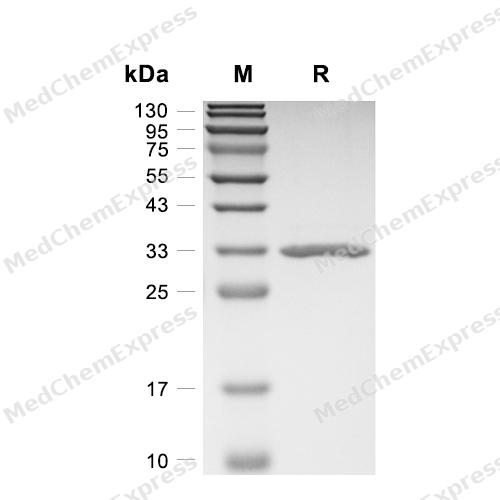
Purity - SDS-PAGE


Technical Parameters
-
Species Virus
-
Source E. coli
-
Tag Tag Free
-
Accession
YP_009725301.1 (S1-Q306)
-
Gene ID43740578
-
Molecular Construction
-
N-term
-
SARS-CoV-2 3CLpro (S1-Q306)
Accession # YP_009725301.1 -
C-term
-
-
Protein Length
Full Length
-
Synonyms
3C-like protease; 3CL Protease; 3CL-Mpro; 3CL Pro; COVID-19; M Proteinase; Mpro
-
AA Sequence
SGFRKMAFPSGKVEGCMVQVTCGTTTLNGLWLDDVVYCPRHVICTSEDMLNPNYEDLLIRKSNHNFLVQAGNVQLRVIGHSMQNCVLKLKVDTANPKTPKYKFVRIQPGQTFSVLACYNGSPSGVYQCAMRPNFTIKGSFLNGSCGSVGFNIDYDCVSFCYMHHMELPTGVHAGTDLEGNFYGPFVDRQTAQAAGTDTTITVNVLAWLYAAVINGDRWFLNRFTTTLNDFNLVAMKYNYEPLTQDHVDILGPLSAQTGIAVLDMCASLKELLQNGMNGRTILGSALLEDEFTPFDVVRQCSGVTFQ
-
Predicted Molecular Mass
33.8 kDa
-
Molecular Weight
Approximately 33 kDa, based on SDS-PAGE under reducing conditions.
-
Purity
≥ 95%, as determined by Bis-Tris PAGE.


Product Properties
Lyophilized powder.
Lyophilized from a 0.22 μm filtered solution of PBS, pH 7.4, 8% trehalose.
<1 EU/μg, determined by LAL method.
It is not recommended to reconstitute to a concentration less than 100 μg/mL in ddH2O.
Stored at -20°C for 2 years from date of receipt. After reconstitution, it is stable at 4°C for 1 week or -20°C for longer (with carrier protein). It is recommended to freeze aliquots at -20°C or -80°C for extended storage.
Room temperature in continental US; may vary elsewhere.


Documentation
-
Data Sheet (264 KB)
-
SDS (251 KB)
- English - EN (251 KB)
- Français - FR (251 KB)
- Deutsch - DE (251 KB)
- Norwegian - NO (251 KB)
- Español - ES (251 KB)
- Swedish - SV (251 KB)
- Italian - IT (251 KB)
- Korean - KR (251 KB)
- Portuguese - PT (251 KB)
-
Handling Instructions (2659 KB)


References

Calculators
Concentration (start) × Volume (start) = Concentration (final) × Volume (final)


 Powered by Bioz

