



SLPI Protein, Mouse (HEK293, Fc)

Based on 1 Customer Validation
The SLPI protein is an acid-stable protease inhibitor that modulates immune responses to bacterial infections.It downregulates responses to bacterial lipopolysaccharide (LPS) and modulates NF-kappa-B activation and inflammatory responses.SLPI Protein, Mouse (HEK293, Fc) is the recombinant mouse-derived SLPI protein, expressed by HEK293 , with C-hFc labeled tag.
- Species: Mouse
- Source: HEK293
-
Storage:Stored at -80°C for 1 year from date of receipt. It is stable at -20°C for 3 months after opening. It is recommended to freeze aliquots at -80°C for extended storage. Avoid repeated freeze-thaw cycles.


To place orders, for customer services and technical support, please contact: MedChemExpress USA
Tel: 609-228-6898 E-mail: [email protected] [email protected]


-
 Biological Activity
-
Technical Parameters
-
Product Properties
- Documentation
- Help & FAQs




Biological Activity
Description
The SLPI protein is an acid-stable protease inhibitor that modulates immune responses to bacterial infections.It downregulates responses to bacterial lipopolysaccharide (LPS) and modulates NF-kappa-B activation and inflammatory responses.SLPI Protein, Mouse (HEK293, Fc) is the recombinant mouse-derived SLPI protein, expressed by HEK293 , with C-hFc labeled tag.
Background
The jGranzyme B/GZMB protein is an abundant protease found in the cytosolic granules of cytotoxic T-cells and NK-cells. It plays a crucial role in various cellular processes. When delivered into the target cell through the immunological synapse, Granzyme B/GZMB activates caspase-independent pyroptosis, leading to target cell death. It achieves this by cleaving after Asp and catalyzing the cleavage of gasdermin-E (GSDME), releasing the pore-forming component of GSDME, which triggers pyroptosis. Granzyme B/GZMB is also involved in the activation cascade of caspases, including caspase-3, -9, and -7, which are responsible for apoptosis execution and plasma membrane repair in response to bacterial infection. Moreover, the Acid-stable proteinase inhibitor SLPI Protein exhibits strong affinities for trypsin, chymotrypsin, elastase, and cathepsin G. It modulates the innate immune response after bacterial infection and contributes to regulating the inflammatory and immune responses to the intracellular parasite L.major. SLPI Protein also down-regulates responses to bacterial lipopolysaccharide (LPS) and plays a role in regulating the activation of NF-kappa-B and inflammatory responses. Additionally, it has antimicrobial activity against mycobacteria, contributes to normal resistance against infection by M.tuberculosis, and is required for normal resistance to L.major. SLPI Protein is also involved in wound healing by preventing tissue damage through limiting protease activity. It interacts with GRN and this interaction protects progranulin from proteolysis.
MCE Validation Data
-
Purity - SDS-PAGE
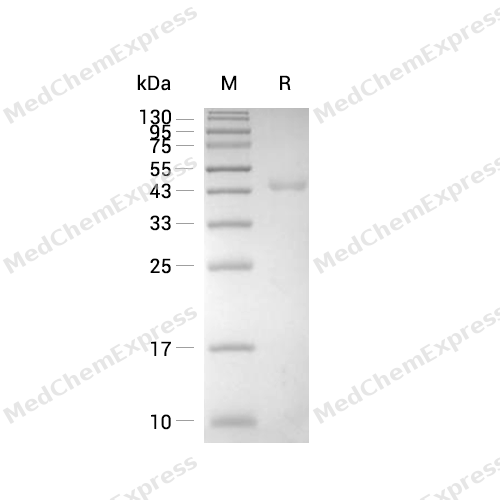
Purity - SDS-PAGE


Technical Parameters
-
Species Mouse
-
Source HEK293
-
Tag C-hFc
-
Accession
P97430 (G26-M131)
-
Molecular Construction
-
N-term
-
SLPI (G26-M131)
Accession # P97430 -
hFc
-
C-term
-
-
Protein Length
Full Length of Mature Protein
-
Synonyms
SLPI; Secretory Leukocyte Protease Inhibitor (Antileukoproteinase); Secretory Leukocyte Peptidase Inhibitor; WAP Four-Disulfide Core Domain Protein 4; WFDC4; Seminal Proteinase Inhibitor; BLPI; Mucus Proteinase Inhibitor; WAP4; Protease Inhibitor WAP4; AL
-
AA Sequence
GKNDAIKIGACPAKKPAQCLKLEKPQCRTDWECPGKQRCCQDACGSKCVNPVPIRKPVWRKPGRCVKTQARCMMLNPPNVCQRDGQCDGKYKCCEGICGKVCLPPM
-
Predicted Molecular Mass
38.5 kDa
-
Molecular Weight
Approximately 40-50 kDa, based on SDS-PAGE under reducing conditions, due to the glycosylation.
-
Purity
≥ 95%, as determined by Bis-Tris PAGE.


Product Properties
Solution
Supplied as a 0.22 μm filtered solution of PBS, 350 mM NaCl, pH 7.4.
<1 EU/μg, determined by LAL method.
Stored at -80°C for 1 year from date of receipt. It is stable at -20°C for 3 months after opening. It is recommended to freeze aliquots at -80°C for extended storage. Avoid repeated freeze-thaw cycles.
Shipping with dry ice.


Documentation
-
Data Sheet (236 KB)
-
SDS (252 KB)
- English - EN (252 KB)
- Français - FR (252 KB)
- Deutsch - DE (252 KB)
- Norwegian - NO (252 KB)
- Español - ES (252 KB)
- Swedish - SV (252 KB)
- Italian - IT (252 KB)
- Korean - KR (252 KB)
- Portuguese - PT (252 KB)
-
Handling Instructions (2659 KB)

Calculators
Concentration (start) × Volume (start) = Concentration (final) × Volume (final)


 Powered by Bioz

