



TGFBR1/ALK-5 Protein, Human (Active, sf9, His-GST)
Based on 1 Customer Validation
TGFBR1/ALK-5 proteins cooperate with TGFBR2 to form dedicated receptors for TGFB1, TGFB2, and TGFB3, transmitting signals and coordinating different physiological and pathological processes. It induces cell cycle arrest, modulates mesenchymal cell dynamics, contributes to wound healing, and affects immunosuppression and carcinogenesis. TGFBR1/ALK-5 Protein, Human (sf9, His-GST) is the recombinant human-derived TGFBR1/ALK-5 protein, expressed by Sf9 insect cells , with N-His, N-GST labeled tag.
- Species: Human
- Source: Sf9 insect cells
-
Storage:Stored at -80°C for 1 year from date of receipt. It is stable at -20°C for 3 months after opening. It is recommended to freeze aliquots at -80°C for extended storage. Avoid repeated freeze-thaw cycles.


To place orders, for customer services and technical support, please contact: MedChemExpress USA
Tel: 609-228-6898 E-mail: [email protected] [email protected]


-
 Biological Activity
-
Technical Parameters
-
Product Properties
- Documentation
- Help & FAQs


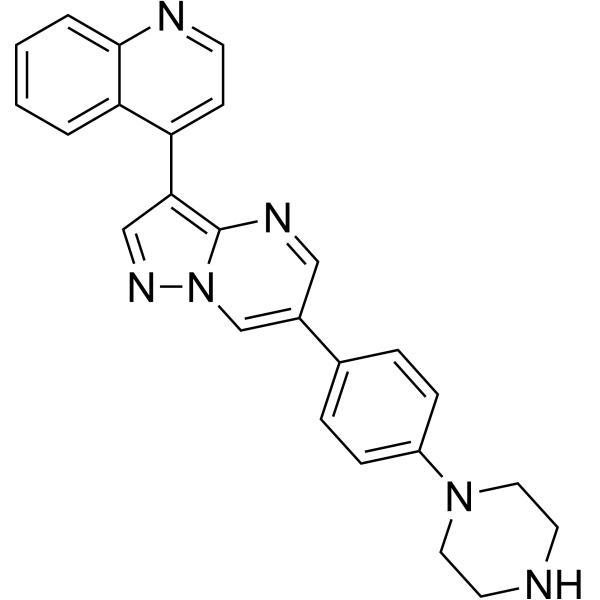


Biological Activity
Description
TGFBR1/ALK-5 proteins cooperate with TGFBR2 to form dedicated receptors for TGFB1, TGFB2, and TGFB3, transmitting signals and coordinating different physiological and pathological processes. It induces cell cycle arrest, modulates mesenchymal cell dynamics, contributes to wound healing, and affects immunosuppression and carcinogenesis. TGFBR1/ALK-5 Protein, Human (sf9, His-GST) is the recombinant human-derived TGFBR1/ALK-5 protein, expressed by Sf9 insect cells , with N-His, N-GST labeled tag.
Background
The transmembrane serine/threonine kinase, TGFBR1 (ALK-5), collaborates with the TGF-beta type II serine/threonine kinase receptor, TGFBR2, to form the dedicated receptor for TGF-beta cytokines, including TGFB1, TGFB2, and TGFB3. Serving as a signal transducer, TGFBR1 mediates the transmission of TGFB1, TGFB2, and TGFB3 signals from the cell surface to the cytoplasm, thereby orchestrating a diverse array of physiological and pathological processes. These include cell cycle arrest in epithelial and hematopoietic cells, control of mesenchymal cell proliferation and differentiation, wound healing, extracellular matrix production, immunosuppression, and carcinogenesis. The receptor complex, composed of 2 TGFBR1 and 2 TGFBR2 molecules symmetrically bound to the cytokine dimer, leads to the phosphorylation and activation of TGFBR1 by the constitutively active TGFBR2. Activated TGFBR1 phosphorylates SMAD2, causing its dissociation from the receptor and interaction with SMAD4. The resulting SMAD2-SMAD4 complex translocates to the nucleus, where it modulates the transcription of TGF-beta-regulated genes, constituting the canonical SMAD-dependent TGF-beta signaling cascade. Additionally, TGFBR1 is involved in non-canonical, SMAD-independent TGF-beta signaling pathways. For instance, it induces TRAF6 autoubiquitination, leading to MAP3K7 ubiquitination and activation, triggering apoptosis. TGFBR1 also regulates epithelial to mesenchymal transition through a SMAD-independent signaling pathway involving PARD6A phosphorylation and activation.
Verified Bioactivity
The specific activity was determined to be > 5 nmol/min/mg using casein as substrate.
MCE Validation Data
-
Purity - SDS-PAGE
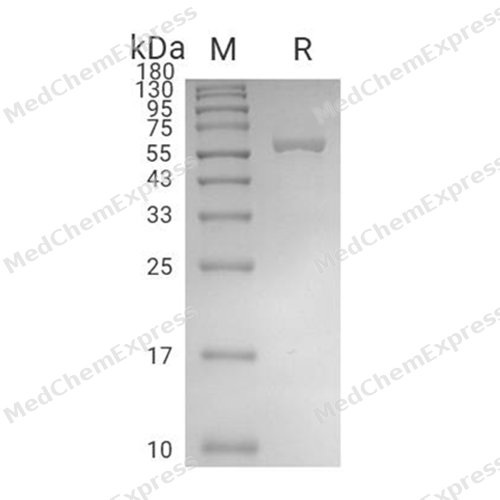
Purity - SDS-PAGE


Technical Parameters
-
Species Human
-
Source Sf9 insect cells
-
Tag N-10*His;N-GST
-
Accession
P36897-1 (T200-M503)
-
Molecular Construction
-
N-term
-
10*His-GST
-
TGFBR1 (T200-M503)
Accession # P36897-1 -
C-term
-
-
Protein Length
Partial
-
Synonyms
TGFBR1; Serine/Threonine-Protein Kinase Receptor R4; Prev. ESS1; Activin Receptor-Like Kinase 5; Prev. MSSE; TbetaR-I; ALK-5; TGFR-1; ALK5; SKR4; Transforming Growth Factor-Beta Receptor Type I; Multiple Self-Healing Squamous Epithelioma; TGF-Beta Recepto
-
AA Sequence
TIARTIVLQESIGKGRFGEVWRGKWRGEEVAVKIFSSREERSWFREAEIYQTVMLRHENILGFIAADNKDNGTWTQLWLVSDYHEHGSLFDYLNRYTVTVEGMIKLALSTASGLAHLHMEIVGTQGKPAIAHRDLKSKNILVKKNGTCCIADLGLAVRHDSATDTIDIAPNHRVGTKRYMAPEVLDDSINMKHFESFKRADIYAMGLVFWEIARRCSIGGIHEDYQLPYYDLVPSDPSVEEMRKVVCEQKLRPNIPNRWQSCEALRVMAKIMRECWYANGAARLTALRIKKTLSQLSQQEGIKM
-
Predicted Molecular Mass
62.6 kDa
-
Molecular Weight
Approximately 57 kDa, based on SDS-PAGE under reducing conditions.
-
Purity
≥ 90%, as determined by reducing SDS-PAGE.


Product Properties
Solution
1.Supplied as a 0.22 μm filtered solution of 20 mM Tris, 300 mM NaCl, pH 8.5, 25% glycerol, 0.5 mM TCEP.
2.Supplied as a 0.22 μm filtered solution of 20 mM Tris, 500 mM NaCl, pH 8.5, 10% glycerol.
3.Supplied as a 0.22 μm filtered solution in 20 mM Tris-HCl, 500 mM NaCl pH 8.5, 20% glycerol.
Note: For SPR assay, please replace the buffer. Primary amine components (e.g., Tris, imidazole) can affect protein-coupled chips.
Please refer to the lot-specific COA for specific buffer information.
<1 EU/μg, determined by LAL method.
Please use rapid thawing with running water to thaw the protein.
Stored at -80°C for 1 year from date of receipt. It is stable at -20°C for 3 months after opening. It is recommended to freeze aliquots at -80°C for extended storage. Avoid repeated freeze-thaw cycles.
Shipping with dry ice.


Documentation
-
Data Sheet (238 KB)
-
SDS (254 KB)
- English - EN (254 KB)
- Français - FR (254 KB)
- Deutsch - DE (254 KB)
- Norwegian - NO (254 KB)
- Español - ES (254 KB)
- Swedish - SV (254 KB)
- Italian - IT (254 KB)
- Korean - KR (254 KB)
- Portuguese - PT (254 KB)
-
Handling Instructions (2659 KB)

Calculators
Concentration (start) × Volume (start) = Concentration (final) × Volume (final)


 Powered by Bioz

