



TRAIL R2/TNFRSF10B Protein, Human (Biotinylated, HEK293, His-Avi)
Based on 1 Customer Validation
TRAIL R2/TNFRSF10B protein is the receptor of TNFSF10/TRAIL and recruits caspase-8 through FADD to initiate cell apoptosis. It forms the death-inducing signaling complex (DISC), activates caspases and mediates apoptosis. TRAIL R2/TNFRSF10B Protein, Human (Biotinylated, HEK293, His-Avi) is the recombinant human-derived TRAIL R2/TNFRSF10B protein, expressed by HEK293 , with C-Avi, C-His labeled tag.
- Species: Human
- Source: HEK293
-
Storage:Stored at -20°C for 2 years from date of receipt. After reconstitution, it is stable at 4°C for 1 week or -20°C for longer (with carrier protein). It is recommended to freeze aliquots at -20°C or -80°C for extended storage.


To place orders, for customer services and technical support, please contact: MedChemExpress USA
Tel: 609-228-6898 E-mail: [email protected] [email protected]


-
 Biological Activity
-
Technical Parameters
-
Product Properties
- Documentation
- Help & FAQs




Biological Activity
Description
TRAIL R2/TNFRSF10B protein is the receptor of TNFSF10/TRAIL and recruits caspase-8 through FADD to initiate cell apoptosis. It forms the death-inducing signaling complex (DISC), activates caspases and mediates apoptosis. TRAIL R2/TNFRSF10B Protein, Human (Biotinylated, HEK293, His-Avi) is the recombinant human-derived TRAIL R2/TNFRSF10B protein, expressed by HEK293 , with C-Avi, C-His labeled tag.
Background
The TRAIL R2/TNFRSF10B Protein functions as a receptor for the cytotoxic ligand TNFSF10/TRAIL. Upon ligand binding, the adapter molecule FADD recruits caspase-8 to the activated receptor, forming the death-inducing signaling complex (DISC), which triggers caspase-8 proteolytic activation and initiates the subsequent cascade of caspases, mediating apoptosis. Additionally, TRAIL R2/TNFRSF10B promotes the activation of NF-kappa-B and is essential for endoplasmic reticulum (ER) stress-induced apoptosis. In its monomeric state, it can interact with TRADD and RIPK1, and in the absence of stimulation, it interacts with BIRC2, DDX3X, and GSK3B. Stimulation of the receptor enhances interactions with BIRC2 and DDX3X, accompanied by their cleavage. Notably, TRAIL R2/TNFRSF10B can also interact with the HCMV protein UL141, preventing cell surface expression, where two TNFRSF10B monomers interact with a UL141 homodimer, and three TNFRSF10B molecules interact with TNFSF10 homotrimer. These intricate interactions underline the multifaceted role of TRAIL R2/TNFRSF10B in apoptotic and signaling pathways.
Verified Bioactivity
1. Measured by its binding ability in a functional ELISA. When immobilized Anti-Trail R2 Antibody hFc Tag at 5 μg/mL (100 μl/Well), can bind Biotinylated Human TRAIL R2 His tag and the EC50 is 0.15 μg/mL.
2. Loaded Drozitumab (HY-P99286) on AHC2 biosensor, can bind TRAIL R2/TNFRSF10B Protein, Human (Biotinylated, HEK293, His-Avi) with an affinity constant of 1.051E-08 M as determined in BLI assay.
MCE Validation Data
-
Bioactivity - BLI
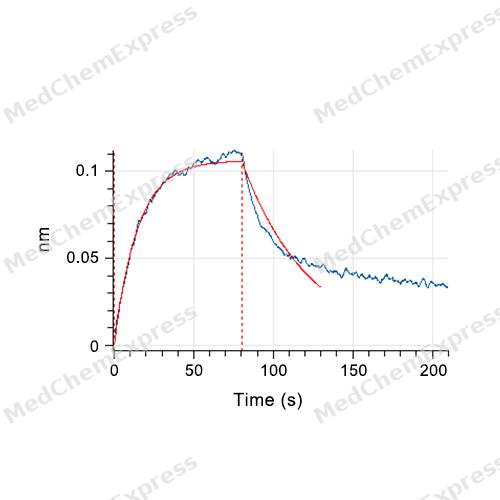
Bioactivity - BLI


Technical Parameters
-
Species Human
-
Source HEK293
-
Tag C-Avi;C-8*His
-
Accession
O14763 (I56-E182)
-
Molecular Construction
-
N-term
-
TRAIL-R2 (I56-E182)
Accession # O14763 -
8*His-Avi
-
C-term
-
-
Protein Length
Partial Extracellular Domain
-
Conjugation
Biotin
-
Conjugate Method
The single lysine residue in Avitag is biotinylated through an enzymatic reaction.
-
Synonyms
TNFRSF10B; ZTNFR9; TNF Receptor Superfamily Member 10b; CDNA FLJ76289, Highly Similar To Homo Sapiens Tumor Necrosis Factor Receptor Superfamily, Member 10b (TNFRSF10B), Transcript Variant 1, MRNA; TRAIL-R2; P53-Regulated DNA Damage-Inducible Cell Death R
-
AA Sequence
ITQQDLAPQQRAAPQQKRSSPSEGLCPPGHHISEDGRDCISCKYGQDYSTHWNDLLFCLRCTRCDSGEVELSPCTTTRNTVCQCEEGTFREEDSPEMCRKCRTGCPRGMVKVGDCTPWSDIECVHKE
-
Predicted Molecular Mass
17.1 kDa
-
Molecular Weight
Approximately 18-25 kDa, based on SDS-PAGE under reducing conditions, due to the glycosylation.
-
Purity
≥ 95%, as determined by Bis-Tris PAGE.


Product Properties
Lyophilized powder.
Lyophilized from a 0.22 μm filtered solution of PBS, pH 7.4, 5% trehalose.
<1 EU/μg, determined by LAL method.
It is not recommended to reconstitute to a concentration less than 100 μg/mL in ddH2O.
Stored at -20°C for 2 years from date of receipt. After reconstitution, it is stable at 4°C for 1 week or -20°C for longer (with carrier protein). It is recommended to freeze aliquots at -20°C or -80°C for extended storage.
Room temperature in continental US; may vary elsewhere.


Documentation
-
Data Sheet (237 KB)
-
SDS (254 KB)
- English - EN (254 KB)
- Français - FR (254 KB)
- Deutsch - DE (254 KB)
- Norwegian - NO (254 KB)
- Español - ES (254 KB)
- Swedish - SV (254 KB)
- Italian - IT (254 KB)
- Korean - KR (254 KB)
- Portuguese - PT (254 KB)
-
Handling Instructions (2659 KB)

Calculators
Concentration (start) × Volume (start) = Concentration (final) × Volume (final)


 Powered by Bioz

