



Transthyretin/TTR Protein, Human (HEK293, His)
Based on 1 Customer Validation
Transthyretin (TTR) belongs to the serum transporter family and is a plasma transporter of T4 and retinol. Transthyretin inhibits Aβ1-42 fibrillization and is a potential target for amyloidosis and Alzheimer's disease. Transthyretin mutations (such as V30M) can destabilize the tetramer and promote the formation of amyloid fibrils in monomers, causing hereditary amyloidosis transthyretin (ATTRv). Transthyretin/TTR Protein, Human (HEK293, His) is a recombinant transthyretin/TTR protein expressed in HEK293 with a C-6*His tag.
- Species: Human
- Source: HEK293
-
Storage:Stored at -20°C for 2 years from date of receipt. After reconstitution, it is stable at 4°C for 1 week or -20°C for longer (with carrier protein). It is recommended to freeze aliquots at -20°C or -80°C for extended storage.


To place orders, for customer services and technical support, please contact: MedChemExpress USA
Tel: 609-228-6898 E-mail: [email protected] [email protected]


-
 Biological Activity
-
Technical Parameters
-
Product Properties
- Documentation
- References
- Help & FAQs




Biological Activity
Description
Transthyretin (TTR) belongs to the serum transporter family and is a plasma transporter of T4 and retinol. Transthyretin inhibits Aβ1-42 fibrillization and is a potential target for amyloidosis and Alzheimer's disease. Transthyretin mutations (such as V30M) can destabilize the tetramer and promote the formation of amyloid fibrils in monomers, causing hereditary amyloidosis transthyretin (ATTRv). Transthyretin/TTR Protein, Human (HEK293, His) is a recombinant transthyretin/TTR protein expressed in HEK293 with a C-6*His tag.
Background
1. Protein characteristics of Transthyretin/TTR
Transthyretin (TTR) is a homotetramer linked by disulfide bonds, containing a conserved β-folded structure and two thyroxine (T4) binding sites. Transthyretin/TTR needs to be cleaved by the signal peptide to form a mature protein, and the stability of the tetramer is maintained by T4 binding[1]. Transthyretin/TTR belongs to the serum transport protein family and is a plasma transporter of T4 and retinol. Transthyretin/TTR forms a complex with retinol binding protein to mediate vitamin A transport and maintain the homeostasis of thyroid hormone and vitamin A[2]. Mutations (such as V30M and L55P) can destroy the stability of Transthyretin/TTR tetramers, causing monomers to dissociate and self-assemble into β-sheet fibers, which are deposited in nerve, heart and other tissues to cause hereditary transthyretin amyloidosis (ATTRv). Non-fibrillar oligomers cause cytotoxicity through calcium influx and endoplasmic reticulum stress[1].
Transthyretin/TTR binds to Aβ1-42, inhibits its fibrillation through the T4 binding pocket, and delays Alzheimer's disease-related pathology[2]. Or Transthyretin/TTR and endogenous factors such as glycosaminoglycans synergistically promote amyloid deposition[1].
2. Applications of Transthyretin/TTR
Transthyretin/TTR can be used to study the pathological mechanism of the amyloidosis disease ATTRv. For example, mutant (e.g., L55P) transgenic mice are constructed for drug screening, and Transthyretin/TTR stabilizers such as Diflunisal are studied, which delays amyloid fibril formation by stabilizing Transthyretin/TTR tetramers[3]; meanwhile, the stabilizer Tafamidis has been shown to be useful for inhibiting ATTRv neuropathy[1]. Transthyretin/TTRR targets Aβ aggregation and is a potential target for Alzheimer's disease[2].
Verified Bioactivity
Measured by its binding ability in a functional ELISA. Immobilized recombinant human TTR-His at 10 μg/ml (100 μl/well) can bind recombinant Canine RBP4-Fc with a linear range of 0.3-10.0 μg/ml.
MCE Validation Data
-
Purity - SDS-PAGE
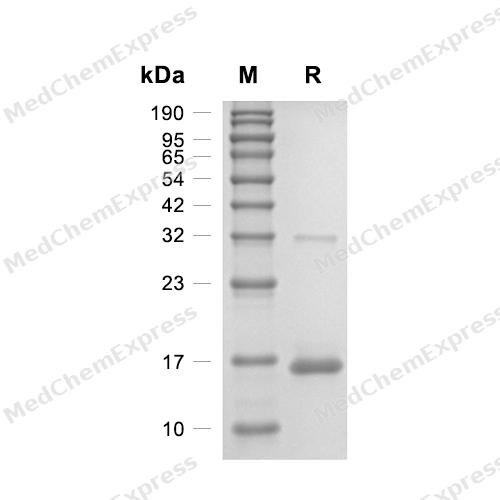
Purity - SDS-PAGE


Technical Parameters
-
Species Human
-
Source HEK293
-
Tag C-6*His
-
Accession
P02766 (G21-E147)
-
Molecular Construction
-
N-term
-
TTR (G21-E147)
Accession # P02766 -
6*His
-
C-term
-
-
Protein Length
Full Length of Mature Protein
-
Synonyms
TTR; Transthyretin; PALB; CTS1; HsT2651; CTS; Prealbumin, Amyloidosis Type I; ATTR; TBPA; Epididymis Luminal Protein 111; Thyroxine-Binding Prealbumin; Carpal Tunnel Syndrome 1; TTR Protein; Prealbumin; AMYLD1; HEL111; TTN
-
AA Sequence
GPTGTGESKCPLMVKVLDAVRGSPAINVAVHVFRKAADDTWEPFASGKTSESGELHGLTTEEEFVEGIYKVEIDTKSYWKALGISPFHEHAEVVFTANDSGPRRYTIAALLSPYSYSTTAVVTNPKE
-
Predicted Molecular Mass
14.8 kDa
-
Molecular Weight
Approximately 18 kDa & 37 kDa, based on SDS-PAGE under reducing conditions, due to the glycosylation.
-
Glycosylation
Yes
-
Structure/Form
Homotetramer
-
Purity
≥ 95%, as determined by reducing SDS-PAGE.


Product Properties
Lyophilized powder.
1.Lyophilized from a 0.22 μm filtered solution of 20 mM Tris-HCl, 150 mM NaCl, pH 8.0.
2.Lyophilized from a 0.22 μm filtered solution of 20 mM PB, 150 mM NaCl, pH 7.8.
3.Lyophilized from a 0.22 μm filtered solution of PBS, pH 7.4, 5% trehalose, 5% mannitol and 0.01% Tween 80.
4.Lyophilized from a 0.22 μm filtered solution of PBS, pH 7.4, 8% trehalose.
Please refer to the lot-specific COA for specific buffer information.
Note: For SPR assay, please replace the buffer. Primary amine components (e.g., Tris, imidazole) can affect protein-coupled chips.
<1 EU/μg, determined by LAL method.
It is not recommended to reconstitute to a concentration less than 100 μg/mL in ddH2O. For long term storage it is recommended to add a carrier protein (0.1% BSA, 5% HSA, 10% FBS or 5% Trehalose).
Stored at -20°C for 2 years from date of receipt. After reconstitution, it is stable at 4°C for 1 week or -20°C for longer (with carrier protein). It is recommended to freeze aliquots at -20°C or -80°C for extended storage.
Room temperature in continental US; may vary elsewhere.


Documentation
-
Data Sheet (264 KB)
-
SDS (252 KB)
- English - EN (252 KB)
- Français - FR (252 KB)
- Deutsch - DE (252 KB)
- Norwegian - NO (252 KB)
- Español - ES (252 KB)
- Swedish - SV (252 KB)
- Italian - IT (252 KB)
- Korean - KR (252 KB)
- Portuguese - PT (252 KB)
-
Handling Instructions (2659 KB)


References
[1]. Manganelli F, et al. Hereditary transthyretin amyloidosis overview. Neurol Sci. 2022 Dec;43(Suppl 2):595-604. [Content Brief]
[2]. Li X, et al. Mechanisms of transthyretin inhibition of β-amyloid aggregation in vitro. J Neurosci. 2013 Dec 11;33(50):19423-33. [Content Brief]
[3]. Tagoe CE, et al. In vivo stabilization of mutant human transthyretin in transgenic mice. Amyloid. 2007 Sep;14(3):227-36. [Content Brief]

Calculators
Concentration (start) × Volume (start) = Concentration (final) × Volume (final)


 Powered by Bioz

