



VEGFR-3/FLT4 Protein, Mouse (HEK293, hFc)
Based on 1 Customer Validation
VEGFR-3/FLT4 proteins are tyrosine protein kinase receptors for VEGFC and VEGFD and are critical in adult lymphangiogenesis and embryonic vascular development. It promotes endothelial cell function, angiogenesis, and forms a positive feedback loop that increases VEGFC production. VEGFR-3/FLT4 Protein, Mouse (HEK293, hFc) is the recombinant mouse-derived VEGFR-3/FLT4 protein, expressed by HEK293 , with C-hFc labeled tag.
- Species: Mouse
- Source: HEK293
-
Storage:Stored at -20°C for 2 years from date of receipt. After reconstitution, it is stable at 4°C for 1 week or -20°C for longer (with carrier protein). It is recommended to freeze aliquots at -20°C or -80°C for extended storage.


To place orders, for customer services and technical support, please contact: MedChemExpress USA
Tel: 609-228-6898 E-mail: [email protected] [email protected]


-
 Biological Activity
-
Technical Parameters
-
Product Properties
- Documentation
- Help & FAQs




Biological Activity
Description
VEGFR-3/FLT4 proteins are tyrosine protein kinase receptors for VEGFC and VEGFD and are critical in adult lymphangiogenesis and embryonic vascular development. It promotes endothelial cell function, angiogenesis, and forms a positive feedback loop that increases VEGFC production. VEGFR-3/FLT4 Protein, Mouse (HEK293, hFc) is the recombinant mouse-derived VEGFR-3/FLT4 protein, expressed by HEK293 , with C-hFc labeled tag.
Background
VEGFR-3/FLT4 protein, a tyrosine-protein kinase, functions as a cell-surface receptor for VEGFC and VEGFD, playing a pivotal role in adult lymphangiogenesis and contributing significantly to the development of the vascular network and cardiovascular system during embryonic development. Its diverse functions include promoting the proliferation, survival, and migration of endothelial cells, along with the regulation of angiogenic sprouting. Activation of FLT4 leads to an augmented production of VEGFC and, to a lesser extent, VEGFA, establishing a positive feedback loop that enhances FLT4 signaling. Additionally, VEGFR-3/FLT4 modulates KDR signaling through the formation of heterodimers. Its signaling cascade involves the activation of the MAPK1/ERK2, MAPK3/ERK1, MAPK8, and JUN pathways, as well as the AKT1 pathway. VEGFR-3/FLT4 phosphorylates SHC1 and mediates the phosphorylation of PIK3R1, the regulatory subunit of phosphatidylinositol 3-kinase. Furthermore, it promotes the phosphorylation of MAPK8 at 'Thr-183' and 'Tyr-185,' as well as AKT1 at 'Ser-473,' underscoring its integral role in orchestrating complex signaling events crucial for lymphangiogenesis and vascular development.
Verified Bioactivity
1.This product does not contain protein kinase domain.
2.Mouse VEGF R3, hFc Tag captured on CM5 Chip via Protein A can bind Human VEGF-C, His Tag with an affinity constant of 12.93 pM as determined in SPR assay (Biacore T200).
MCE Validation Data
-
Purity - SDS-PAGE
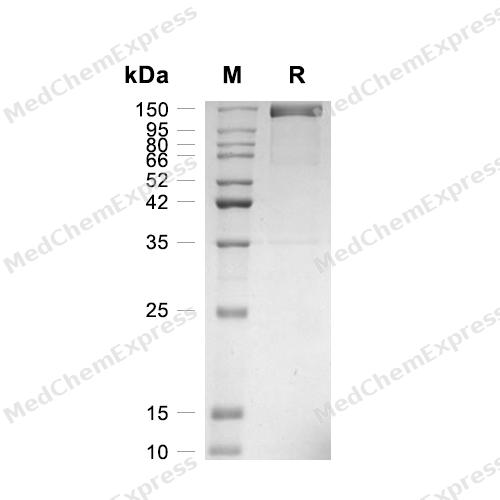
Purity - SDS-PAGE


Technical Parameters
-
Species Mouse
-
Source HEK293
-
Tag C-hFc
-
Accession
P35917 (Y25-E775)
-
Molecular Construction
-
N-term
-
VEGFR-3 (Y25-E775)
Accession # P35917 -
hFc
-
C-term
-
-
Protein Length
Extracellular Domain
-
Synonyms
FLT4; Fms Related Tyrosine Kinase 4; Fms Related Receptor Tyrosine Kinase 4; VEGF Receptor-3; VEGFR3; FLT-4; Vascular Endothelial Growth Factor Receptor 3; Vascular Endothelial Growth Factor Receptor 3 Variant; VEGFR-3; Alternative Protein FLT4; Tyrosine-
-
AA Sequence
YSMTPPTLNITEDSYVIDTGDSLSISCRGQHPLEWTWPGAQEVLTTGGKDSEDTRVVHDCEGTEARPYCKVLLLAQTHANNTGSYHCYYKYIKARIEGTTAASTYVFVRDFKHPFINKPDTLLVNRKDSMWVPCLVSIPGLNITLRSQSSALHPDGQEVLWDDRRGMRVPTQLLRDALYLQCETTWGDQNFLSNLFVVHITGNELYDIQLYPKKSMELLVGEKLVLNCTVWAEFDSGVTFDWDYPGKQAERAKWVPERRSQQTHTELSSILTIHNVSQNDLGPYVCEANNGIQRFRESTEVIVHEKPFISVEWLKGPVLEATAGDELVKLPVKLAAYPPPEFQWYKDRKAVTGRHNPHALVLKEVTEASAGVYTLALWNSAAGLRQNISLELVVNVPPHIHEKEASSPSIYSRHSRQTLTCTAYGVPQPLSVQWHWRPWTPCKTFAQRSLRRRQQRDGMPQCRDWKEVTTQDAVNPIESLDSWTEFVEGKNKTVSKLVIQDANVSAMYKCVVVNKVGQDERLIYFYVTTIPDGFSIESEPSEDPLEGQSVRLSCRADNYTYEHLRWYRLNLSTLHDAQGNPLLLDCKNVHLFATPLEANLEEAEPGARHATLSLNIPRVAPEDEGDYVCEVQDRRSQDKHCHKKYLSVQALEAPRLTQNLTDLLVNVSDSLEMRCPVAGAHVPSIVWYKDERLLEKESGIDLADSNQRLSIQRVREEDAGRYLCSVCNAKGCVNSSASVAVEGSEDKGSME
-
Molecular Weight
Approximately 65-160 kDa, based on SDS-PAGE under reducing conditions, due to the glycosylation.
-
Glycosylation
Yes
-
Purity
≥ 95%, as determined by Bis-Tris PAGE.


Product Properties
Lyophilized powder.
Lyophilized from a 0.22 μm filtered solution of PBS, pH 7.4, 8% trehalose.
<1 EU/μg, determined by LAL method.
It is not recommended to reconstitute to a concentration less than 100 μg/mL in ddH2O.
Stored at -20°C for 2 years from date of receipt. After reconstitution, it is stable at 4°C for 1 week or -20°C for longer (with carrier protein). It is recommended to freeze aliquots at -20°C or -80°C for extended storage.
Room temperature in continental US; may vary elsewhere.


Documentation
-
Data Sheet (241 KB)
-
SDS (254 KB)
- English - EN (254 KB)
- Français - FR (254 KB)
- Deutsch - DE (254 KB)
- Norwegian - NO (254 KB)
- Español - ES (254 KB)
- Swedish - SV (254 KB)
- Italian - IT (254 KB)
- Korean - KR (254 KB)
- Portuguese - PT (254 KB)
-
Handling Instructions (2659 KB)

Calculators
Concentration (start) × Volume (start) = Concentration (final) × Volume (final)


 Powered by Bioz

