



RIPK1-IN-19

Based on 1 Customer Validation
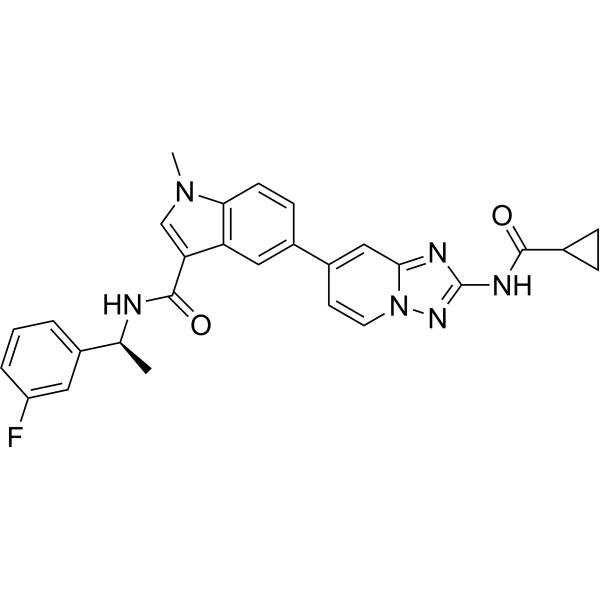
RIPK1-IN-19 is a selective RIPK1 inhibitor (IC50=15 nM). RIPK1-IN-19 does not show obvious activity against RIPK2, RIPK3, and RIPK4. RIPK1-IN-19 displays potent protective activity in TNFα-induced systemic inflammatory response syndrome (SIRS) model and Imiquimod (IMQ)-induced psoriasis model. RIPK1-IN-19 can be used in research on inflammation and immune system diseases.
For research use only. We do not sell to patients.
- Purity : 98.87%
- CAS No.: 2763831-43-0
- Formula: C28H25FN6O2
- Molecular Weight:496.54
-
Storage:Powder -20°C, 3 years , 4°C, 2 years ; In solvent -80°C, 6 months , -20°C, 1 month

To place orders, for customer services and technical support, please contact: MedChemExpress USA
Tel: 609-228-6898 E-mail: [email protected] [email protected]


-
 Biological Activity
-
Chemical Information
- Protocols
- Purity & Documentation
- References
-
 Help & FAQs




Biological Activity
Description
IC50 & Target
[1]|
RIPK1 15 nM (IC50) |
Cellular Effect
|
Cell Line

|
Type | Value | Description | References |
|---|---|---|---|---|
| HT-29 | EC50 |
0.032 nM
Compound: 10b
|
Protection against TSZ-induced necroptosis in human HT-29 cells preincubated with compound followed by TNA-alpha,Smac mimetic and Z-VAD-FMK addition and measured after 24 hrs by CCK-8 assay
Protection against TSZ-induced necroptosis in human HT-29 cells preincubated with compound followed by TNA-alpha,Smac mimetic and Z-VAD-FMK addition and measured after 24 hrs by CCK-8 assay
|
[PMID: 38159286] |
| J774.A1 | EC50 |
75.3 pM
Compound: 10b
|
Protection against TSZ-induced necroptosis in mouse J774.A1 cells preincubated with compound followed by TNA-alpha,Smac mimetic and Z-VAD-FMK addition and measured after 24 hrs by CCK-8 assay
Protection against TSZ-induced necroptosis in mouse J774.A1 cells preincubated with compound followed by TNA-alpha,Smac mimetic and Z-VAD-FMK addition and measured after 24 hrs by CCK-8 assay
|
[PMID: 38159286] |
| L929 | EC50 |
10.2 pM
Compound: 10b
|
Protection against TSZ-induced necroptosis in mouse L929 cells preincubated with compound followed by TNA-alpha,Smac mimetic and Z-VAD-FMK addition and measured after 24 hrs by CCK-8 assay
Protection against TSZ-induced necroptosis in mouse L929 cells preincubated with compound followed by TNA-alpha,Smac mimetic and Z-VAD-FMK addition and measured after 24 hrs by CCK-8 assay
|
[PMID: 38159286] |
| U-937 | EC50 |
47.8 pM
Compound: 10b
|
Protection against TSZ-induced necroptosis in human U-937 cells preincubated with compound followed by TNA-alpha,Smac mimetic and Z-VAD-FMK addition and measured after 24 hrs by CCK-8 assay
Protection against TSZ-induced necroptosis in human U-937 cells preincubated with compound followed by TNA-alpha,Smac mimetic and Z-VAD-FMK addition and measured after 24 hrs by CCK-8 assay
|
[PMID: 38159286] |
In Vitro
RIPK1-IN-19 (compound 10b) effectively protects U937, J774A.1, and L929 cells from necroptosis with EC50 values of 47.8, 75.3, and 10.2 pM, respectively[1].
RIPK1-IN-19 (0.03-300 nM) inhibits the phosphorylation of RIPK1 and its downstream signaling proteins RIPK3 and MLKL[1].
MedChemExpress (MCE) has not independently confirmed the accuracy of these methods. They are for reference only.
Parmacokinetics
| Species | Dose | Route | T1/2 | Cmax | Tmax | AUC0-t | F |
|---|---|---|---|---|---|---|---|
| Rat[1] | 10 mg/kg | p.o. | 5.21 h | 401.86 ng/mL | 0.5 h | 2353.02 ng·h/mL | 15.31 % |
In Vivo
The topical administration of RIPK1-IN-19 (10%) ameliorates the psoriasis-like skin symptoms by reducing skin scaling and thickening in Imiquimod-induced psoriasis model[1].
MedChemExpress (MCE) has not independently confirmed the accuracy of these methods. They are for reference only.
-
Animal Model:C57BL/6 mice (aged 6-8 weeks, ~20 g)[1]
-
Dosage:10 mg/kg
-
Administration:p.o.; for around 15 min and then challenged with mouse TNF-α (450 μg/kg)
-
Result:Dramatically increased the survival rate of TNFα-treated mice.
Strongly reduced TNFα-induced temperature loss in mice.
Significantly reduced the contents of proinflammatory cytokines including IL-1β and IL-6.


Chemical Information
-
CAS No. 2763831-43-0
-
Appearance Solid
-
Molecular Weight 496.54
-
Formula C28H25FN6O2
-
Color Light brown to brown
-
SMILES
C[C@@H](C1=CC=CC(F)=C1)NC(C2=CN(C3=C2C=C(C=C3)C4=CC5=NC(NC(C6CC6)=O)=NN5C=C4)C)=O
-
Shipping
Room temperature in continental US; may vary elsewhere.
-
Storage
Powder -20°C 3 years 4°C 2 years In solvent -80°C 6 months -20°C 1 month


Purity & Documentation
-
Data Sheet (272 KB)
-
SDS (251 KB)
- English - EN (251 KB)
- Français - FR (251 KB)
- Deutsch - DE (251 KB)
- Norwegian - NO (251 KB)
- Español - ES (251 KB)
- Swedish - SV (251 KB)
- Italian - IT (251 KB)
- Korean - KR (251 KB)
- Portuguese - PT (251 KB)
-
Handling Instructions (2659 KB)
References

Calculators
Concentration (start) × Volume (start) = Concentration (final) × Volume (final)


RIPK1-IN-19 Related Classifications
HY-157456 Related Classifications
 Powered by Bioz