



S961 TFA
Based on 9 publication(s) in Google Scholar
S961 TFA is an high-affinity and selective insulin receptor (IR) antagonist with IC50s of 0.048, 0.027, and 630 nM for HIR-A, HIR-B, and human insulin-like growth factor I receptor (HIGF-IR) in SPA-assay, respectively.
For research use only. We do not sell to patients.
- Formula: C211H295N55O71S2.xC2HF3O2
- Molecular Weight:4802.12 (free acid)
-
Storage:
Sealed storage, away from moisture and light.
Powder -80°C, 2 years , -20°C, 1 year* In solvent : -80°C, 6 months; -20°C, 1 month (sealed storage, away from moisture and light)

To place orders, for customer services and technical support, please contact: MedChemExpress USA
Tel: 609-228-6898 E-mail: [email protected] [email protected]


-
 Biological Activity
-
Chemical Information
-
Solvent & Solubility
- Protocols
- Purity & Documentation
- References
-
 Help & FAQs


Publications Citing Use of MedChemExpress (MCE) S961 TFA
More- Nature. 2026 Jun;654(8120):1065-1075. [Abstract]
- Nat Commun. 2026 Jun 9;17(1):5068.
- Neuron. 2026 Jun 10:S0896-6273(26)00384-3. [Abstract]
- Neural Regen Res. 2021 Dec;16(12):2465-2474. [Abstract]
- Neuropharmacology. 2023 Nov 1:238:109649. [Abstract]
- Bioconjug Chem. 2022 May 18;33(5):892-906. [Abstract]
- bioRxiv. 2025 Aug 24:2025.08.23.671589. [Abstract]
- SSRN. 2024 Dec 31.
- J Womens Health Dev. 2023;6(2):56-67. [Abstract]
 Customer Validation & Images

-
Bio/Physico-chemical Assay


Biological Activity
Description
In Vitro
S961 also shows high-affinity to Rat IR and Pig IR with IC50s of 0.056 nM and 0.084 nM in PEG-assay, respectively[1].
MedChemExpress (MCE) has not independently confirmed the accuracy of these methods. They are for reference only.


Chemical Information
-
Appearance Solid
-
Molecular Weight 4802.12 (free acid)
-
Formula C211H295N55O71S2.xC2HF3O2
-
Color White to off-white
-
Sequence
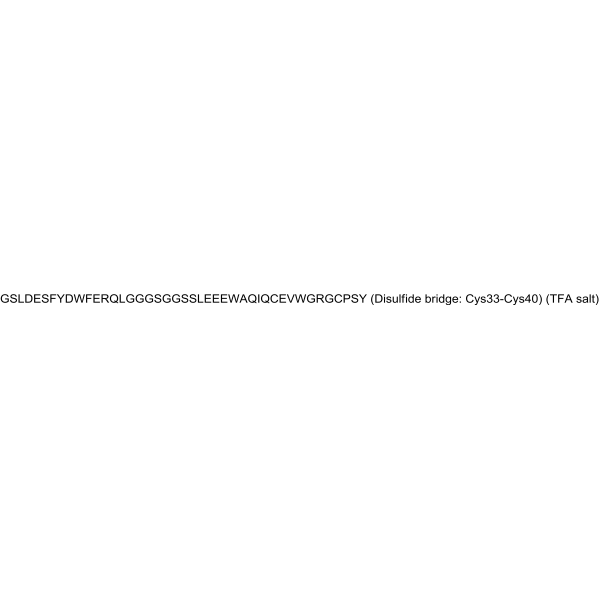
Gly-Ser-Leu-Asp-Glu-Ser-Phe-Tyr-Asp-Trp-Phe-Glu-Arg-Gln-Leu-Gly-Gly-Gly-Ser-Gly-Gly-Ser-Ser-Leu-Glu-Glu-Glu-Trp-Ala-Gln-Ile-Gln-Cys-Glu-Val-Trp-Gly-Arg-Gly-Cys-Pro-Ser-Tyr (Disulfide bridge: Cys33-Cys40)
-
Sequence Shortening
GSLDESFYDWFERQLGGGSGGSSLEEEWAQIQCEVWGRGCPSY (Disulfide bridge: Cys33-Cys40)
-
Shipping
Room temperature in continental US; may vary elsewhere.
-
Storage
Sealed storage, away from moisture and light
Powder -80°C 2 years -20°C 1 year * In solvent : -80°C, 6 months; -20°C, 1 month (sealed storage, away from moisture and light)


Publications (9)
-
Journal Impact Factor
-
Most Recent
-
Nature
2026 Jun;654(8120):1065-1075. PMID: 42056521
S961 TFA purchased from MedChemExpress. Usage Cited in: Nature. 2026 Jun;654(8120):1065-1075. [Abstract]
Panc02, a murine pancreatic cancer cell line was used as positive control for staining Insr. Mice were injected with Insr blocking chemical S961 (1 mg/kg; i.p.) during fasting/fed period. OCR and ECAR were measured of ex vivo CD8+ T cells purified from pool of respective group. OCR and ECAR associated parameters were calculated (right) (n = 3 wells). The results showed that blocking insulin receptors (using S961) did not show significant changes in vivo under fasting and full conditions, indicating that the insulin signaling pathway is not essential for the postprandial benefits observed in T cells.
-
-
Neuron
2026 Jun 10:S0896-6273(26)00384-3. PMID: 42269609 -
Neural Regen Res
Hippocampal insulin resistance and the Sirtuin 1 signaling pathway in diabetes-induced cognitive dysfunction. [Abstract]2021 Dec;16(12):2465-2474. PMID: 33907035 -
Neuropharmacology
Insulin potentiates inhibitory synaptic currents between fast-spiking and pyramidal neurons in the rat insular cortex. [Abstract]2023 Nov 1:238:109649. PMID: 37393988 -
Bioconjug Chem
Design, Synthesis, and Preliminary Evaluation of [68Ga]Ga-NOTA-Insulin as a PET Probe in an Alzheimer's Disease Mouse Model. [Abstract]2022 May 18;33(5):892-906. PMID: 35420782 -
bioRxiv
2025 Aug 24:2025.08.23.671589. PMID: 40894704 -
-
J Womens Health Dev
Placental Fatty Acid Metabolism and Transport in a Rat Model of Gestational Diabetes Mellitus. [Abstract]2023;6(2):56-67. PMID: 37288271


Solvent & Solubility
In Vitro:
H2O : 6.5 mg/mL (ultrasonic and adjust pH to 12 with NaOH)


Purity & Documentation
-
Data Sheet (268 KB)
-
SDS (252 KB)
- English - EN (252 KB)
- Français - FR (252 KB)
- Deutsch - DE (252 KB)
- Norwegian - NO (252 KB)
- Español - ES (252 KB)
- Swedish - SV (252 KB)
- Italian - IT (252 KB)
- Korean - KR (252 KB)
- Portuguese - PT (252 KB)
-
Handling Instructions (2659 KB)
References

Calculators
Concentration (start) × Volume (start) = Concentration (final) × Volume (final)


S961 TFA Related Classifications
HY-P2093A Related Classifications
 Powered by Bioz