



Scillascillin
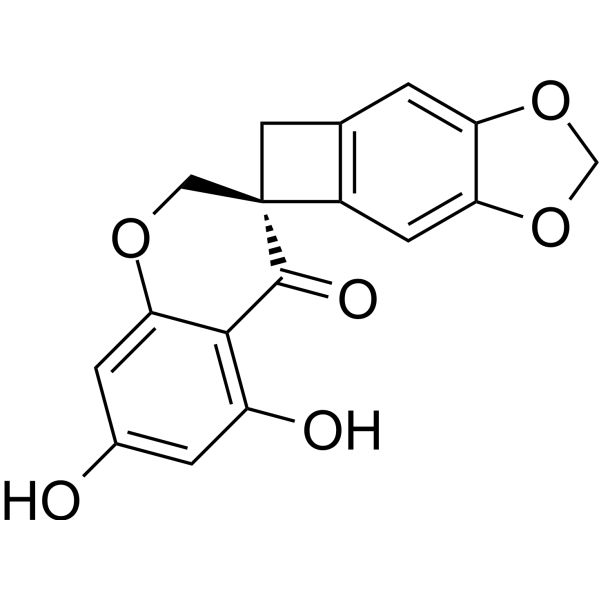
Scillascillin (compound 10) is a homoisoflavanone. Scillascillin can be isolated from S. scilloides. Scillascillin shows anticancer activity towards MCF-7 (breast cancer) and DU-145 (prostate cancer) cells with the IC50 of 9.59 and 11.32 ug/ml, respectively.
For research use only. We do not sell to patients.
- CAS No.: 52706-07-7
- Formula: C17H12O6
- Molecular Weight:312.27
-
Storage:
Please store the product under the recommended conditions in the Certificate of Analysis.

To place orders, for customer services and technical support, please contact: MedChemExpress USA
Tel: 609-228-6898 E-mail: [email protected] [email protected]


-
 Biological Activity
-
Chemical Information
- Protocols
- Purity & Documentation
- References
-
 Help & FAQs




Biological Activity
Description
Cellular Effect
|
Cell Line

|
Type | Value | Description | References |
|---|---|---|---|---|
| HUVEC | GI50 |
>100 μM
Compound: 15
|
Antiproliferative activity against HUVEC assessed as reduction in cell number incubated for 44 hrs by alamar blue based fluorescence assay
Antiproliferative activity against HUVEC assessed as reduction in cell number incubated for 44 hrs by alamar blue based fluorescence assay
|
[PMID: 30951308] |
| Y79 | GI50 |
>100 μM
Compound: 15
|
Cytotoxicity against human Y79 cells assessed as reduction in cell number incubated for 44 hrs by alamar blue based fluorescence assay
Cytotoxicity against human Y79 cells assessed as reduction in cell number incubated for 44 hrs by alamar blue based fluorescence assay
|
[PMID: 30951308] |


Chemical Information
-
CAS No. 52706-07-7
-
Molecular Weight 312.27
-
Formula C17H12O6
-
SMILES
O=C1[C@]2(C3=C(C2)C=C(OCO4)C4=C3)COC5=CC(O)=CC(O)=C15
-
Structure Classification
-
Shipping
Room temperature in continental US; may vary elsewhere.
-
Storage
Please store the product under the recommended conditions in the Certificate of Analysis.


Purity & Documentation
References
[1]. Yoichiro Nishida, et al. A new homostilbene and two new homoisoflavones from the bulbs of Scilla scilloides. Chem Pharm Bull (Tokyo). 56, 7. [Content Brief]
[2]. Chinthala Y, et al. Anticancer Active Homoisoflavone from the Underground Bulbs of Ledebouria hyderabadensis. Pharmacognosy Res. 2014;6(4):303-305. [Content Brief]

Calculators
Concentration (start) × Volume (start) = Concentration (final) × Volume (final)


Scillascillin Related Classifications
HY-N1252 Related Classifications
 Powered by Bioz